Morocco Just Became Africa's Top Industrial Economy. Here Is How It Got There.
Two developments landed within days of each other at the AfDB's 2026 Annual Meetings in Brazzaville. The first was the launch of the Africa Industrialisation Index 2025 and the inaugural Africa Industrial Investment Barometer, the most detailed assessment yet of which African economies are industrialising fastest, where investment is concentrating, and how much value stays on the continent. The second, signed three days earlier in Rabat, was a €450 million partial credit guarantee between the AfDB and Morocco's OCP Group to mobilise a €530 million green financing facility supporting OCP's 2023–2030 investment programme.
At first reading, these appeared to be separate events, but they weren't. One measured the outcome of a long industrial strategy, the other financed the next phase of it. And at the centre of both sat the same country, Morocco.
Morocco has overtaken South Africa as Africa's leading industrial economy. The AfDB attributes the achievement to sustained industrial upgrading, export diversification, and strong industrial policy sustained across 54 countries measured over the 2010–2024 period, a combination, the Bank notes, that no other African economy has produced at the same scale and consistency.
Morocco didn't arrive at the top of that ranking accidentally; instead, it built toward it over nearly two decades. The question is what that building actually required, and whether the rest of Africa can follow the same path.
What the index actually measures and what it finds
The Industrialisation Index shows that 41 of 54 countries improved their industrial performance between 2010 and 2024, with overall continental progress rising by 6 percent. Improvements were more pronounced among lower-performing economies, suggesting some convergence across countries.
That is the optimistic reading of the data, but the structural reading is less comfortable. Both reports share a single diagnosis: Africa's industrial integration is low, and intra-African trade stands at just 14.4 percent of total trade, reflecting weak regional production linkages and fragmented industrial ecosystems.
The Investment Barometer indicates that North Africa attracted about 56 percent of total industrial investment between 2020 and 2025, with Morocco and Egypt receiving a large share. East Africa recorded relatively higher levels of local value retention, while Southern Africa continues to rely on imported inputs in sectors such as automotive manufacturing. In West and Central Africa, industrial activity remains focused on primary processing commodities such as cocoa, bauxite, and minerals, which are often exported in raw or semi-processed form.
South Africa remains a continental powerhouse, but its competitiveness has declined steadily. That decline isn't primarily a story about South Africa failing, but about Morocco advancing and what the nature of that advance reveals about the requirements of industrialisation.
Morocco did not industrialise around raw exports
One of the most important things Morocco understood early was that industrialisation wouldn't emerge from exporting raw phosphate alone. The country already possessed one of the world's largest phosphate reserves and could easily have remained primarily an extraction economy, dependent on commodity exports and exposed to global price volatility. Instead, it moved deliberately into higher-value industrial supply chains, and the sequencing of how it did so contains the analytical core of the AfDB data.
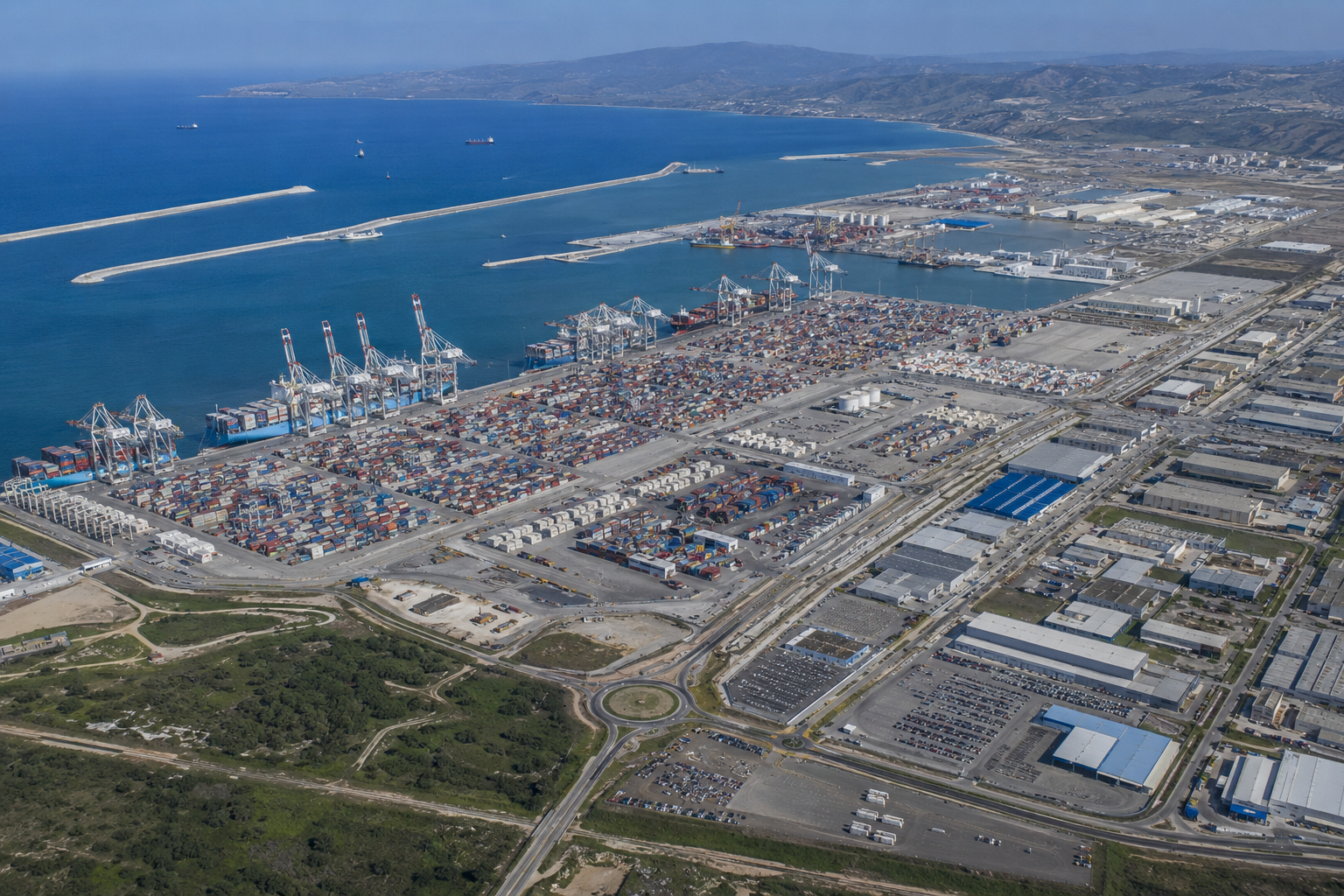
The clearest illustration is automotive manufacturing. By early 2026, Morocco's automotive exports had reached approximately $4.57 billion. Twenty years ago, Morocco had no globally competitive automotive export ecosystem. The transformation followed a deliberate sequence that began with infrastructure, most notably the development of Tanger Med, now one of Africa's largest ports and one of the Mediterranean's most strategically important industrial gateways. Then came anchor investors: Renault established operations in Tangier in 2012, and Stellantis followed. These investments mattered not simply because they created factories but because they created industrial gravity. Once major manufacturers arrived, supplier ecosystems began clustering around them. Then came local content expansion, pushing domestic suppliers deeper into automotive value chains.
The sequencing matters because many industrialisation discussions across Africa still begin at the wrong end of the process. Governments announce ambitions for manufacturing leadership before the logistics, infrastructure, financing systems, and supplier ecosystems required to sustain manufacturing have been built. Morocco reversed that order. It built the platform first, and the industrial activity followed.
As WITBA President Dr Harouna Kaboré stated at the Brazzaville meetings: "The continent's real deficit is no longer the absence of industrial strategies. What is still lacking is execution discipline, continuity in public policy, and systemic coherence between financing, energy, infrastructure, human capital, governance, and industrial vision." That statement is an accurate description of what Morocco built, and what most African economies haven't yet assembled.
What the OCP guarantee reveals about what industrial policy actually costs
The €450 million AfDB guarantee signed on 22 May 2026 is significant not only because of its scale. It is the first mechanism of its kind in Morocco, and it illustrates the African Development Bank Group's role as a catalyst for innovative financing in support of the energy transition and sustainable water management.
More importantly, it reveals something often absent from political speeches about industrialisation: industrial upgrading is extraordinarily capital-intensive. The guarantee supports OCP's 2023–2030 Green Investment Programme, a $13 billion commitment that encompasses renewable energy deployment, decarbonisation measures, and water and energy efficiency improvements across its operations. The programme is expected to help avoid more than 43 million tonnes of CO₂ emissions between 2026 and 2038 and create thousands of jobs, particularly for youth and women.
In practical terms, this is Morocco financing the transition from industrial growth to industrial competitiveness under decarbonisation pressure. Many African economies are still attempting to establish industrial capacity, while Morocco is already financing how to keep existing capacity globally competitive in a world increasingly shaped by carbon constraints, green trade standards, and industrial decarbonisation requirements imposed through European border adjustment mechanisms and supply-chain reporting standards.
AfDB Country Manager Achraf Tarsim stated: "Leveraging our AAA credit rating, we are mobilising international capital to accelerate the development of a low-carbon fertiliser producer, the deployment of renewable energy, and sustainable water management." The mechanism itself, a partial credit guarantee that lowers financing risk for lenders and mobilises larger volumes of private capital, is a model that extends beyond Morocco's specific context. It represents industrial policy finance: the use of development finance institution balance sheet strength to unlock private capital for industrial upgrading at a scale that purely commercial instruments cannot easily achieve in African markets.
Why the model cannot be quickly replicated, and what the honest lesson is
There is a temptation whenever one African economy succeeds to immediately ask whether the model can be copied elsewhere. The answer is yes in principle, and no in the timeframes most policy discussions assume.
Morocco's industrial rise depended on a combination of factors that are difficult to replicate simultaneously: long-horizon political continuity, proximity to European markets, aggressive infrastructure investment that preceded manufacturing ambition rather than following it, export-oriented industrial policy sustained across multiple government cycles, and state coordination over nearly two decades without the reversals that characterise shorter political cycles elsewhere on the continent.
The AfDB's data reflects this structural unevenness directly. North Africa's 56 percent share of cumulative continental industrial investment between 2020 and 2025 isn't a function of superior mineral endowment, because Sub-Saharan Africa possesses far more of the transition minerals the world needs. It is a function of the institutional conditions that make industrial investment commercially viable over the time horizons that industrialisation requires.
This doesn't mean industrialisation elsewhere is impossible. It means the institutional requirements are more demanding than many policy discussions acknowledge. As ETA has previously documented in the context of mineral beneficiation, the coordination failure across mining, energy, and industrial policy frameworks is the primary constraint on industrial development in most Sub-Saharan economies, due to the absence of the systemic coherence required to execute them consistently.
The green transition is now part of industrial competition
The OCP financing announcement signals something broader about the direction of industrial competition. The next phase will be shaped not only by production capacity but by carbon intensity. European industrial regulation is tightening, supply-chain reporting requirements are expanding, and global manufacturers increasingly require lower-carbon industrial inputs as a condition of supplier relationships rather than a preference.
This means countries seeking industrial competitiveness in the next decade need renewable energy systems, lower-emission production methods, and access to green industrial finance. Morocco's renewable energy investments surrounding OCP aren't peripheral sustainability projects. They are part of maintaining industrial relevance in a global economy where carbon intensity is increasingly a competitive variable rather than a compliance matter.
That is the strategic significance of the AfDB guarantee beyond its immediate financial function. It supports Morocco's attempt to move from industrial growth toward industrial resilience in a decarbonising world, an ambition that the continent's other industrialising economies will need to reach on a compressed timeline relative to Morocco's two-decade trajectory.
Morocco's rise to the top of the AfDB ranking was built on sequencing, institutional coherence, and the patience to build the platform before the industry. The €450 million guarantee represents the continuation of that strategy into the phase where industrial competitiveness and industrial decarbonisation are becoming the same challenge. For the rest of Africa, that is the lesson the data is actually offering, not that Morocco's specific path is replicable, but that no version of industrialisation is spontaneous, cheap, or achievable without the systemic coherence that Morocco spent two decades building.