Africa's Firms Lose 5% of Their Sales to Darkness.
Seventy-eight percent of firms across Africa experienced electricity outages in the past year. Forty-one percent of African firms identify electricity as the single biggest constraint on their operations, the highest share of any region in the world, confirmed by the World Bank's Africa's Pulse and corroborated by the World Bank Enterprise Survey data across multiple survey cycles. Enterprises in sub-Saharan Africa experienced power interruptions averaging 56 hours per month in 2024, equivalent to roughly 25 lost working days every year. By comparison, firms in East Asia and the Pacific average 20 hours per month. Latin America and the Caribbean average five.
The 56-hour figure is not a statistic about energy access, but about competitiveness. A firm in sub-Saharan Africa loses the equivalent of three full working weeks per year to darkness, which a competitor operating in Asia, Latin America, or Europe doesn't face. The electricity reliability gap between those two firms isn't captured in productivity rankings, trade statistics, or most competitiveness indices. It operates as a tax, levied on every firm, sector, and country, without appearing in any government budget or any firm's balance sheet as a line item called what it is.
The scale of what this costs
Nigeria is the case that the data makes unavoidable. Standard Bank's Africa Trade Barometer places economic losses from electricity shortages in Nigeria at USD 26 billion annually. That figure excludes what businesses spend compensating for those losses: the Energy Commission of Nigeria estimates that approximately USD 22 billion is spent each year on fuel for the estimated 40 GW of off-grid generator capacity deployed across Nigerian businesses and households, a shadow electricity system roughly seven times larger than the national grid's average available generation.
Combined, Nigeria's electricity reliability deficit costs its economy approximately USD 48 billion per year. The World Bank's broader economy-wide estimate of the annual cost is approximately USD 29 billion, representing close to 10 percent of Nigeria's GDP in 2025. Each estimate uses different methodological boundaries, but they agree on the order of magnitude: the electricity problem in Africa's most populous economy results in annual losses comparable in scale to the annual budgets of several African nations.
The country-level picture isn't confined to Nigeria. Research by the Center for Global Development, examining data from more than 3,000 firms across 37 African countries, found that in Nigeria, Angola, and Ghana more than 25 percent of businesses reported losing double-digit sales to outages in a given year. At the extreme, some firms lost up to 31 percent of annual sales. These aren't marginal impacts on marginal operations. They are economy-shaping losses concentrated in the countries that carry the largest share of sub-Saharan Africa's formal industrial capacity.
The four channels through which outage costs operate
The direct sales loss, the 5 percent of annual turnover that the World Bank Enterprise Survey data documents as the average for affected firms in sub-Saharan Africa, is only the most visible layer of the cost. Electricity outages impose costs through four distinct channels, each of which standard economic statistics address partially or not at all.
The first is lost output: production that can't be recovered when power returns. A cement kiln that goes cold, a batch pharmaceutical process interrupted mid-cycle, a cold chain broken for a consignment of perishables. This is what the sales loss figure measures: output that was planned, resourced, and never completed.
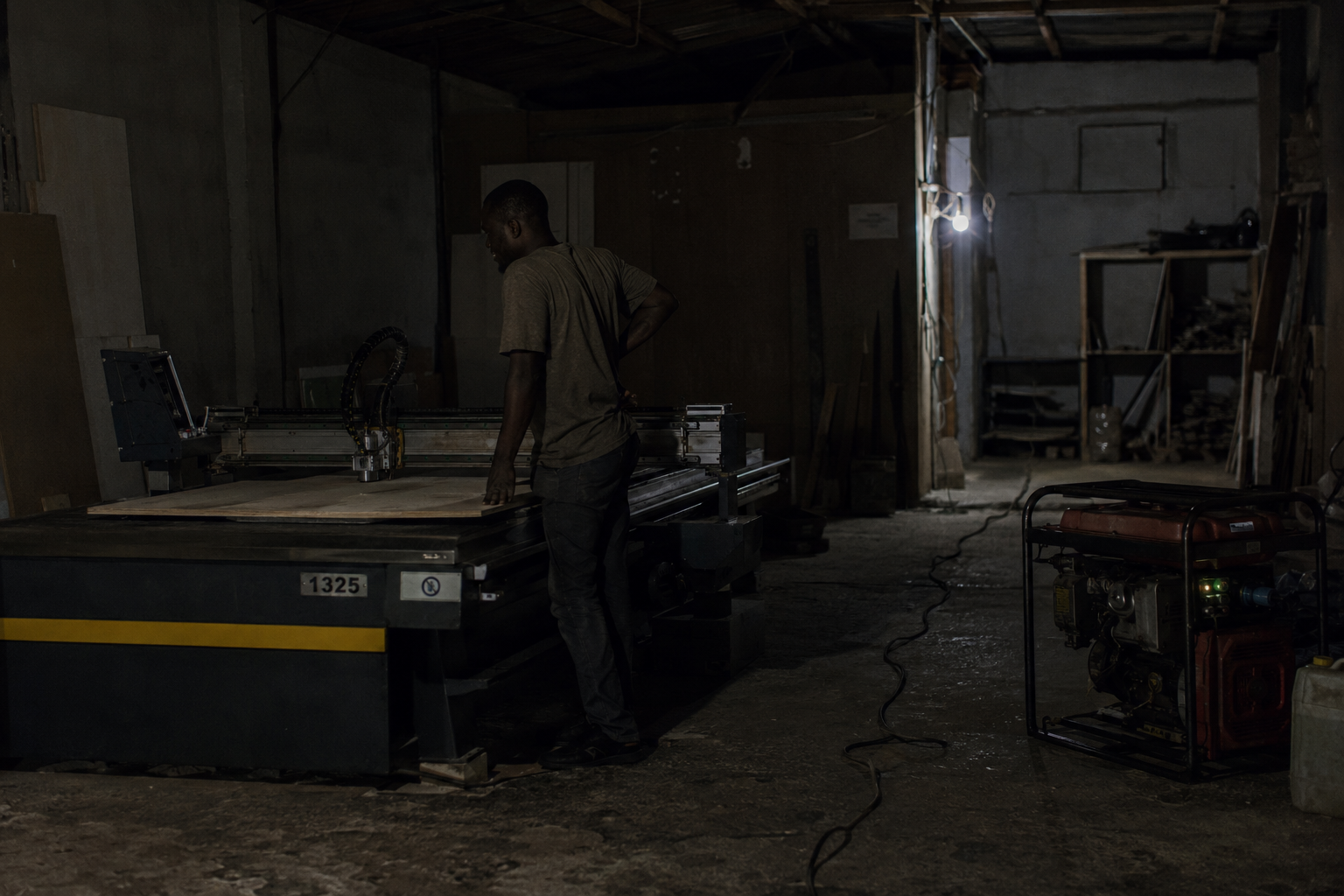
The second is the cost of mitigation. Firms that can afford to respond to outages invest in doing so. African businesses spend an estimated 2 USD to 32 USD per kilowatt-hour on unmitigated outage costs, depending on sector and context; the cost of self-generation through diesel generators averages approximately 0.35 USD per kilowatt-hour, up to ten times prevailing grid electricity tariffs in well-functioning markets. A manufacturer in Lagos operating two 500-kVA generators may have spent 100,000 USD on procurement and 50,000 USD or more annually on fuel, maintenance, and spare parts. Firms that can afford to mitigate pay a permanent premium for reliability that competitors in more stable electricity environments don't pay, while those that can't afford to mitigate absorb the output loss directly.
The third is investment distortion. Capital deployed on backup generation is capital not deployed on productive investment, on expanding capacity, upgrading technology, developing workforce skills, or entering new markets. At the firm level, this is a straightforward opportunity cost. At the aggregate level, it creates an economy-wide misallocation of capital that suppresses industrial productivity growth year after year, without ever being captured in standard investment climate diagnostics.
The fourth is structural competitive disadvantage. A firm competing in regional or global markets against producers in countries with reliable electricity isn't competing on equal terms. The electricity reliability gap is a cost disadvantage embedded in every product price, invisible in trade data, unaddressed by trade agreements, and uncorrected by workforce training programmes. The Africa Continental Free Trade Area opens markets, but unreliable electricity ensures that African manufacturers face a structural cost penalty when attempting to compete in them.
What the employment data makes explicit
The evidence of what electricity unreliability costs the labour market comes from research published through the UNU-WIDER's South Africa Towards Inclusive Economic Development programme, examining the labour market effects of load shedding across South Africa. The findings reveal that load shedding is significantly and negatively associated with employment, working hours, and monthly earnings. On average, periods of load shedding are associated with a 2.6 percent lower probability of being employed, 1.3 percent fewer working hours per week, and 1.7 percent lower real monthly earnings.
The manufacturing sector bears the heaviest burden. Load shedding is associated with nearly 17 percent lower manufacturing employment, approximately 6.5 times larger than the all-industry average effect. If electricity unreliability suppresses manufacturing employment disproportionately, it suppresses the sector through which Africa's industrial potential could most credibly translate into broadly shared economic development.
The employment effects also vary non-linearly with outage intensity. Low levels of load shedding don't strongly affect the labour market. High levels do so markedly, and the relationship accelerates rather than stabilises as outage intensity increases. Firms that survive high outage intensity are those with the capital to self-generate. Workers who lose jobs are those employed by firms that can't.
The competitiveness frame the energy conversation is not using
The standard frame for Africa's electricity challenge is about energy access: how many people are connected, how many megawatts have been commissioned, and how many facilities have power. These are legitimate metrics for a development agenda focused on human welfare and basic service delivery, but are insufficient for an industrial policy agenda focused on economic competitiveness.
The cost of electricity outages on African industry isn't primarily an energy sector problem. It is a competitiveness problem of large enough magnitude to materially offset the gains from trade liberalisation, investment promotion, and workforce development policy. A country that signs a trade agreement while its manufacturers lose 25 working days per year to power cuts hasn't resolved the competitiveness constraint that will determine whether the agreement produces the intended economic outcomes.
This is the analytical gap in the conversation. Africa's electricity policy discussions focus on capacity, megawatts added, connections achieved, and projects commissioned. Its industrial policy discussions focus on productivity, skills, and market access. The channel through which electricity unreliability depresses productivity, distorts investment, destroys output, and erodes market competitiveness sits between those two conversations, captured inadequately by either.
The 5 percent of annual sales that the average affected firm loses to outages doesn't appear in industrial policy diagnostics as a constraint of equivalent weight to tariff barriers or skills gaps, as it should. It is larger than most of the barriers that Africa's trade and investment promotion programmes are designed to address, and it operates not on the margins of African industry but at its productive core.