Renewable Energy Is Now Cheaper in Africa Than It Has Ever Been. The Report That Proves It Also Explains Why Africa Is Still Paying More Than Anyone Else.
IRENA's Renewable Power Generation Costs in 2025, released recently, is the most authoritative annual measurement of what renewable energy actually costs worldwide. It covers utility-scale solar, onshore wind, hydropower, and battery storage across all major regions, drawing on project-level data from more than 21,000 renewable power projects worldwide. For Africa, it contains findings that belong at the centre of every energy ministry's planning conversation, and one structural finding that explains precisely why a decade of extraordinary cost reductions has not translated into affordable electricity for the people who need it most.
Africa achieved the world's largest solar cost reduction of any region, and it still pays more than Europe
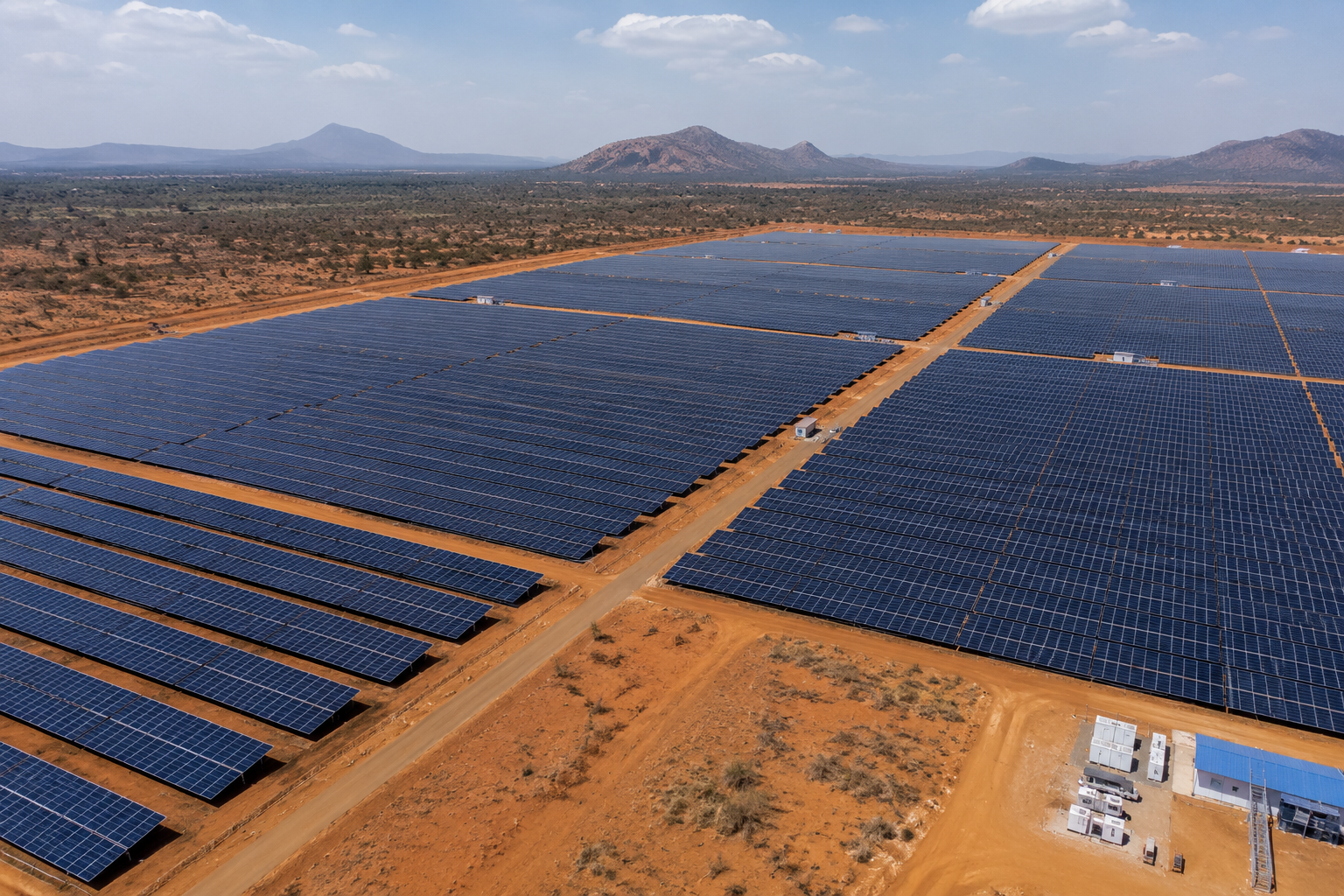
Between 2015 and 2025, Africa recorded the largest regional reduction in solar photovoltaic total installed costs of any region in the world: a fall of 76 percent, from USD 3,520 per kilowatt to USD 837 per kilowatt. The weighted-average levelised cost of electricity from utility-scale solar across Africa fell 77 percent over the same period, from USD 222 per megawatt-hour to USD 52 per MWh. Both reductions, in hardware cost and in electricity cost, are the largest of any region globally between 2015 and 2025.
The scale of these reductions deserves to be acknowledged before any qualification is added. Solar panels in Africa cost 76 percent less to install today than they did a decade ago. The electricity they produce costs 77 percent less per unit than it did in 2015. These are extraordinary numbers by any measure.
And yet USD 52/MWh for African utility-scale solar sits above Oceania at USD 41/MWh, above Europe's most competitive projects, and significantly above China's best projects, which produce solar electricity at well below USD 30/MWh. The reduction is real. The remaining gap is equally real, and the report explains precisely what is producing it.
The hardware cost is no longer the primary driver of that gap. IRENA's analysis of cost variation across markets produces a finding that frames the rest of the report's Africa picture: country-level macroeconomic conditions, sovereign risk, interest rates, and inflation explain approximately 56 percent of the variation in financing costs across markets. Technology characteristics explain 24 percent, while the remaining 20 percent comes from the interaction between country conditions and technology type. The report states that the same technology can cost far more to finance in a high-risk economy than in a mature one, and this impact is most significant for emerging and developing economies, where most new demand will arise.
Africa has largely solved the technology cost problem. The solar panel costs the same in Nairobi as in Oslo, but the loan to build the solar farm doesn't, and the cost of that loan, not the cost of the panel, is now the binding constraint on Africa's renewable energy economics.
Africa has the world's strongest onshore wind resource, and the financing constraint applies here too
Africa's wind sector produces a further finding that the IRENA data makes visible for the first time in aggregate. In 2025, Africa achieved the highest regional weighted-average capacity factor for onshore wind of any region in the world, at 43 percent, while Europe and Oceania recorded the lowest, both at 34 percent. Africa's wind projects, driven significantly by Egypt's Gulf of Suez developments, extract more energy from the same installed capacity than wind projects anywhere else on Earth.
Total installed costs for onshore wind in Africa fell from USD 2,636 per kilowatt in 2015 to USD 1,550 per kilowatt in 2025, a reduction of 41 percent, placing Africa's weighted-average wind installation cost broadly in line with other developing regions. The combination of high capacity factors and declining installation costs should, in principle, produce among the world's lowest wind electricity costs in Africa. In Egypt, at its best sites, it does.
But the same structural pattern that applies to solar applies to wind. A wind farm in a country carrying a speculative-grade sovereign credit rating will be financed at a weighted average cost of capital substantially higher than an identical project in an investment-grade economy, regardless of how strong the wind resource is or how competitive the installation cost. The resource advantage, Africa's world-leading capacity factors, is partially or wholly offset by the financing disadvantage that country risk imposes. The IRENA data makes both sides of that trade-off visible simultaneously, which is what gives the 2025 report its analytical value for Africa specifically.
The Grand Ethiopian Renaissance Dam and Africa's hydropower position
The hydropower chapter contains a finding specific to Africa that has received limited attention in the coverage of the IRENA report. In 2025, Africa recorded the lowest weighted-average total installed cost for large hydropower of any region globally, at USD 1,414 per kilowatt. This outcome was significantly influenced by the commissioning of the Grand Ethiopian Renaissance Dam, Africa's largest hydroelectric project, which at full capacity represents one of the largest single renewable generation assets anywhere on the continent.
GERD's commissioning is the proximate driver of Africa's historically low hydropower installed cost in 2025. Its economic significance is straightforward: Africa has added substantial, low-cost, dispatchable renewable generation capacity that strengthens the continent's position on both energy supply and transition economics. The ongoing diplomatic complexity between Ethiopia and Egypt over the dam and Nile water flows is a separate matter; the IRENA cost data records the economic fact of commissioning what was built, at what cost, and what it means for Africa's regional renewable energy picture.
Africa's weighted-average capacity factor for large hydropower stands at 56 percent in 2025, reflecting strong hydrological conditions across much of the continent and project designs that favour high utilisation rates. Small hydropower capacity factors are higher still. These figures indicate that Africa's hydropower assets, where they operate, are among the most productive in the world, an asset that the transition conversation often underweights relative to solar.
Battery storage: costs have fallen 95 percent globally. Africa is almost absent from the market.
The battery storage chapter contains the most significant absence in the IRENA report's Africa-specific picture.
Global utility-scale battery energy storage costs fell by 95 percent between 2010 and 2025, from USD 2,634 per kilowatt-hour to USD 140 per kilowatt-hour. In 2025 alone, costs declined 30 percent year-on-year, driven by lithium iron phosphate battery technology, manufacturing scale concentrated in China, and intensifying global market competition. The IRENA foreword notes that this cost trajectory has enabled round-the-clock solar hybrid systems to deliver electricity at below USD 85/MWh at the best sites, making solar-plus-storage competitive with dispatchable thermal generation in an increasing number of markets.
The geographic concentration of who is capturing that cost trajectory is stark. China installed 173 GWh of new battery storage in 2025, 56 percent of the global total. The United States added 55 GWh. Europe added 32 GWh. Saudi Arabia and the UAE are scaling rapidly: Saudi Arabia targets 48 GWh of battery storage by 2030, and the Al Dhafra complex in Abu Dhabi is pairing 5.2 GW of solar with 19 GWh of battery storage to deliver a firm, continuous 1 GW of output.
Africa's presence in the battery storage data is limited to a single country: South Africa. The IRENA report documents that South Africa's utility-scale battery storage deployments carry a discharge duration of 4.3 hours, the joint highest of any market surveyed globally alongside Chile, and are concentrated on grid resilience and peak demand reduction. South Africa's battery storage market is a direct response to load shedding.
The rest of sub-Saharan Africa, the 53 countries that account for the overwhelming majority of the global electricity access deficit, don't appear in the battery storage data with any materiality. The technology whose cost has fallen 95 percent in fifteen years, and which the IRENA report identifies as the enabling condition for firm, round-the-clock renewable power at competitive cost, isn't reaching Africa outside its most advanced electricity market.
Battery storage cost has fallen 95 percent, but its deployment across Africa remains structurally concentrated in one country. The same financing architecture that raises the cost of solar and wind in African markets raises the cost of battery storage further, because storage assets carry technology risk alongside country risk. The result is a market in which the technology that would make Africa's world-class solar and wind resources dispatchable is systematically unavailable at the scale and cost the access challenge requires.
The structural finding and what it implies for Africa's transition strategy
IRENA's foreword to the 2025 report reveals the core transition finding: after more than a decade of steep cost declines, the costs of solar photovoltaic and onshore wind have begun to stabilise. Future reductions to 2035 will be less dramatic than those of the previous decade. The era in which falling technology costs were the primary driver of renewable energy economics is ending.
Figure 1.3 in the report makes the regional implication visible. Across all regions, including Sub-Saharan Africa specifically, the capital expenditure and operations and maintenance components of levelised cost are broadly comparable, but the financing component widens sharply in higher-risk markets. It is visible in the chart as the dominant source of cost difference between what renewable electricity costs in Africa and what it costs in Europe or East Asia. Country risk explains 56 percent of financing cost variation across markets. This is the structural condition of African energy finance, made measurable in IRENA's project-level dataset.
The implication for Africa's energy transition strategy is specific. Technology cost advocacy is no longer the primary lever, they've fallen further in Africa than in any other region over the past decade. What hasn't fallen at the same pace is the cost of capital, determined by sovereign risk assessments, the institutional infrastructure around project development and financing, currency risk and hedging availability, and by the regulatory frameworks that determine whether a project is bankable in the first instance.
The renewable energy technology argument has been won. The financing architecture argument hasn't. IRENA's 2025 data puts both findings in writing simultaneously, in a single report, drawing on the most comprehensive project-level cost dataset available anywhere. The question for Africa's energy transition institutions governments, regulators, development finance institutions, and the civil society organisations that hold them accountable is, what they do with that evidence.