Zambia Is Mining More Copper. September Will Test How Much Value It Keeps
Zambia produced 890,346 tonnes of copper in 2025, roughly 8% more than the previous year but still short of the government's one-million-tonne target. Lusaka wants annual production to reach 3 million tonnes by 2031, which from the 2025 base would require output to grow by about 22% a year for six consecutive years.
Global conditions make the ambition understandable. Benchmark copper futures were trading around $14,000 a tonne in early August, more than 40% higher than a year earlier, and the IEA still expects the copper market to face a supply gap of about 25% by 2035 under its stated-policy scenario, with new projects in Zambia and the Democratic Republic of Congo among those narrowing the deficit.
Investment is following the opportunity, as Zambia Chamber of Mines president Anthony Malenga told Reuters that more than $10 billion had entered or been committed to the sector since the 2021 election, Barrick is spending $2 billion to double Lumwana's output to around 240,000 tonnes, First Quantum commissioned its $1.25 billion Kansanshi S3 expansion in 2025, and KoBold Metals' proposed Mingomba mine is expected to cost $2.3 to $2.5 billion for around 300,000 tonnes annually in the early 2030s.
The copper boom is real, but the more interesting question is whether Zambia is improving the terms on which it participates in it, and the answer is more complicated than a simple choice between exporting raw copper and processing it at home.
Zambia has been here before
Copper has shaped Zambia's economic fortunes for generations. The warning from the previous boom is more accurate than the familiar story that Zambia merely "failed to add value."
By 1975, copper represented more than 90% of Zambia's exports by value and roughly half of GDP. When the international copper price fell by almost 50% that year, World Bank analysis calculated a terms-of-trade loss equivalent to more than one-quarter of GDP compared with 1970 prices, and the balance of payments deteriorated sharply. The vulnerability was that too much of the economy, public revenue and foreign exchange depended on a single commodity and on conditions Zambia couldn't control. That exposure remains significant today, as mining contributes around 9% of GDP, 72% of export earnings and nearly half of government revenue, according to figures cited by Reuters this month.
The debt crisis that culminated in Zambia's November 2020 Eurobond default shouldn't be reduced to copper dependence alone; public debt had already become unsustainable before COVID-19, and the pandemic intensified existing fiscal problems. Zambia became Africa's first pandemic-era sovereign default after missing a $42.5 million bond coupon, and its long restructuring process has since made substantial progress, with agreements covering approximately 94% of debt within the restructuring perimeter by May 2026.
That history changes what should count as success in the present boom. Three million tonnes of copper would be an extraordinary production achievement, but wouldn't, by itself, demonstrate structural transformation.
The export waiver reveals a real bottleneck
The most contiguous test comes on 30 September 2026, as Zambia imposes a 10% export duty on copper concentrates, an instrument intended in part to favour domestic processing, but the government first suspended that duty in August 2025 and has now extended the waiver until the end of September as miners deal with accumulated concentrate while major smelters undergo maintenance and repairs.
The current waiver covers 271,742 tonnes of concentrate: Mopani has the largest quota at 100,000 tonnes, Barrick's Lumwana has 56,986 tonnes, First Quantum and Chinese-owned Nkana Mining and Minerals Processing have roughly 43,000 tonnes each, and Lubambe and Konkola Copper Mines have 15,000 and 12,541 tonnes respectively.
Those numbers make September important, but they shouldn't be misread, because Zambia already processes a large share of its copper domestically; Reuters notes that the country mostly exports copper as refined cathode rather than concentrate. The temporary waiver doesn't represent a wholesale return to raw-mineral exports. It reveals something more particular: Zambia's ability to enforce a processing policy ultimately depends on the reliability and competitiveness of the processing infrastructure itself. A government can tax concentrate exports, but it can't tax a smelter into operating while that smelter is undergoing major maintenance, and that distinction is important for mineral policy across Africa.
A smelter policy is only as strong as the smelters
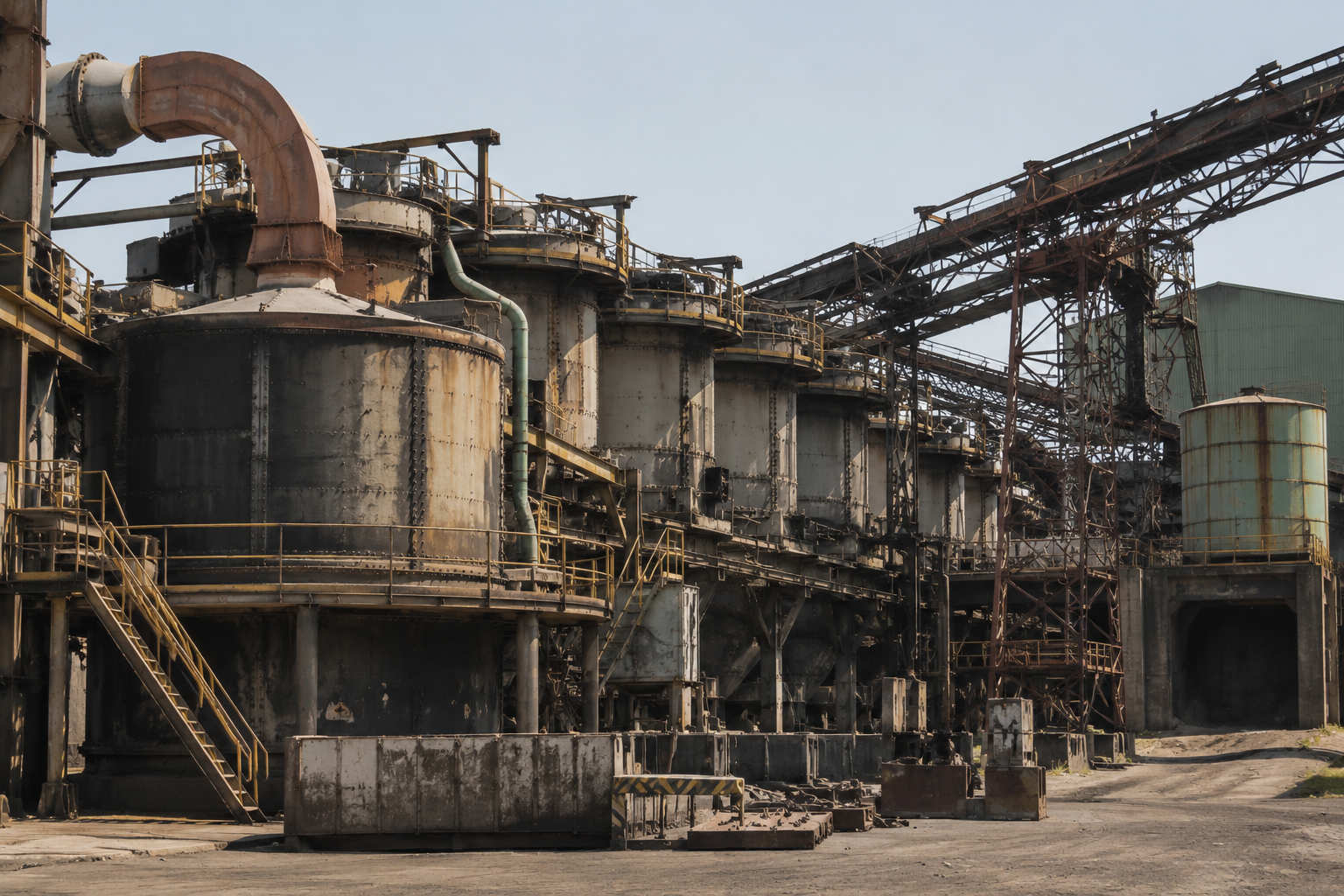
Several of Zambia's processing facilities are undergoing significant work: Mopani's Mufulira smelter faces an extended shutdown through mid-September, Chambishi is midway through a roughly two-month outage, and Konkola's Nchanga smelter began a 60-day maintenance shutdown at the end of May.
This makes the September decision less straightforward than the politics of "beneficiation versus exports" suggests. If processing capacity has returned sufficiently by 30 September, restoring the duty would reinforce the incentive to smelt domestically. If substantial capacity remains unavailable, restoring it without alternative arrangements could simply create new stockpiles or constrain mine production. The measure tests whether industrial policy and industrial capacity have been sequenced: an export restriction creates an incentive to process, but it does not create the electricity, equipment or smelter availability required to make processing possible, a distinction other African mineral producers should watch closely.
Power remains the harder constraint
Zambia's electricity crisis makes this challenge more consequential. The 2023-24 drought exposed the vulnerability of an electricity system heavily dependent on hydropower, and the World Bank says load shedding reached as much as 23 hours per day as water levels collapsed. But the situation in August 2026 isn't the situation of 2024: Lake Kariba's usable storage had recovered to 46.46% on 4 August 2026, compared with 22.96% on the same date a year earlier, an improvement that should be recognised rather than presenting Zambia as if it remained at the depth of the previous drought.
The structural problem nevertheless remains; industry executives estimate Zambia may require at least 2,000 MW of additional generation capacity to sustain the production expansion implied by the 3-million-tonne target. That figure changes the meaning of beneficiation: increasing mine output threefold while asking more copper to pass through domestic smelters raises electricity demand at both stages, and moving further downstream into wire rod, cables and transformers raises the industrial power requirement again. The electricity system is therefore not adjacent to Zambia's minerals strategy; it is part of the minerals strategy. Barrick appears to recognise this: its Lumwana expansion includes a new transmission framework being developed with ZESCO alongside the mine and processing expansion.
Value capture does not end at copper cathode
There is another reason the September debate shouldn't become too narrowly focused on concentrates: smelting isn't the final stage of value addition. Zambia already has an advantage many mineral-producing African countries are still trying to create: an established mining, smelting and refining ecosystem, and the larger opportunity is to use that base to expand into the products the energy transition needs copper for: wire, cable, transformers, electrical equipment, industrial components. The IEA estimates copper represents around 10% to 15% of the cost of transformers and power cables, and as global electricity networks expand, these products sit directly inside one of the fastest-growing demand centres for copper.
This is where Zambia's new local-content regime becomes important. The Geological and Minerals Development Local Content Regulations require mining and mining-related companies to devote at least 20% of qualifying annual procurement to local Zambian companies, a threshold rising progressively to at least 40% within five years. That measure addresses a different part of value capture from the concentrate duty: one tries to keep processing activity inside the country, the other tries to ensure the billions spent operating and expanding mines create business for Zambian suppliers. Neither is sufficient alone. As ETA has previously examined, Zambia's importance to the global energy transition increasingly rests on what it builds around its copper, not simply how much it extracts, and the deeper test here is whether Zambia begins producing a larger share of the manufactured products its copper ultimately becomes.
September is a test, not the verdict
That makes the 30 September waiver deadline important without making it decisive. Allowing the suspension to lapse would show the government believes domestic smelting capacity has recovered sufficiently to absorb more concentrate; another extension could indicate operational constraints remain more powerful than the policy incentive. Neither outcome, by itself, tells us whether Zambia has escaped the structural weaknesses of previous copper booms.
The larger evidence will come from several places: whether smelters return to reliable operation, the electricity system expands quickly enough to support mining and processing simultaneously, local-content regulations create competitive Zambian suppliers rather than simply procurement targets, and whether investment begins moving beyond cathode into wire, cable and electrical manufacturing. There is also a new political context as Zambia goes to the polls on 13 August, so the September waiver decision falls on the other side of a national election, and whatever administration makes it inherits the same underlying arithmetic of production, processing capacity and electricity supply have to grow together.
Zambia enters this period with something it didn't control during earlier commodity cycles: unusually strong international competition for the resource it possesses, with the IEA still projecting a substantial supply deficit through 2035. The opportunity is to use the shortage to deepen an industrial system around copper.
Zambia's previous boom showed how much national income can depend on a metal whose global price the country doesn't determine. This boom will be different if rising output leaves behind something more durable than export receipts: reliable power, functioning smelters, competitive Zambian suppliers and industries capable of selling higher-value copper products long after the price cycle turns. September will provide one useful signal. The real verdict will be written in the industrial structure Zambia builds around the copper before the boom ends.