
ETA's First Fellows Cohort Begins: Building the People Behind Africa's Energy Transition
Energy transitions are usually measured through physical and financial indicators: megawatts installed, transmission lines completed, minerals produced and capital mobilised. These measures matter, but none operates independently of people.
Financing agreements must be interrogated. Regulations must be written and enforced. Infrastructure must be managed after commissioning. Evidence must be translated for institutions, communities and the public. When the people responsible for these functions lack the necessary analytical and institutional capability, ambitious projects can still produce weak outcomes.
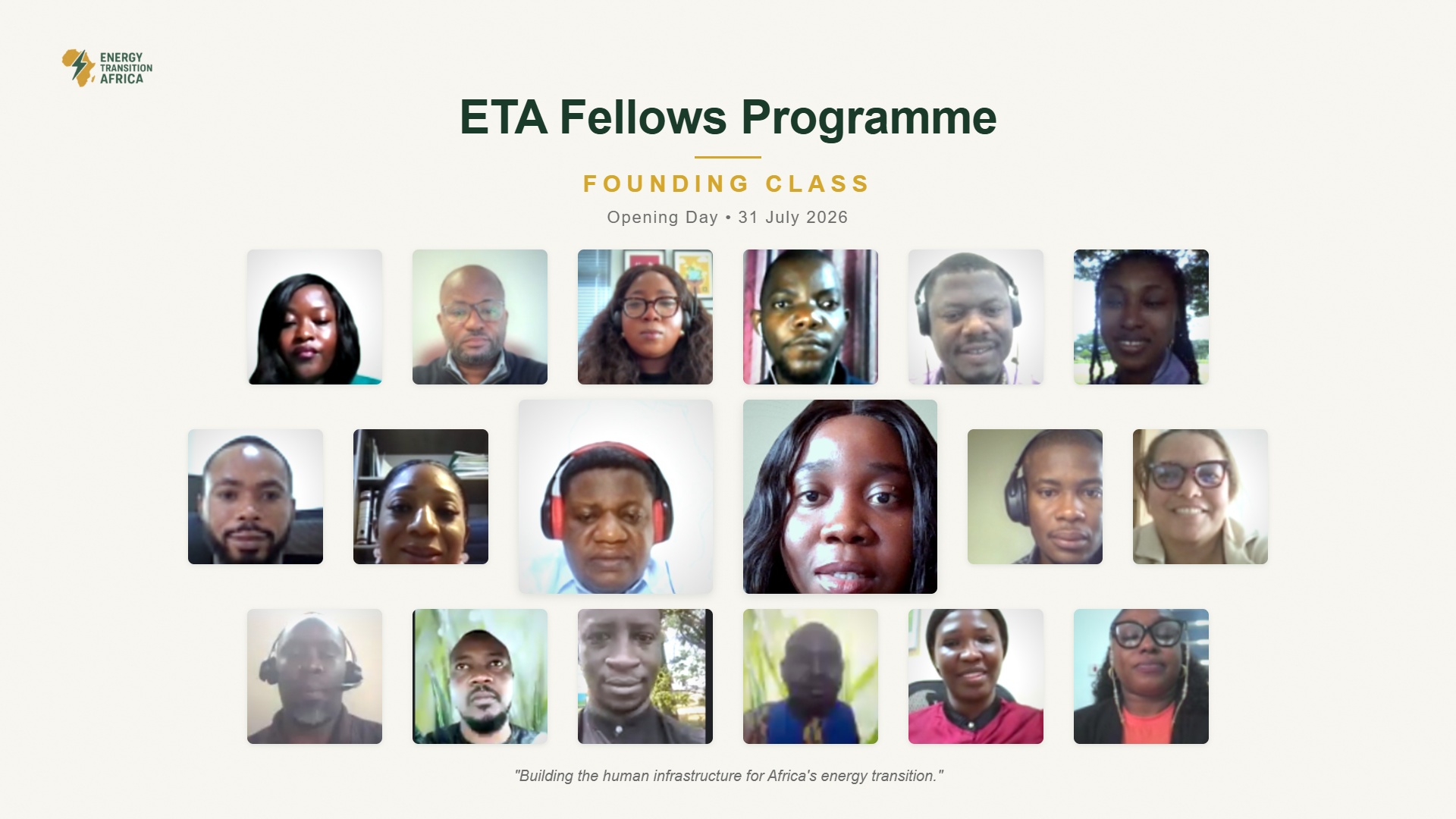
On Friday, 31 July, fifteen professionals from eight African countries began Cohort Zero of the ETA Fellows Programme. Selected from 231 applications, the founding Fellows come from Ghana, Kenya, Liberia, Madagascar, Nigeria, South Africa, Togo and Zambia. The eleven-week programme runs until 15 October.
Their orientation marked the point at which one of ETA's central institutional arguments became a practical commitment. As ETA's Executive Director Vincent Egoro put it when the programme was announced in June: "The ETA Fellows Programme is an investment in those people."
The constraint behind the visible transition
Africa's transition debate is dominated by the resources that can be counted. Governments announce renewable-energy targets, development institutions report financing commitments, companies publish project pipelines, while countries promote their critical-mineral reserves and green-industrial ambitions.
Less attention is paid to the professionals who must convert these announcements into functioning systems. An electricity regulator must understand increasingly complex power markets. A public official negotiating climate finance must be able to interrogate the risk-allocation and repayment implications of an agreement. A journalist covering a major energy project must distinguish an announcement from a financially closed, operationally viable one. And civil society organisations need enough technical knowledge to scrutinise decisions, and utilities need specialists who understand grid integration, system protection and long-term asset performance.
The Fellows Programme was announced in June in response to shortages in exactly this capacity: the ability to govern, finance, analyse, and communicate Africa's transition. Its four-stage structure moves participants from analytical foundations to practical interrogation, published production and institutional influence.
This doesn't mean human capacity is Africa's only transition constraint. Financing remains limited, infrastructure gaps are extensive, and technology costs and weak electricity systems continue to shape what countries can implement. The programme begins from a narrower proposition: that the quality of people and institutions influences how effectively every other transition resource is used.
Who the founding Fellows represent
Cohort Zero brings together professionals working across government, regulation, infrastructure, energy access, climate and energy finance, research, civil society, journalism, strategic communication and enterprise development. That multidisciplinary composition matters because Africa's energy transition doesn't belong to a single profession. Poor financing terms can undermine a sound technical project; a reasonable policy can fail because implementing institutions lack the capacity to apply it; a valuable research finding can have little influence if it isn't communicated in a form decision-makers can use.
The founding cohort doesn't represent every country, institution or transition challenge on the continent, and fifteen people cannot close Africa's professional-capacity gap alone. Its value lies in testing a focused model: bringing professionals with different institutional experience into one production process and requiring them to convert that experience into rigorous, publicly defensible work.
What Friday's orientation established
The orientation set the standards against which the programme will be judged. Fellows will progress through four stages, Foundation, Interrogation, Production and Influence, moving from analytical frameworks and Africa-centred thinking to real institutional problems, original written work, and the communication skills needed to present that work to relevant audiences.
Each Fellow is expected to produce a Signature Analysis addressing a defined energy-transition challenge, alongside a public communication product and an institutional pitch, before presenting their findings at the ETA Fellows Colloquium in October. The work is intended to undergo peer engagement and editorial scrutiny before publication. Successful Fellows will then join the College of ETA Fellows, a continuing professional and intellectual community rather than a temporary programme mailing list.
This production requirement is central to the programme's identity. Attendance confirms that a participant was present, but a published argument reveals whether that participant can define a problem, evaluate evidence, construct a credible position and communicate it clearly enough to be challenged. That is a more demanding standard, and a more useful one.
What success should mean
Fewer than 7 percent of the 231 applicants entered the founding class, a level of interest that says something about the demand for structured professional formation around Africa's energy transition. Selection, however, is not an outcome.
The programme's credibility will depend on what happens after orientation. Do the Fellows produce analyses that add something original to African policy debates? Are their arguments grounded in verifiable evidence, and do their conclusions reach institutions capable of using them? Some of this will take longer than eleven weeks to assess; a research argument's institutional influence often emerges months or years after publication, and a professional community only becomes valuable if its members keep collaborating once the formal programme ends.
Cohort Zero should be understood as a beginning rather than a demonstration of success. It sets the standards, processes and culture future cohorts may inherit, and it creates a basis on which ETA itself can be judged.
From an argument to an institutional responsibility
ETA has consistently argued that Africa's energy transition depends on stronger knowledge systems, professional capability and institutional resilience alongside technology and finance, including in its earlier reporting on the shortage of specialised grid and operational expertise required to sustain new energy infrastructure. The Fellows Programme moves that position from editorial diagnosis into institutional practice, and that movement creates responsibility. ETA must apply to its own Fellows the evidentiary and editorial standards it expects from policymakers and other contributors, and be transparent about what the programme produces, where it falls short, and what changes after Cohort Zero.
Publishing this Dispatch isn't a victory announcement, but a public record of what has begun and what readers should expect next. Friday's orientation didn't prove that Africa's transition challenge can be solved through a fellowship. Instead, it established a smaller, more meaningful test: whether a deliberately designed, production-based programme can help capable African professionals produce stronger analysis, communicate it persuasively, and carry it into the institutions shaping the continent's energy future. The next important story will be what they produce.