Is Africa Training for Yesterday’s Energy System?
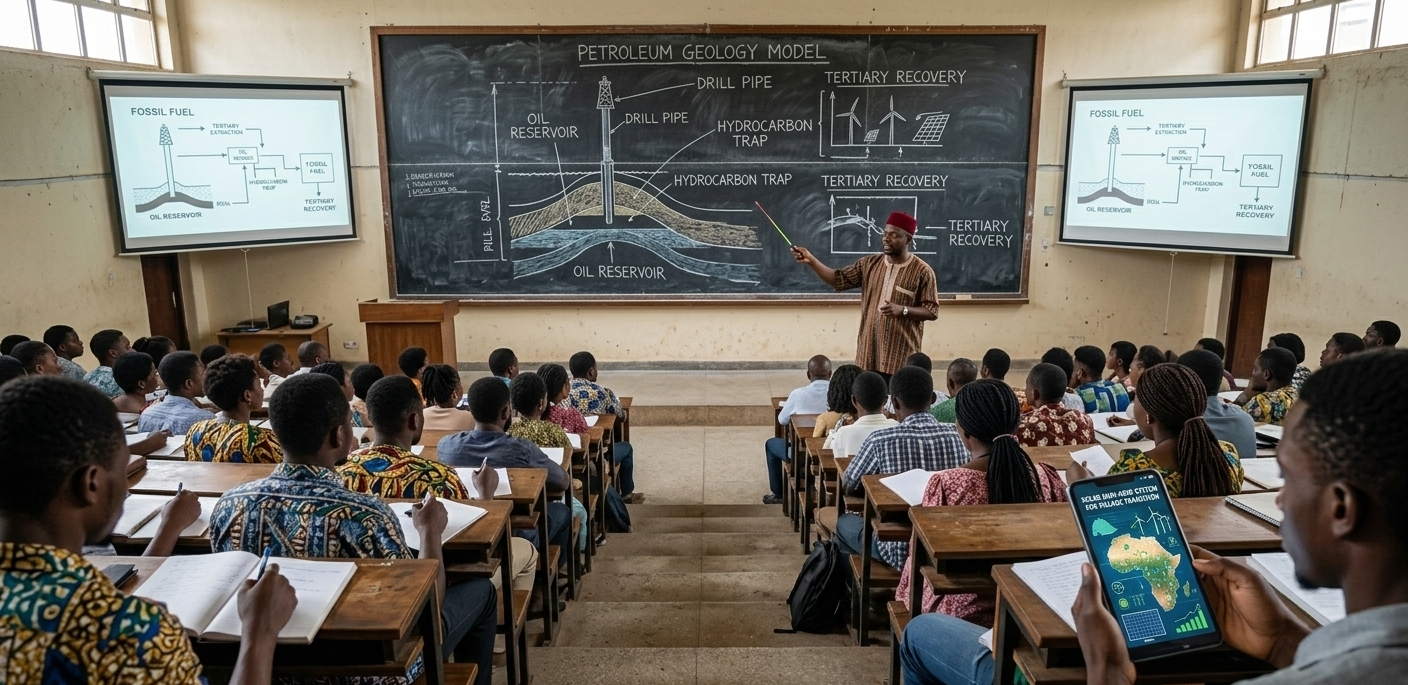
Walk into many university engineering departments across Africa, and the curriculum still looks familiar.
Thermodynamics.
Petroleum geology.
Power plant engineering.
Mechanical systems design.
All important subjects, no doubt, all foundational, but increasingly incomplete for the future of work.
Across Nigeria’s major university cities, Lagos, Ibadan, Port Harcourt and Abuja, an emerging pattern is visible in informal surveys among energy and engineering students. When asked where they first learned about renewable energy, climate policy, carbon markets, or the energy transition, many point to TikTok, YouTube, and online courses rather than lecture halls.
Social media, not universities, has become the entry point to one of the most consequential economic shifts of the century. The finding is anecdotal but revealing, as it suggests a widening gap between formal education systems and the evolving energy economy.
Globally, the energy transition is reshaping labour markets, investment patterns and industrial strategies, and countries that adapt their education systems early will cultivate the engineers, policy analysts and system planners needed for the next energy system. While those who don't risk training students for an energy system that is already fading.
The question is uncomfortable but unavoidable: Is Africa preparing its workforce for the future energy economy or for the past?
The global race to train the transition workforce
Across advanced economies, the energy transition is now deeply embedded in education policy.
China has expanded university programmes in renewable engineering, grid management and battery technology as part of its broader industrial strategy. European universities increasingly offer specialised master’s degrees in energy transition economics, climate policy and sustainable infrastructure.
In the United States, universities and community colleges are scaling workforce programmes focused on grid modernisation, electric vehicles, battery manufacturing and renewable deployment.
The International Energy Agency notes that global electricity demand is growing faster than overall energy demand as electrification accelerates across industries. That shift requires a workforce capable of designing, managing and regulating increasingly complex energy systems.
Engineering alone is no longer enough. Energy systems now require interdisciplinary expertise spanning:
grid integration
digital systems
climate policy
carbon accounting
energy finance
Education systems in leading economies are adapting accordingly. New training pipelines are emerging in universities, technical institutes and vocational programmes.
Africa’s universities remain anchored in legacy energy systems
The curriculum in engineering faculties often reflects the priorities of the late twentieth century: petroleum extraction, thermal power generation and conventional mechanical systems. These disciplines, though valuable, particularly in major hydrocarbon-producing economies such as Nigeria and Angola, where oil and gas continue to underpin fiscal stability, but the energy system now emerging globally is broader, more digital and increasingly interdisciplinary.
Equivalent programmes in renewable systems engineering, grid flexibility, battery storage or energy systems modelling remain limited across much of the continent. Where renewable energy courses exist, they are frequently offered as optional electives rather than integrated components of engineering curricula. As a result, students may graduate with strong theoretical foundations yet limited exposure to the evolving architecture of modern energy systems.
This gap becomes visible once graduates enter the workforce. Early-career engineers often encounter concepts such as carbon markets, grid integration, storage technologies or climate finance only after beginning professional roles. In effect, the workplace becomes the classroom for topics that universities have yet to fully incorporate.
The consequence isn't a lack of talent, but a fragmented pipeline between academic training and the energy system transformation now underway globally.
The missing discipline: system literacy
The challenge facing Africa’s energy education systems isn't simply the absence of renewable energy modules, but what might be called system literacy.
Modern energy systems are no longer defined solely by generation technologies. They operate at the intersection of infrastructure, finance, regulation and geopolitics. Electricity markets depend on tariff design and regulatory stability, grid expansion depends on transmission planning and utility solvency, and renewable integration requires sophisticated modelling of demand patterns and storage capacity.
Understanding how these layers interact is increasingly essential. The World Bank has repeatedly highlighted that electricity reliability, regulatory capacity and utility financial health remain central constraints to energy sector development across many African economies.
To solve these challenges, we will require expertise that extends beyond engineering design, and having professionals capable of navigating complex institutional ecosystems.
Energy planners must understand grid stability and demand forecasting, regulators must design tariff structures that balance affordability and investment incentives, while financial analysts must evaluate energy transition risks and blended finance structures.
Without this interdisciplinary capability, discussions about the energy transition risk will remain abstract. The technology may exist, but the system required to deploy it effectively doesn't.
Our universities and institutions must do more than add renewable courses; they must cultivate professionals capable of understanding and managing the entire energy system.
The digital learning paradox
In many respects, African students themselves are moving faster than the institutions that train them. The rise of digital learning platforms has opened an unprecedented window into global knowledge ecosystems. A student in Lagos or Nairobi can now watch lectures on grid modelling from European universities, follow discussions on climate policy from American think tanks or learn about battery chemistry from Asian research institutions.
Platforms such as YouTube, LinkedIn and massive open online courses have become informal gateways into the energy transition conversation. Students encounter explanations of carbon pricing, renewable integration or electric vehicle systems that may not yet appear in their formal coursework.
This democratisation of knowledge is remarkable, but it also reveals a structural imbalance. Access to information isn't the same as structured education. Online lectures cannot replace laboratory work, collaborative research or mentorship from experienced academics, and self-directed learning rarely provides the rigorous frameworks required for professional expertise.
The result is a paradox. Awareness of the energy transition is spreading rapidly among young Africans, yet institutional structures responsible for training professionals remain slower to adapt.
Students may understand the vocabulary of transition: net zero, decarbonisation, and electrification, but lack the analytical depth needed to translate these concepts into real-world infrastructure and policy.
Why this matters for Africa’s economic future
Africa is positioning itself as a central player in the global energy transition in several ways.
The continent is expanding renewable energy capacity, supplying critical minerals essential for electrification technologies and exploring new industrial opportunities linked to green manufacturing and hydrogen production.
Each of these ambitions requires skilled professionals.
Battery supply chains require materials scientists and electrochemical engineers, grid expansion requires power system planners and digital infrastructure specialists, and carbon markets require economists and regulatory experts.
If training systems don't evolve alongside these ambitions, Africa risks repeating a familiar pattern of exporting raw materials while importing expertise.
The institutional question for policymakers
Addressing this gap requires more than incremental curriculum updates. It demands coordinated institutional action across governments, universities and technical institutes.
Universities should modernise curricula to integrate interdisciplinary energy education that spans engineering, economics and policy. Our vocational programmes should be expanded to include renewable technologies, grid maintenance and energy system operations, and governments should also incorporate workforce development directly into national energy transition strategies.
Agreed, Africa needs infrastructure investments, but this alone won't guarantee productivity gainsif not combined with deliberate human capital development.
Without skilled professionals, infrastructure investments risk underperforming, and even well-financed projects struggle to deliver sustained impact if the institutional ecosystem surrounding them remains weak.
Conclusion: training the architects of tomorrow’s energy system
Debates about Africa’s energy transition often revolve around infrastructure and finance. Discussions focus on solar capacity additions, transmission corridors and climate finance flows. While these elements are undeniably important, the most decisive factor in the long term may be far less visible: People.
The engineers who design the grids that carry electricity across cities and industries, the regulators who shape the rules governing power markets, the economists who structure tariffs and financing mechanisms, and the technicians who maintain renewable installations and transmission networks.
Energy systems are ultimately human systems. If Africa continues training these professionals primarily for the energy architecture of the past century, the continent risks entering the transition economy structurally disadvantaged. The technologies may arrive, but the capacity to manage them may lag.
But if universities and technical institutes adapt, embedding energy transition literacy across engineering, economics and policy, Africa can cultivate the expertise required to shape its own energy future.