Africa Has Energy Finance but It Is Not Reaching Where It Matters
When the global conversation about Africa's energy transition turns to finance, it almost always arrives at the same destination: the gap. How large is the financing gap? How many billions are needed? How far short current flows fall of what is required. These are real questions, but they aren't the decisive ones.
Because the framing of a financing gap implies that the primary constraint is the absence of capital, that somewhere in global markets, there isn't enough money to fund Africa's energy transition.
But that is a wrong assumption, because there is capital. Global energy investment rose to $3.3 trillion in 2025, and clean energy investment globally is at record levels. Development finance institutions have collectively committed hundreds of billions to energy transitions across the developing world, so the money isn't missing from the system.
What is missing is a system that delivers it to the right places, in the right structures, at a price that makes deployment economically coherent. That is a different problem from a financing gap, and it requires a different diagnosis.
The concentration problem
Africa accounts for only 2 percent of global clean energy investment despite having 20 percent of the world's population. That figure is widely cited, but what is less frequently examined is where within Africa those 2 percent lands.
Of the $13.84 billion in tracked clean energy investment that reached Africa in 2025, the distribution was sharply concentrated. Egypt attracted $1.95 billion, reflecting the maturity of its renewables programme and the scale of facilities like the Benban Solar Park, Morocco attracted $1.38 billion, anchored by its Noor complex and established procurement frameworks, while West Africa attracted $3.91 billion, driven substantially by Nigeria's large-ticket transactions.
Three countries, Egypt, Morocco, and Nigeria, account for a structurally disproportionate share of what reaches the continent. The remaining 51 African countries compete for what is left, in a market where the conditions that attract capital, regulatory predictability, creditworthy offtakers, established procurement processes, and liquid local capital markets, are unevenly distributed to say the least.
This is the concentration problem. The financing gap that matters most is not between Africa and the rest of the world. It is between the handful of African markets that have built the conditions to attract capital and the majority that have not.
The structure problem
Even where capital reaches African energy markets, the structures through which it arrives are often misaligned with what projects actually need.
The cost of capital for utility-scale clean energy generation projects in Africa is at least two to three times higher than in advanced economies and China, and it is even higher for smaller-scale projects, especially those that can only access debt from local commercial banks.
This differential doesn't reflect the technology risk of a solar installation in Kenya or a wind farm in Senegal; both are mature, commercially proven technologies operating with some of the best renewable resources in the world. It reflects the sovereign risk assigned to the economies in which those projects are located, compounded by the structural characteristics of the finance being deployed.
The dominant financing structure for African clean energy projects remains dollar-denominated debt from international lenders, with high collateral requirements and short tenors that don't match the long-lived nature of energy infrastructure. Measures by lenders to mitigate risks, such as demanding high collateral requirements, can be prohibitive, not only acting as a brake on investment but also pushing up the costs of electricity for consumers, leaving them reliant on polluting options with lower upfront costs.
Local currency financing would reduce the foreign exchange exposure that makes dollar debt structurally costly for African projects, but local capital markets in most African countries lack the depth to provide it at scale. Energy for Growth Hub analysis has found that local currency financing can lower capital costs by up to 31 percent and electricity costs by up to 29 percent but the domestic financial market development required to enable it at scale is a decade-long institutional project, not a policy switch.
The retreat of public finance at the wrong moment
The structural imbalance between what African energy markets need and what the private capital market delivers makes public and development finance not a supplement to private investment but a precondition for it.
Public and development finance institution funding for energy projects in Africa has fallen by approximately one-third over the past decade, reaching $20 billion in 2024, largely due to a reduction of more than 85 per cent in spending by Chinese development finance institutions.
The timing of this retreat is structurally damaging. Chinese DFI spending drove a significant share of grid infrastructure investment across sub-Saharan Africa between 2005 and 2016, including transmission lines, substations, and generation capacity, in markets where Western DFIs were either not present or not deploying at a comparable scale. The structural retreat of public finance, precisely at the moment when private investment is growing yet remains insufficient, creates a dangerous gap. The IEA estimates that reaching universal electricity access in Africa will require investment to scale to $15 billion per year, yet tracked financing commitments remain well below that threshold.
The World Bank and African Development Bank's Mission 300 initiative, which aims to connect 300 million people to electricity by 2030, represents the most significant mobilisation of development finance for African energy access in a decade. By 2030, $28 billion of concessional capital will be necessary to mobilise the required $90 billion in private investment in clean energy. That leverage ratio, roughly one dollar of concessional finance mobilising three dollars of private capital, is the architecture that makes the transition investable. But it requires the concessional dollar to be deployed strategically and at scale, in markets where private capital will not go without it.
Where most projects fail, and why
The most revealing statistic in Africa's energy finance picture is one that rarely appears in investment announcements.
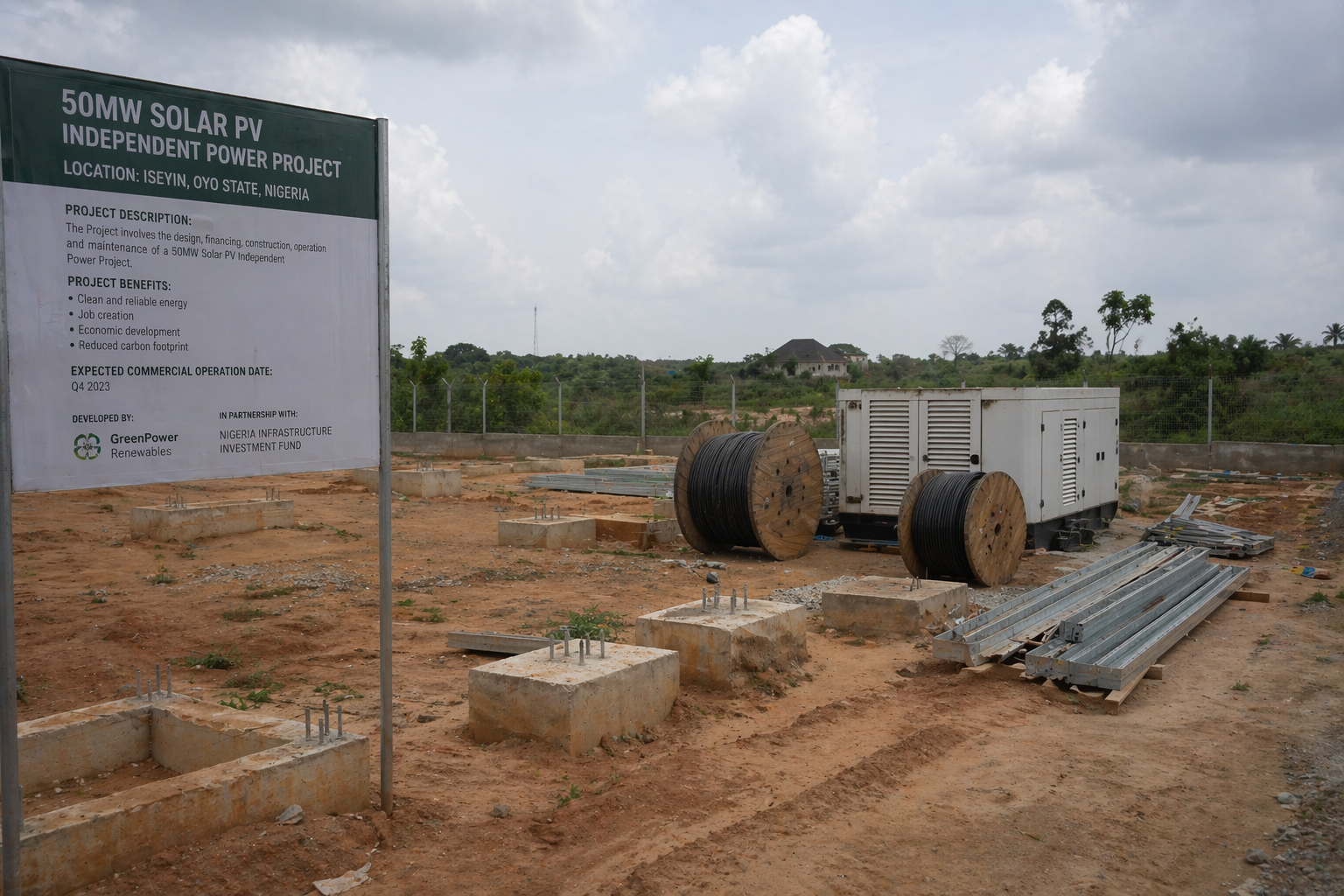
In 2025, Electron Intelligence tracked 322 projects across 47 African countries, representing 74,461 MW of announced generation capacity, but only 14,589 MW was recorded as actually installed during the year. That is a project-to-completion ratio of approximately one in five. More than 80 percent of announced capacity did not materialise into installed infrastructure.
The gap between announcement and completion is where Africa's energy finance problem is most concretely visible. Projects fail to reach financial close not primarily because capital is unavailable but because the conditions required to make projects bankable, creditworthy utilities as offtakers, stable regulatory frameworks, reliable procurement processes, and liquid hedging markets for currency risk are absent or unreliable in the majority of African markets.
In nascent markets, the regulatory environment is often not fully developed and may lead to contract instability and delays. In countries with rising debt, there are higher payment risks from state-owned utilities. In fragile states, the political and reputational risks can be too high. The result is that most investors feel there are not enough investable projects.
This is the paradox at the heart of the finance question. Capital is available, and projects are needed. Between them sits a bankability gap, a set of institutional, regulatory, and financial conditions whose absence prevents the capital from reaching the projects. And that bankability gap isn't closed by more capital, but by institutional development, regulatory reform, and utility financial restructuring interventions that take years and require political commitment that donor capital cannot substitute for.
The institutional question that financing cannot answer
The observation that has emerged clearly from Africa's investment landscape, that where regulation is predictable, financing costs fall, and where procurement is transparent, capital flows more readily, isn't a governance sermon. It is an empirical description of how the bankability gap is actually structured, and what closes it.
Egypt's renewable energy procurement framework, Morocco's integrated solar strategy, and Kenya's geothermal programme each represent cases in which sustained institutional investment produced financing environments that private capital entered at a meaningful scale. These aren't accidental outcomes, but the result of regulatory capacity, utility reform, and procurement consistency developed over the years, the unglamorous preconditions that turn energy resources into energy investment.
The implication for how Africa's energy transition should be supported is precise. The most valuable intervention is not another financing pledge at a summit. It is targeted, technically specific support for the regulatory and institutional frameworks that determine whether pledges become projects.
To close the financing gap in African countries and other emerging economies, international public finance needs to be scaled up and used strategically to bring in larger volumes of private capital. Scaled up and used, both halves of that formulation matter equally. Volume without strategic deployment produces the concentration problem already visible in the data. Strategic deployment without sufficient volume leaves most markets unserved.
Africa's energy finance question, properly understood, is not where the money is, but what would have to be true for the money to reach the 47 countries and 600 million people for whom it currently does not arrive and to work when it gets there. Until that question is treated as the primary one, the transition will continue to produce announcements without infrastructure, and the gap will persist not because capital is missing but because the system that delivers it remains incomplete.