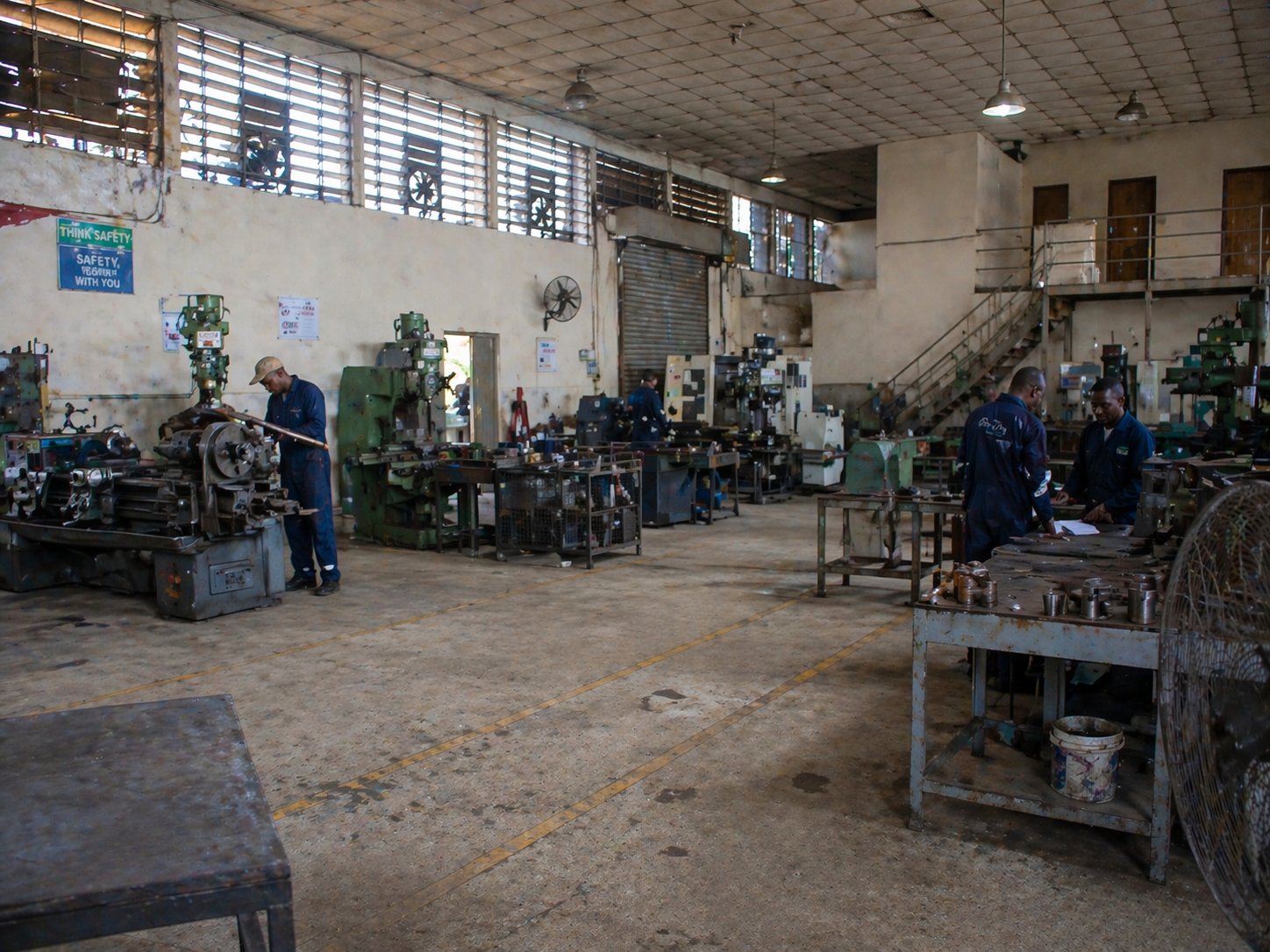
A few months ago, I was in a small industrial workshop on the outskirts of Lagos. The machines and workers were there, with orders waiting to be fulfilled. The owner walked me past a row of equipment and said something I have heard, in different forms, across the continent for years.
"We have power. We just can't afford to use it." I have been turning that sentence over ever since.
Not because it is surprising, I have known this reality for a long time, but because of the gap it exposes between what is being said about Africa's energy transition in the rooms where decisions are made, and what is actually happening in the places where those decisions land. The gap is widening, and I think it is time to say so directly.
The promise
For the better part of a decade, the energy transition has been sold to Africa with a particular story.
Clean energy would be cheaper, solar would unlock access at scale, finance would flow, and Africa would leapfrog the fossil fuel infrastructure that locked earlier economies into carbon dependency and build something better, cleaner, more distributed, and more equitable, from the start.
It was a compelling vision. It was also, in many ways, sincerely held by the people advancing it, and I don't doubt the intentions behind it. But intentions are not outcomes. And the outcomes, when you look at them carefully, tell a different story.
What is actually being built
Electricity tariffs across sub-Saharan Africa have, for the most part, been rising. The IEA's tracking data confirms that over the past decade, tariffs in many African countries have increased more rapidly than household incomes, and the consequence is visible in usage patterns: although the electrification rate in sub-Saharan Africa has risen from 30 percent of the population in 2012 to 50 percent in 2024, average household electricity consumption per capita has fallen by approximately a quarter over the same period. More people have a connection. Fewer people can afford to use it.
For industrial users, the dynamic is similar, but the consequences are more immediately legible. The World Bank's own analysis is direct: high electricity costs undermine the competitiveness of private sector firms across the region, often forcing them to rely on manual processes rather than productivity-enhancing technologies that require more energy. The blackouts alone are estimated to reduce employment rates by 5 to 14 percentage points in affected areas. The workshop in Lagos I described is a pattern and not an outlier.
And the pattern is this: the system is growing, but it is not becoming more usable for the people who need it most.
Why the cost trap is not being resolved
The cost of electricity in Africa isn't high because the resources are scarce or the technology is unavailable, but because of the conditions under which capital reaches African energy projects, and the financial architecture within which utilities are expected to operate.
Clean energy projects in Africa are financed at a weighted average cost of capital running between 15 and 18 percent, compared with 2 to 5 percent in Europe and the United States. That differential, documented by the Columbia Climate School and confirmed by the Clean Air Task Force, doesn't reflect the quality of African solar resources or the contractual robustness of power purchase agreements. It reflects the position African economies occupy in a global financial system that assigns them elevated sovereign risk regardless of project-level fundamentals.
Those financing costs flow through to tariffs. Utilities price electricity to recover the cost of capital they paid to build the infrastructure, and because that cost of capital is two to three times what equivalent infrastructure costs in Europe, the tariffs required to achieve cost recovery are higher than most African households and businesses can sustainably pay.
The utilities are then caught in a structural trap. They can't charge tariffs high enough to remain financially solvent without pricing out the customers they depend on, and they can't hold tariffs low enough to serve those customers without accumulating deficits. Nigeria's electricity sector, where tariff reforms introduced in 2024 and 2025 raised rates for commercial users by 35 percent while affordability concerns intensified, is one version of this trap. South Africa's Eskom, facing an 8.76 percent tariff increase in April 2026 with a further 8.83 percent projected for April 2027, is another. The form differs, but the structural condition is the same.
What this produces is a transition that expands supply without expanding economic utility. You have more megawatts and connections, but less usable electricity, at a higher cost, delivered by institutions that can't sustain themselves financially.
Infrastructure without systems
There is a second dimension to the gap that is less discussed but equally consequential.
Across the continent, infrastructure is being deployed into environments that aren't fully prepared to sustain it. Solar installations without maintenance pathways, grid extensions without the operational capacity to manage them over time. Projects designed for commissioning performance rather than operational durability.
I have written about this in more detail elsewhere: the protection relay that sat degraded for months because no one on the utility's payroll was certified to recalibrate it, the irrigation pump that was abandoned within a growing season because no technician within reach could diagnose the fault. These are not isolated failures, but the predictable outcome of a transition model that measures success at installation and doesn't measure what happens in the years that follow.
The IEA's Financing Electricity Access in Africa report published last October is precise about the system-level consequence: public utilities across sub-Saharan Africa are among the most indebted state-owned enterprises in the region, with low profit margins limiting their ability to deliver and sustain even their existing programmes. The utility that can't pay its own contractors cannot build the operational human infrastructure that keeps the systems it receives functioning. The transition is treating installation as transformation, but it is not the same thing.
Shaped by forces not of Africa's making
What makes this harder to address is that the conditions producing it are largely external to the decisions of African governments.
The cost of capital is determined in global financial markets by creditworthiness frameworks that weren't designed for the energy transition and that consistently assign African economies higher risk than project-level fundamentals warrant. Technology pricing is shaped by industrial policy in China, Europe, and the United States.
The withdrawal of Chinese development finance institutions, which reduced their energy-related disbursements in Africa by more than 85 percent between 2015 and 2024, according to IEA tracking, wasn't a decision made in Lagos or Nairobi. It happened in Beijing, for reasons that had nothing to do with the quality of African energy projects.
African countries are participating in the transition. They are not controlling the terms on which it is unfolding, and the terms currently in force are producing a system that is expanding energy supply without expanding economic possibility.
This is the distinction the workshop owner in Lagos made for me, more clearly than any policy document I have read. He has power. He cannot afford to use it.
That sentence contains the entire structural condition of Africa's energy transition in 2026. More capacity, higher cost, and less economic transformation. A system that is growing in the metrics that are easy to count and falling short in the outcomes that actually matter.
What a different transition would require
I am not arguing for abandonment. The transition must continue, and in many respects it is producing real gains: record renewable capacity additions, millions of new connections, and policy momentum in markets that have historically resisted reform.
But continuation on current terms isn't sufficient. What the Lagos workshop owner's sentence describes is not a temporary inefficiency that will resolve as the system matures. It is a structural condition produced by the cost of capital, the financial fragility of utilities, and the mismatch between how the transition is financed and the economic environments into which it is being deployed.
Addressing it requires changes to the architecture, not just the volume. The creditworthiness framework that prices African clean energy projects at three times the European rate must be recalibrated, not as a favour, but as a correction of a mismatch between how risk is assessed and how risk actually behaves at project level. The utility insolvency problem must be addressed as a financing priority in its own right, not as a background condition to be managed around. And the transition must be designed for durability, for what happens in year five and year ten, rather than optimised for commissioning events.
Until that redesign happens, we will keep building a transition that expands energy without expanding the possibility that energy is supposed to unlock.
And that is not the transition Africa was promised.