What the World Is Missing About Africa’s Energy Transition Is What Happens After Installation
There is a particular quality to the TED stage that is difficult to describe until you have stood on it.
It is not just the size of the room, or the red circle on the floor that marks where you are supposed to stand, or the darkness beyond the lights that means you can feel an audience you cannot see. It is the weight of the expectation, the assumption, built into the architecture of the moment itself, that what is said here is important. That the people in this room, and the millions who will watch later, are hearing something that will move the world forward.
I felt that weight. And I also felt something else.
I kept thinking about a farmer I have never personally met, somewhere in the middle of the continent, standing next to a solar irrigation pump that stopped working three months after it was installed.
What the room in Vancouver believed
The conversations in Vancouver were full of momentum. The energy transition, in the version of it that circulates on global platforms, is a story of accelerating progress. Solar is cheaper than it has ever been, battery storage is scaling, financing is mobilising, and deployment targets are being exceeded. The path forward is visible and, in the language that surrounds these events, increasingly inevitable.
Nobody in that room was wrong.
The technology is real, the capital is moving, and the intention, by almost everyone I encountered, is genuine.
But there is a version of Africa's energy transition that circulates in those conversations that I recognise only partially. It is a version in which the continent is a market to be reached, a frontier to be scaled, and a set of communities to be connected. In which the problem is fundamentally one of supply, of getting enough of the right infrastructure to enough of the right places.
What it doesn't account for is what happens the days or months after the installation is complete.
The people the transition is built on top of
Africa's economy is more than ninety percent informal. This is not a statistic that appears often in energy transition reports, but it is the structural reality within which almost everything on the continent actually functions.
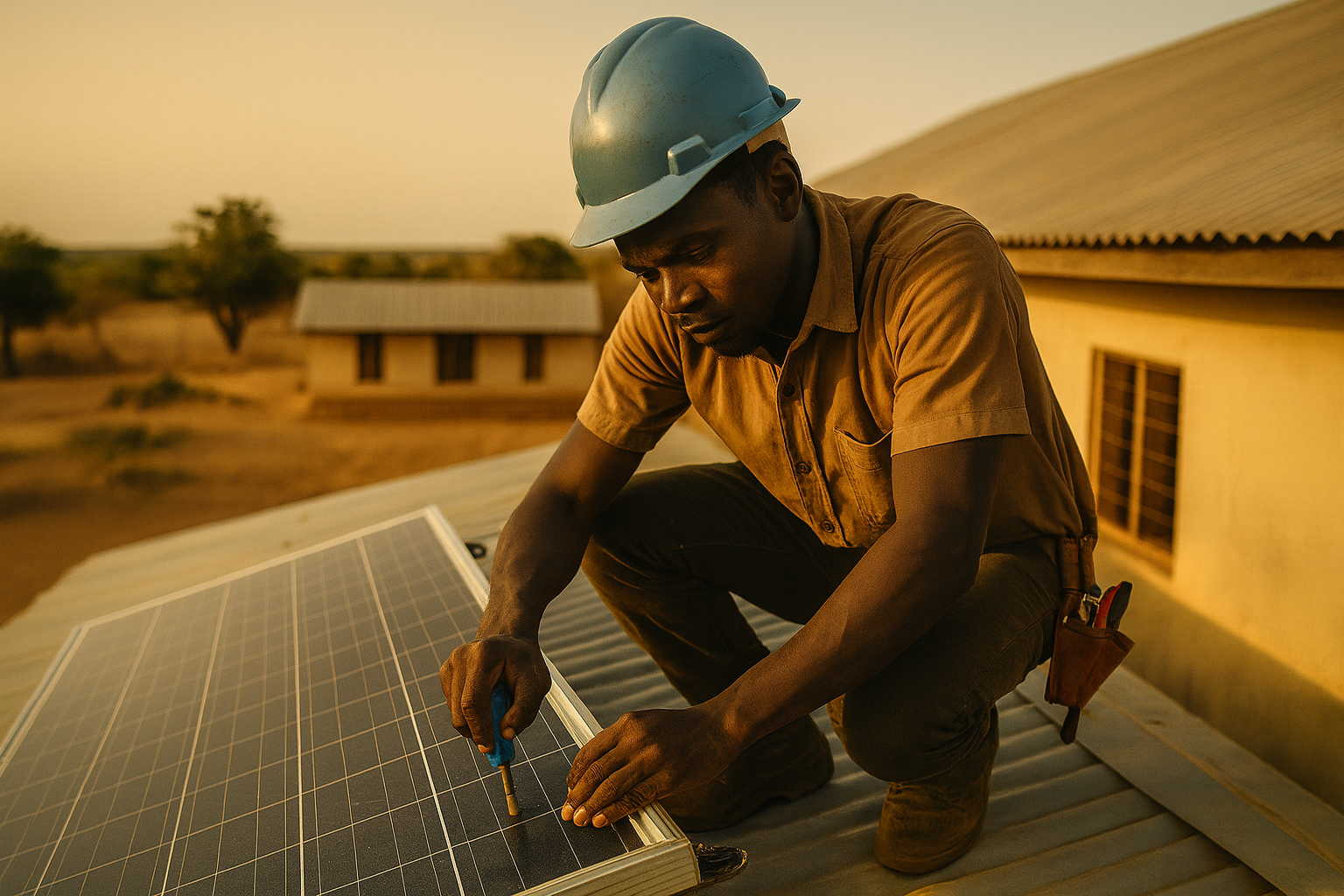
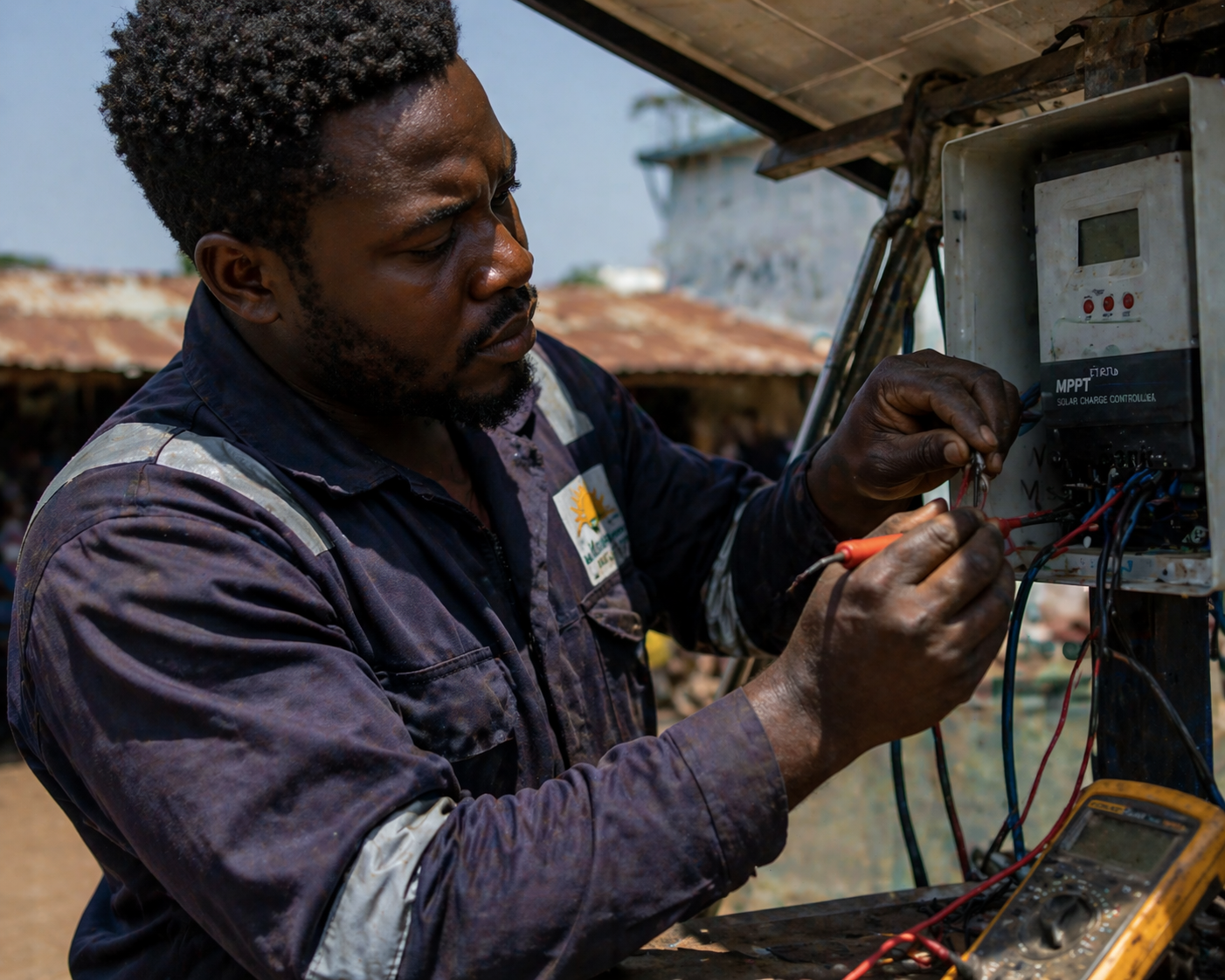
The electrician who rewires a building in Lagos is not registered with any professional body. The mechanic who keeps a diesel generator running in Kampala didn't study engineering at a university. The solar technician who climbs onto a roof in Accra learned what she knows from someone who learned it from someone else, in a chain of knowledge transmission that has no institutional name and no entry in any workforce development database.
These are not marginal figures. They are the people who keep Africa's infrastructure alive.
They are why things work at all in contexts where formal systems have failed, are underfunded, or never arrived. They are the human layer beneath every infrastructure project; the layer that determines whether what is built continues to function, or degrades until it stops.
And in the global energy transition, as it is currently designed, they are largely invisible.
We design systems without them, and deploy infrastructure past them. We measure success in megawatts and connections and investment volumes, and don't measure whether any of it is still working two years after the commissioning engineer left.
The irrigation pump that broke
I have seen variations of the same story across more countries and contexts than I can easily count.
Solar irrigation pumps installed with genuine care and real investment, abandoned within a growing season because a component failed, and there was nobody within fifty kilometres who knew how to replace it. Solar home systems that lit a community for a year or two and then went dark because the battery management unit stopped functioning, and the supplier was based in a city three days away. Community water systems, solar-powered and carefully funded, that became monuments to the gap between deployment and durability.
This isn't a technology failure. The technology, in almost every case I can recall, worked exactly as it was designed to work. What failed was the system around it. The assumption, built into the project design, that maintenance would happen, that someone would be there, with the right knowledge and the right parts, when something went wrong.
That assumption fails because the people who would need to be there were never part of the design.
I thought about all of this on the TED stage. I thought about how confident the transition narrative is about what happens before a system is switched on, and how silent it is about what happens after. I thought about how much energy goes into project design, financing, procurement, and installation, and how little goes into the question of who will fix it when it breaks.
And I thought about how the people who already know the answer to that question, the informal electricians, mechanics, and technicians who have been keeping African infrastructure alive for decades, are treated, in the design of almost every transition programme I have encountered, as if they don't exist.
What the transition gets wrong about where power comes from
There is a sentence I used on the TED stage that I want to stay with for a moment.
People are the power plant.
It isn't a metaphor, or not only a metaphor. It is a description of how energy systems actually function in practice, as opposed to how they are described in policy documents.
In the Global North, this human layer is assumed. There are trained technicians, spare parts supply chains, service contracts, and warranty systems. When something breaks, there is a structure to fix it. The structure is so embedded that it rarely appears in policy conversations; it is simply the background condition within which infrastructure operates.
In Africa, that background condition doesn't yet fully exist for clean energy infrastructure. It exists for diesel generators, because the generator economy is old enough and embedded enough to have built its own maintenance ecosystem. It doesn't yet exist for solar, battery storage, or modern grid equipment, at the scale or geographic distribution that the transition requires.
The transition is trying to build a new energy system without the human infrastructure that would allow it to survive contact with reality.
What a different design would look like
I am not arguing that the transition needs to stop and wait. My argument is that it needs to be redesigned around the people who are already there.
Africa doesn't lack technical capability. The continent produces engineers, trains electricians, and has an informal sector workforce that has demonstrated, repeatedly and under difficult conditions, that it can keep complex systems running.
What the transition lacks is integration. The people who can maintain clean energy infrastructure aren't connected to the institutions deploying it. The knowledge that exists in the informal sector is not being channelled into the formal systems that need it. The training that does exist is designed for technicians in contexts that bear little resemblance to the ones they will actually work in.
Every solar installation should be paired with a maintenance pathway. Not an abstract commitment to training, but a specific, named, locally embedded arrangement that ensures someone within the community or district has the knowledge, the parts, and the authority to keep that system running.
And the informal sector workers who are already doing this work, already fixing, improvising, adapting, sustaining, should be recognised as participants in the energy transition rather than bystanders to it.
What I wanted the room in Vancouver to understand
The TED stage is a place where ideas travel. I stood on it knowing that what I was saying would reach people with the power to change how transition programmes are designed, how investments are structured, and how success is measured.
What I wanted them to understand is this.
Africa's energy transition won't fail because of a shortage of solar panels or a shortage of capital. It will fail, and in parts of the continent, it is already failing because the people who make systems work are not part of the system being built.
The transition is not a hardware problem. It has never been a hardware problem.
That was the argument I made on the TED stage in Vancouver.