The G7 Is Building a Minerals War Room but Africa Is Outside the Room
I want to start with a guest list.
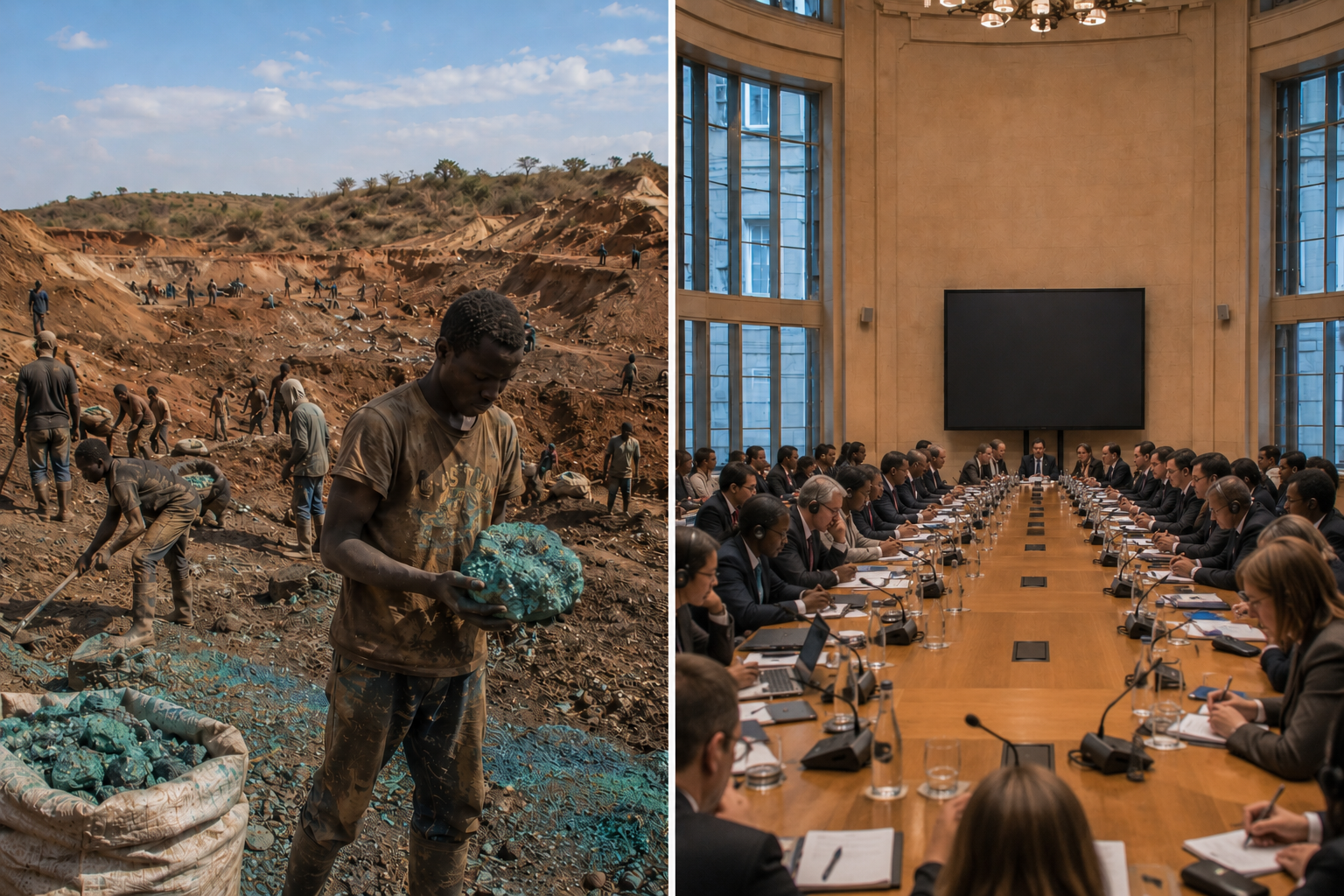
On 5 May 2026, the International Energy Agency held a workshop in Brussels. The agenda was mineral stockpiling, specifically, how the world's most industrialised economies should coordinate the accumulation and management of strategic mineral reserves. Governments registered to attend included the United States, Germany, France, Canada, Italy, and Spain. The European Commission was also represented. Companies expected to attend included General Motors, Glencore, Leonardo, and Umicore.
Read those names carefully. General Motors the company manufacturing the electric vehicles that need cobalt and lithium. Glencore, the company extracting cobalt in the Democratic Republic of Congo. Leonardo, the defence manufacturer whose weapons systems depend on rare earth elements. Umicore, the battery materials company whose supply chains run directly through African ore bodies.
The people responsible for designing how those minerals are stockpiled, priced, and strategically allocated were in that room.
Not one African government was registered to attend.
This is not an oversight. It is a structural condition, and it matters more than almost anything else happening in the global minerals story this week.
What is actually being built in Paris
On 5 May, Reuters reported that G7 countries are in talks to create a permanent secretariat to ensure initiatives to increase critical mineral supplies survive beyond the bloc's rotating presidencies. The proposed body could be housed at the IEA or the OECD, both based in Paris. France, which holds the G7 presidency, called an online G7 meeting to discuss how to break China's stranglehold on critical materials, as preparation for the mid-June leaders' summit in Evian.
The secretariat's function would be to coordinate stockpiling strategy, supply chain diversification, and standards development on behalf of member nations. Its purpose is to maintain execution continuity for G7 minerals policy across the bloc's annual rotating presidencies, ensuring that what is decided in one year does not dissolve when the presidency passes to the next country.
That second purpose is the one that deserves more attention than it is currently receiving.
The G7's mineral strategy problem is not a shortage of ambition. It is a continuity problem. When Canada holds the presidency one year and Italy the next, the initiatives launched under one government risk losing momentum before they are institutionalised. A permanent secretariat solves that by building the coordination architecture into a stable institution that outlasts any individual presidency.
That is not an administrative detail. It is a strategic decision to make the coordination permanent to build infrastructure that will be shaping mineral markets long after the current summit cycle has ended.
Why the guest list tells the whole story
I have spent years watching how decisions about African resources are made. The pattern is familiar enough that I am rarely surprised by it. But something about the Brussels workshop guest list stayed with me.
Not one company in that room was extracting minerals in Europe. Not one was dependent on European geology for its supply chains. The materials being discussed, cobalt, lithium, and rare earths, come from the DRC, Zambia, Guinea, South Africa, and Zimbabwe, from the Democratic Republic of Congo's south-eastern mining belt.
Those countries weren't represented at the table where the stockpiling architecture is being designed.
This is how the system works. It isn't conspiratorial. It is structural. The IEA and the OECD are institutions of wealthy industrial economies. Their membership is built around the countries that consume minerals, not the countries that produce them. When those institutions convene workshops on how to manage mineral supply chains, they naturally convene the governments and companies that define their membership and their mandate.
The consequence is that decisions with direct and material implications for African fiscal positions, such as how much stockpiling will depress demand during price spikes, how coordinated procurement will affect long-term pricing dynamics, and which supply chains will be preferenced over others, are being designed in rooms where African interests have no formal representation.
European governments have already rejected the idea of a single shared stockpile, preferring that each country control its own reserves. They have also resisted the United States leading the project, concerned that Washington could restrict mineral access during a geopolitical emergency. The EU has been developing its own pilot stockpile project since the start of 2026, led by Italy, France, and Germany.
Note what is happening here. The G7's internal disagreements about who controls the stockpile, whether the Americans should lead it, and how much each country should hold are being resolved between the parties present. The resulting architecture will shape how minerals are bought, held, and deployed in a crisis.
African governments will live inside that architecture, but didn't design it.
The level at which the game is being played
I have written and discussed the African critical minerals strategy for years. The debates are important, and I do not dismiss them: export restrictions, beneficiation requirements, royalty frameworks, and renegotiated licences are instruments African governments are deploying, and in many cases, they are the right instruments.
But they are project-level interventions operating against a system-level architecture that is being built in parallel and at speed.
The distinction matters in a specific and practical way. An export restriction on cobalt by the DRC changes the terms of extraction at a single point in the supply chain. A coordinated stockpiling mechanism operated by the world's largest consuming economies changes the timing, volume, and price conditions under which that cobalt is purchased, potentially across decades.
A government can win a royalty negotiation and still lose the larger contest over who shapes the pricing environment that makes those royalties worth collecting.
The risk is that China exploits the coordination gap through long-term offtake agreements with resource-rich nations, progressively deepening G7 supply chain dependencies while the secretariat remains theoretical. That framing, from an analyst following the secretariat discussions, tells you something important: the G7 isn't building this structure to compete with Africa. It is building it to compete with China. But Africa is the terrain over which that competition is being conducted, and it isn't a participant in the competition itself.
This is the position I keep returning to and cannot fully reconcile myself to. The continent whose geological endowment is the primary reason the G7 secretariat is being proposed has no seat at the table where that secretariat is being designed.
What an African response would actually require
I want to be precise here because the instinct to call for continental unity is easy, and the institutional reality is harder.
Africa doesn't need a perfect pan-continental minerals body to respond to what is happening in Paris this week. What it needs is something more targeted and more achievable in the near term: a mechanism for coordinated market intelligence, shared legal capacity for supply-chain negotiations, and a standing African voice in the institutions where these decisions are being made.
The African Union's critical minerals framework exists on paper. The AfCFTA has the structural architecture to house coordination mechanisms. The African Development Bank has the financing capacity to fund an operational secretariat. What has been missing is the political decision to treat minerals coordination as an institutional priority rather than a policy aspiration.
That decision has a deadline. Key decisions on the G7 secretariat are expected at the June leaders' summit in Evian, with 2026 identified as a plausible establishment window. The architecture being built now will shape mineral market dynamics for decades. The window to influence how that architecture treats African supplier interests is not indefinitely open.
The G7 is preparing for permanence. The June summit in Evian will likely produce the institutional mandate that the secretariat needs to begin operations. Once that architecture is established, and the stockpiling frameworks, the supply-chain preferences, and the crisis management protocols are codified within a permanent institution, challenging it from outside will be considerably harder than shaping it from the beginning.
Africa has the minerals. The question being decided in Paris this month is who gets to design the system that determines what those minerals are worth.
Right now, the answer is not Africa.