West Africa Has Payment Rules for Electricity. They Keep Failing.
A regional electricity market depends on something more basic than transmission lines. Someone has to pay the bill, and that sounds obvious until the bill crosses a border. In 2023, the international customers buying electricity-related services from Nigeria's power market paid $50.36 million of the $53.55 million they were invoiced across the year, a remittance rate of 94.04 percent. Then, in the first quarter of 2024, four bilateral supply arrangements serving Benin, Niger and Togo were billed a combined $14.19 million by Nigeria's Market Operator and paid nothing during the quarter. PARAS-SBEE in Benin was billed $3.15 million, Transcorp-SBEE, also in Benin, $4.46 million, Mainstream-NIGELEC in Niger $1.21 million, and Odukpani-CEET in Togo $5.36 million.
It would be easy to read that as a system with no rules for exactly this situation, a market that built the wires and the coordination centre but never thought to ask what happens when the buyer stops paying. That reading would be wrong, because the real story is more interesting than a simple absence of enforcement. West Africa has formal payment-security architecture: a 2018 ECOWAS directive on securing cross-border electricity trade explicitly requires standard contracts with sanctions for non-payment, including graduated disconnection, backed by commercial bank guarantees and, where appropriate, multilateral guarantees.
ERERA has its own sanctions rules covering breaches by market participants, system operators and transmission entities. NERC's 2023 annual report confirms bilateral customers were expected to provide payment guarantees to the Market Operator, drawable whenever invoices went unsettled within the required period. The rulebook doesn't merely tolerate default. It anticipates it. The question is why the arrears keep recurring anyway.
A trajectory too volatile to call a simple collapse
The payment record since 2024 doesn't describe a straight-line failure so much as a market lurching between recovery and relapse. After the zero-payment quarter of early 2024, remittance climbed to 62.88 percent in the second quarter and 53.24 percent in the third. Full-year 2025 performance recovered further still, to 84.90 percent, close to pre-crisis levels. Then it fell away again: 53.28 percent in the fourth quarter of 2025, and just 27.57 percent in the first quarter of 2026, the worst sustained quarter since the original 2024 collapse.
A separate review of Nigerian regulatory accounts published this year found Benin and Togo had accumulated roughly $28.33 million in unpaid Market Operator service charges over three years, fees for the market and transmission services that move electricity through Nigeria's system, distinct from the underlying commodity cost of the power itself.
That volatility, not a single bad quarter, is the more damaging signal. A market can price a known, stable risk into its contracts and guarantees. What it struggles to price is a counterparty that pays 85 percent one year and 28 percent the next, because nobody, including the counterparty's own government, can say with confidence which behaviour is the anomaly.
How the payment chain is supposed to work
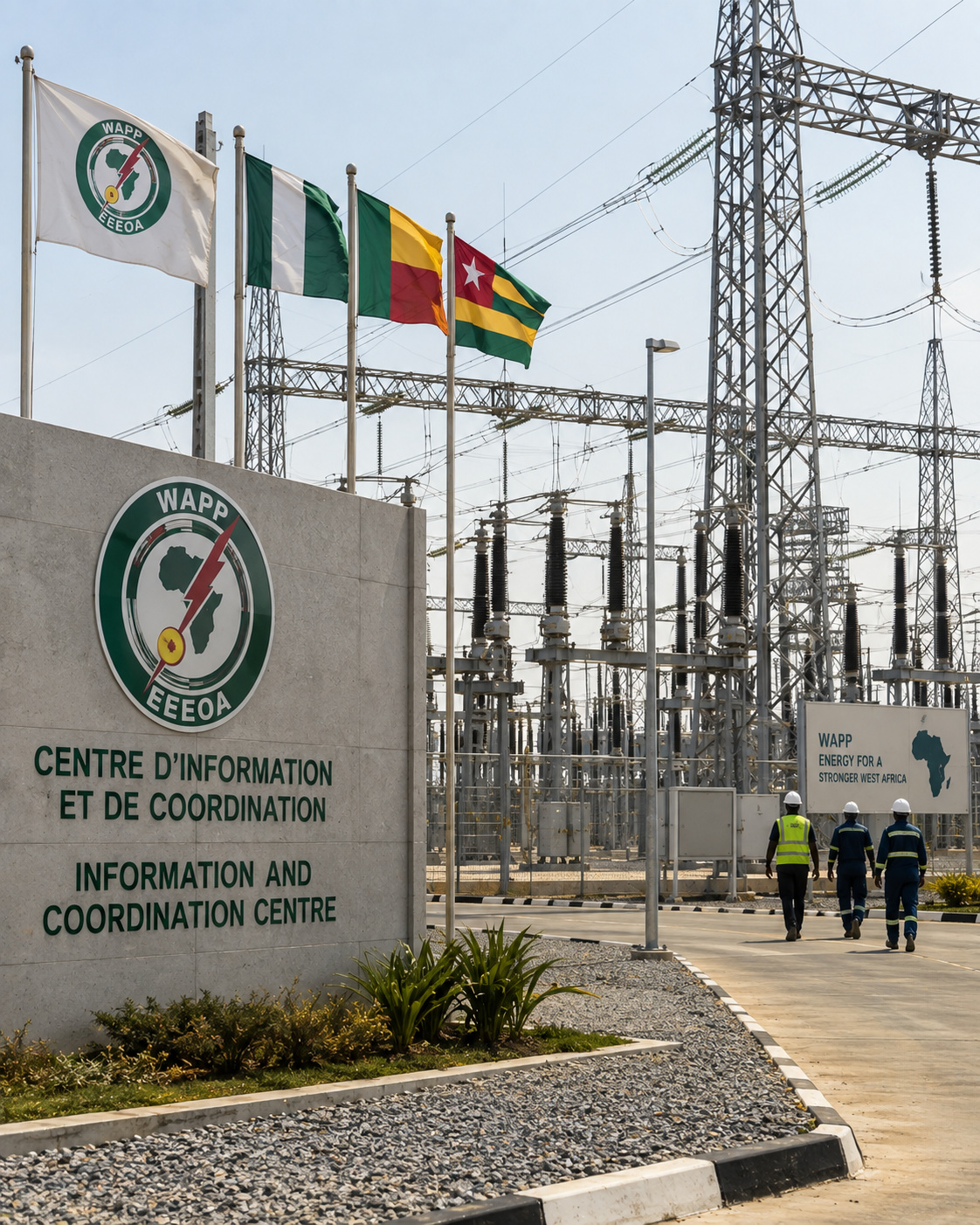
Nigeria's generation companies supply electricity into the national grid under bilateral arrangements, and the Market Operator, a NERC-regulated entity, invoices the international customers for the market and transmission services involved. That sits inside a wider structure: the West African Power Pool coordinates the interconnected physical system, and ERERA provides the regional regulatory framework governing cross-border trade, using standard contracts, transmission tariff rules and market procedures the two institutions developed jointly.
ETA has previously explained how that architecture functions when it works, in "How Electricity Gets Traded Across African Borders." The Nigeria-Benin-Togo payment data show what happens to the same architecture when one of its foundational assumptions, that a signed contract implies a solvent counterparty, does not hold.
The problem begins inside the national utilities, not the regional rules
Regional electricity markets connect national power sectors; they don't replace them, and many West African utilities enter the regional market carrying the same financial weaknesses they already struggle with at home. The World Bank has documented the pattern repeatedly across the region: retail tariffs below cost, expensive generation, high distribution losses, and utilities that fail to collect the full value of the electricity they already supply domestically. A utility can have every incentive to import electricity, because it is genuinely cheaper than generating the same power itself, and still struggle to pay for those imports, because cheaper power improves a utility's economics without repairing its balance sheet overnight.
Benin's SBEE and Togo's CEET operate inside systems where governments have long balanced affordable domestic tariffs against the real cost of supply, exactly the trade-off Nigeria's own distribution companies make at home, where shortfalls in customer collections accumulate as liabilities all the way upstream to generators and gas suppliers. The regional market simply extends that same financial chain across a border. A weak utility doesn't become creditworthy merely because its next invoice arrives from a different country.
Why disconnection is possible in theory and difficult in practice
On paper, sustained non-payment can lead to reduced supply or disconnection under the rules ECOWAS and ERERA have built. In practice, cutting electricity exports to a neighbouring state is a materially different act from disconnecting a domestic factory for non-payment. A cross-border electricity relationship can involve heads of state, energy ministers, decades-old diplomatic agreements and wider questions of regional stability, and an enforcement decision under those conditions becomes political almost by definition. ERERA isn't a sovereign debt-collection court; it cannot enter another member state and seize a utility's assets. Its authority runs through ECOWAS rules, national implementation and sanctions agreed collectively by member states, considerably stronger than informal goodwill, but weaker than a single national regulator overseeing companies entirely inside one legal jurisdiction. That gap between formal authority and practical enforceability is the actual seam the region's payment discipline problem lives in, not an absence of rules on paper.
The institutions are now building financial infrastructure to match the physical kind
The World Bank's own support for West African power trade has been explicit about this risk from early on, requiring participating countries to adopt cash-waterfall arrangements that prioritise cross-border import payments, quarterly clearance of arrears, guarantees and ring-fenced revenue streams as conditions of its financing. More recently, the World Bank reports WAPP is establishing a Liquidity Enhancing Revolving Fund, a collective guarantee mechanism intended to support timely payment and supply security across the regional market. That is a significant admission in itself: interconnectors and coordination centres aren't sufficient on their own to make a power pool function, and the region now needs financial shock absorbers layered on top of its physical infrastructure.
A liquidity facility can protect a seller when a buyer pays late, bank guarantees provide security against non-payment, cash waterfalls can prioritise cross-border obligations ahead of other domestic claims on a utility's revenue; none of it, however, permanently fixes an insolvent national utility. Guarantees move risk to an institution better placed to absorb it. They don't eliminate the underlying reason the utility couldn't pay in the first place, which still requires domestic tariff and collection reform no regional instrument can substitute for.
Why the timing makes this more urgent, not less
West Africa is no longer experimenting with a handful of bilateral deals. More than 4,000 kilometres of high-voltage transmission now connect all 15 mainland ECOWAS countries through WAPP, and roughly 8 percent of the region's electricity trades across borders, a share the World Bank notes is approaching Europe's own benchmark of 10 to 12 percent. That comparison needs care: Europe's markets operate inside deep banking systems, highly liquid currencies and powerful supranational legal institutions, while West Africa is integrating utilities that in some cases still depend on subsidies, carry large arrears and transact in currencies exposed to significant depreciation. The electrons cross the border in exactly the same way in both cases. The financial systems underneath them don't.
That gap matters more, not less, because WAPP and ERERA are launching a regional Day-Ahead Market in 2026, moving the region from a relatively small number of long-standing bilateral contracts toward an organised short-term market that depends on trust in the settlement system itself, not in a handful of known counterparties. A seller submitting electricity into tomorrow's market has to believe payment doesn't depend on a diplomatic negotiation six months later. The same imports that cut Guinea-Bissau's generation costs from around 25 US cents to 11 cents per kilowatt-hour, and delivered roughly 42 percent savings in the Gambia, show the model can genuinely work when the underlying utility can pay. Whether the new day-ahead market can extend those gains without extending the same payment volatility now visible in Nigeria's own accounts is the test the region is about to run in public.
Regional integration is exposing a national problem, not causing one
The debts recorded in Nigeria's own regulatory accounts aren't evidence that cross-border electricity trade fails to work. They are evidence that regional integration cannot permanently outrun the domestic power-sector reform still owed in the utilities it connects. ETA has examined the identical liquidity mechanism operating entirely inside Nigeria's own borders, where unpaid customer bills move upstream through distribution companies, the bulk trader, generators and gas suppliers until the shortfall eventually shows up as reduced generation. At the regional level, the customer changes and the border changes. The financial mechanism does not. A transmission line can connect two electricity systems, a market rule can determine how they trade, and a regulator can define, on paper, the consequences of default. A regional market survives only when the seller actually gets paid, and West Africa has spent two decades building the wires that let electricity cross its borders. Its harder task now is building a payment system solvent enough, on both sides, to make those wires commercially trustworthy rather than merely physically functional.