Africa Extracts the Oil but Others Still Capture the Profits, a New Report Finds
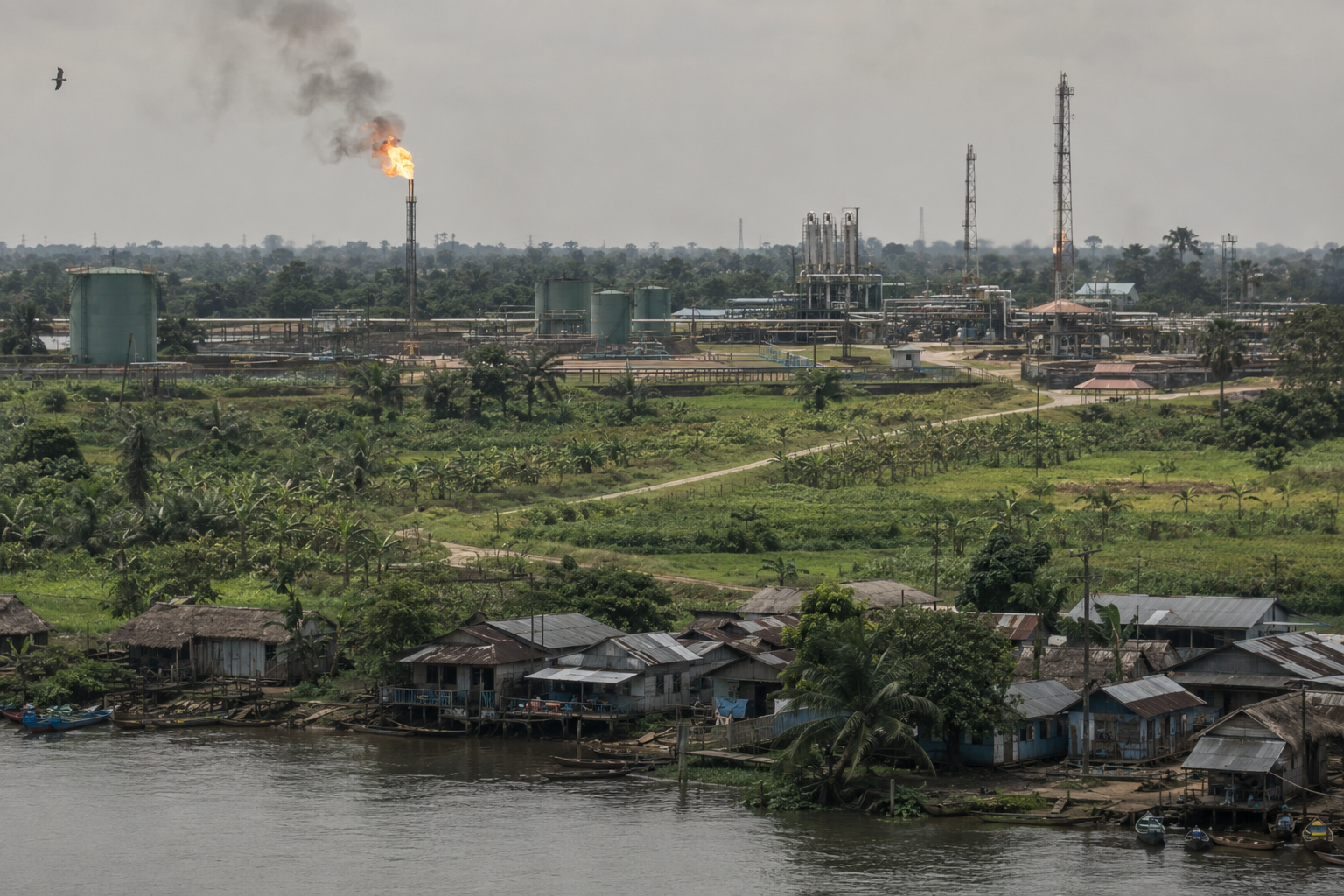
Nigeria has produced oil commercially since 1958. It is the largest crude oil producer on the African continent, and its fiscal architecture, foreign exchange system, and national political economy are built around hydrocarbon revenues. And yet, according to data from the newly released Pipe Dreams report by Oil Change International and Power Shift Africa, published 9 May 2026 in Nairobi, Nigeria's oil industry directly employs 0.01 percent of the country's workforce.
That figure isn't a rounding error. It is a structural indictment.
It compresses into a single data point an argument the report makes systematically across 13 African oil- and gas-producing countries: that decades of extraction have failed to reduce poverty or drive economic growth and instead have lined the pockets of an elite few. The structure of the oil and gas economy concentrates and exports wealth while leaving African governments and communities to bear the costs.
The report arrives at a moment when the argument it makes is no longer theoretical. Global fuel prices surged following US-Israeli attacks on Iran from February 2026. Diesel prices rose by 40 percent in Sierra Leone, 39 percent in Zimbabwe, and 35 percent in Malawi between February and April 2026. In South Africa, the price of illuminating paraffin used by poorer households reportedly doubled, forcing many families to shift back to firewood and charcoal for cooking.
The United Nations Economic Commission for Africa estimates that a 10 percent increase in energy prices raises inflation in African economies by 1.7 percentage points. The African Development Bank projects 2026 inflation of 17 percent in Nigeria and 75 percent in Sudan. The IMF revised its 2026 African growth forecast down from 4.6 per cent to 4.3 percent as a direct consequence of the conflict.
These are the current operating conditions of African economies in 2026. And they are happening in a year when Africa as a whole is a net exporter of crude oil.
The structure of the failure
The Pipe Dreams report doesn't argue that oil and gas have produced no value in Africa. It argues something more precise: that the economic model through which oil and gas are extracted is structurally designed to concentrate value outside African economies while dispersing costs within them.
The report identifies features that appear consistently across all 13 producing countries examined. The first is the extractive character of the oil and gas economy itself. In most African countries, production is dominated by multinational corporations, which frequently secure disproportionate revenue shares through a combination of contract terms and accounting schemes. The report documents how Mozambique's Coral South project, operated by Eni and producing since 2022, won't deliver significant government revenues until the mid- or late 2030s, the contract terms allocate most early revenues to the foreign consortium. The government signed that contract in a position of fiscal and institutional weakness, as most African governments do. The Economic Commission for Africa estimates that $40 billion is lost annually across the continent through illicit financial flows in the extractive sector.
The second feature is the enclave structure of extraction. Oil and gas operations in Africa are systematically isolated from the broader economy. Services and supply contracts go to foreign providers. High-skill employment goes to expatriates. The employment data makes this structural isolation concrete: in Angola, oil and gas employ 0.3 percent of the workforce despite the sector accounting for roughly a third of GDP. In Congo-Brazzaville the figure is 0.1 percent. In Ghana and Chad, as in Nigeria, it is 0.01 percent. Offshore floating production systems can now extract oil and gas without any onshore footprint whatsoever, removing even the limited economic linkages that onshore production once created.
The third feature is what economists call Dutch disease. Oil and gas extraction inflates national currencies, making other export sectors, such as manufacturing, agriculture, and processed goods, structurally uncompetitive. Nigeria is the most documented case. Until the 1960s, Nigeria was one of the world's largest producers of palm oil, the largest exporter of peanuts, the second largest exporter of cocoa, and a significant producer of rubber, cotton, and cassava. Between 1970 and 1985, cocoa production fell by 43 percent, rubber by 29 percent, cotton by 65 percent, and peanuts by 64 percent. By the mid-1970s Nigeria had become a net food importer. The oil sector didn't replace what it displaced.
The fourth feature is fiscal vulnerability across the full price cycle. When prices fall, governments cut spending and fall deeper into debt. When prices rise, importing countries face fuel costs that destabilise their economies, while producing countries discover that high prices accelerate the demand destruction that threatens their long-term revenue base. Angola cut its government budget by 25 percent when oil prices fell in 2014, triggering outbreaks of malaria, yellow fever, dengue, and chikungunya as the health sector collapsed. External debt grew from 36 per cent of GDP in 2014 to 115 percent by 2016.
The fifth feature is the most cited but the least structurally analysed: corruption. The report documents how the Elf affair saw senior executives bribe the presidents of Gabon, Angola, Cameroon, and Congo-Brazzaville between 1989 and 1993, embezzling $350 million. The Mozambique tuna bonds scandal drove external debt to 360 per cent of gross national income by 2016. These aren't isolated governance failures sitting alongside the oil economy, but structural consequences of it. The high-value, capital-intensive, enclave nature of oil extraction creates concentrated rent flows that are inherently prone to capture by political elites and corporate intermediaries.
The distinction the report needs more precision on
The Pipe Dreams report's analytical contribution is strongest in documenting the historical record. It requires greater precision when it moves to policy conclusions applied across a continent of 54 countries with fundamentally different circumstances.
The 13 producing countries examined are not a uniform category. Libya, Equatorial Guinea, and South Sudan derive more than 80 percent of government revenues from oil and gas. Chad, Algeria, Angola, and Congo-Brazzaville derive around 60 percent. Nigeria derives over 30 percent. These are not the same policy challenge, and they don't admit the same prescription.
More consequentially, the stranded asset warning, that new producers including Uganda, Mozambique, Namibia, Tanzania, the DRC, and Côte d'Ivoire risk investing in projects that will come online into shrinking markets, applies with far greater urgency to pre-production or early-production countries than to mature producers whose fiscal systems are already structured around hydrocarbon revenues. The report's own data is instructive: the average time from contract signing to first production across the African cases examined is 16 years. Countries committing to new major oil and gas projects today will begin receiving significant government revenues in the early 2040s, when the IEA, Shell, BP, Equinor, Wood Mackenzie, Bloomberg, and McKinsey all project global oil demand to be in structural decline.
For Uganda, Namibia, and Mozambique, that timeline presents a genuine and specific strategic risk that the report documents convincingly. For Nigeria or Algeria, whose fiscal systems, political economies, and state institutions are already deeply structured around hydrocarbon revenues, the question isn't whether to avoid extraction. It is how to manage a transition away from dependence on a timeline that is politically feasible as well as economically necessary. Economic diversification, as the report acknowledges, takes decades. Countries that have been trying to diversify away from oil dependence since the 1970s have largely not succeeded. That is an argument for beginning the work immediately and without illusions about how long it will take.
The report doesn't fully disaggregate these categories. The evidence the report presents is compelling and institutionally sourced. The policy prescriptions it draws require more country-level precision than a 13-country aggregate can supply.
What the evidence is actually for
African energy policy has long suffered from a debate in which the development case for fossil fuels is made in aggregate revenue terms, and the case against it is made in climate and environmental terms. The Pipe Dreams report introduces a third register: an evidence-based assessment of whether the extraction model has actually delivered the development outcomes its proponents claim. Across 13 countries and multiple decades, the documented finding is that it hasn't, not in employment, fiscal resilience, energy access, agricultural or industrial diversification, and not in reducing vulnerability to the very global fuel markets from which extraction was supposed to insulate producing economies.
The report's renewable alternative isn't aspirational. IRENA estimates that renewables create two to three times more jobs per dollar than fossil fuels. A renewable-led transition could create an estimated 14 million jobs in Africa by 2030, jobs that are more geographically distributed and more accessible to women and young people than anything the extraction economy has produced in six decades. That comparison, 14 million jobs from renewables against 0.01 percent workforce employment from Nigeria's oil sector, is the most powerful single argument in the report, and it is the one that should be leading the diplomatic conversation at Évian and COP31.
That finding doesn't resolve the transition debate. It sharpens it considerably. At recent global fossil fuel phase-out talks in Colombia, oil-rich African nations argued they would continue drilling to support economic growth. The Pipe Dreams report doesn't change that political reality overnight. But it places into the evidentiary record ahead of the G7 summit in Évian in June and COP31 later this year a documented answer to the claim that African governments have no alternative but continued fossil fuel development. The answer the report gives is that the model being defended hasn't delivered what its defenders say it has. That isn't a peripheral contribution to the conversation. It is the conversation that should have been happening since 1958.