Africa Connected 86 Million People to Off-Grid Solar but Few Have Enough Power to Run a Business
Africa's off-grid solar sector has produced one of the continent's most cited energy access achievements. At the end of 2024, global off-grid renewable power capacity reached 11.1 gigawatts, connecting 86 million people to electricity. Africa alone accounted for over three-quarters of total beneficiaries.
These numbers have been widely presented as evidence that Africa is closing its energy access gap. That interpretation is accurate but incomplete. The same IRENA dataset that produced the headline figure contains a finding that fundamentally changes how the story should be read. This piece explains what that finding is, why it matters, and what it reveals about the financing architecture that produced the current outcome.
The number buried in the headline data
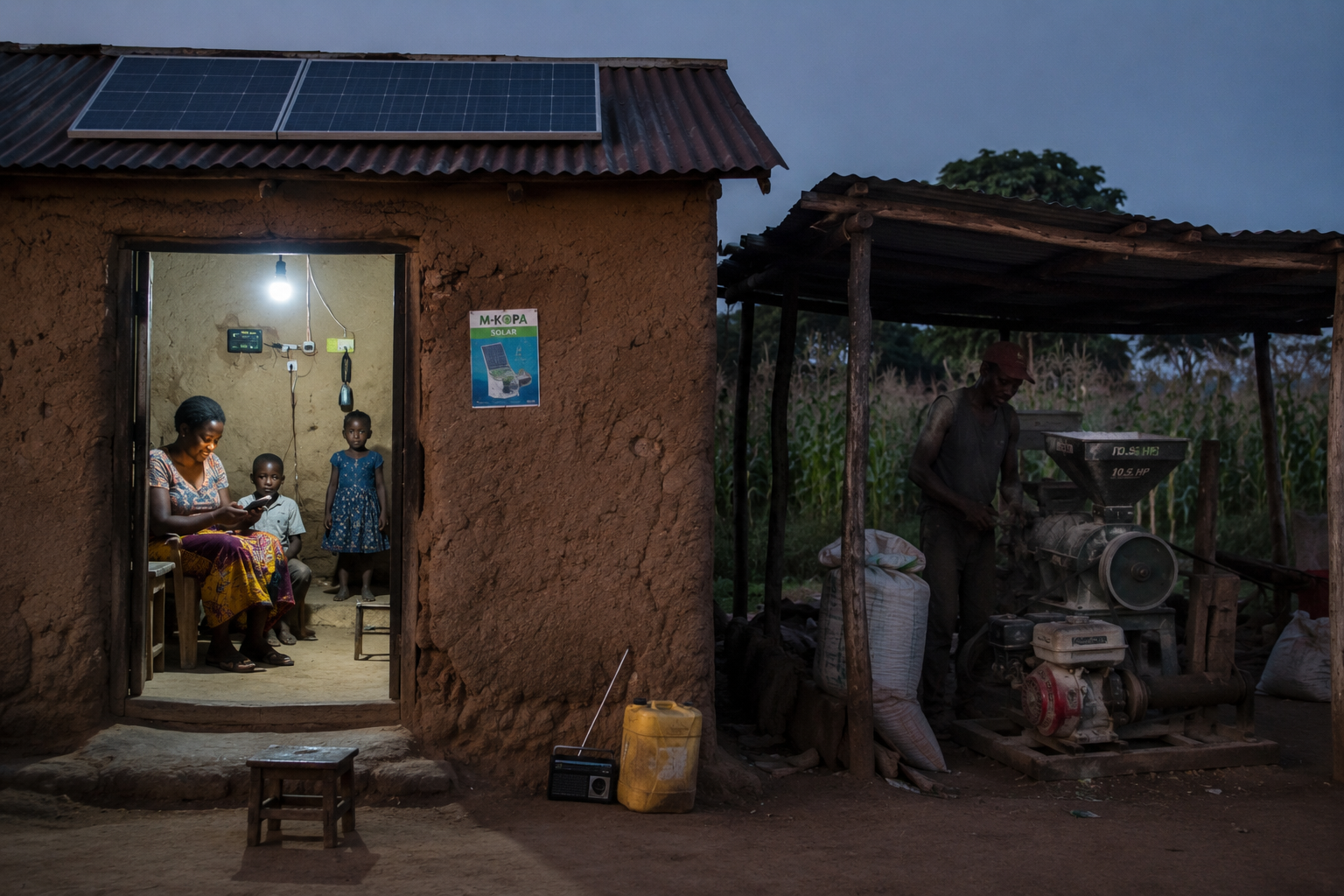
Virtually all people, 99.9 percent, in off-grid households had under eight hours of electricity per day using off-grid systems for basic lighting and entertainment purposes in 2024. Only 0.1 percent of off-grid households had between eight and 16 hours of electricity per day, the tier at which air conditioning, refrigeration, space heating, and home-based productive activities become possible.
That figure warrants careful attention. The global headline shows 86 million people connected to off-grid renewable energy. The tier breakdown shows that virtually all of them are receiving electricity at a level that supports a lightbulb and a phone charger, but not a refrigerator, an irrigation pump, a grain mill, a welding machine, or the sustained load required to run a small enterprise.
This isn't a minor qualification. It is the structural condition of Africa's off-grid solar achievement. The continent has connected tens of millions of households to electricity. It has not, at any meaningful scale, connected those households to productive electricity, the sustained, reliable, sufficient power that transforms energy access into economic capability.
The distinction between access and productive access is becoming one of the defining challenges of the next phase of Africa's energy transition. Studies show that growing productive activities increase household electricity demand by half, with important consequences for determining the cost-optimal electrification technologies. Planning of electricity systems should accommodate this increase in electricity demand for productive uses. The current off-grid system was not designed around that demand.
Why the technology is not the problem
Off-grid solar works. The rapid expansion of solar home systems and mini-grids over the past decade has demonstrated that decentralised renewable technology can reach communities where national grid extension remains economically unviable or decades away.
The technology has delivered on what it was designed to deliver: basic household electricity access at lower cost and faster deployment than grid extension could provide. LED lighting, mobile phone charging, radio, and basic fan use are within reach of millions of households that were previously entirely dependent on kerosene, candles, or diesel generators. The quality of life improvement is real and significant.
But understanding why productive electricity access remains so limited requires looking upstream at the financing architecture that shaped which systems were deployed and at which scale, not at the technology itself.
How the financing architecture produced this outcome
Africa's off-grid solar expansion was financed overwhelmingly through consumer-oriented models. Solar lanterns and small household systems fitted neatly into pay-as-you-go financing structures, microcredit products, and retail consumer markets. These products had identifiable end users, manageable unit economics, and repayment structures that could be modelled with reasonable predictability at scale.
Productive-use systems, such as solar irrigation, cold storage, grain milling, and agro-processing, operate entirely differently. They require larger capital expenditure, longer repayment periods, and commercial financing structures in which repayment depends on business revenue generation rather than household consumption patterns. The risk profile is different because the economics of a business are more variable than the economics of a household lighting commitment.
The consequence is that the off-grid finance market consistently rewarded deployments that maximised household connection numbers, because those were the systems the financing architecture could most easily accommodate. Productive-use deployments were harder to structure, scale, and standardise, so they remained marginal relative to the size of the market they were nominally serving.
This is not a failure of intent. Development finance institutions, impact investors, and off-grid solar operators have consistently stated productive use as a goal. But stated goals and deployed capital are different measures, and the capital consistently flowed toward the model the finance system found easiest to replicate.
The IRENA Renewable Capacity Statistics 2026, published in March 2026, adds a further dimension to this picture. Africa's total off-grid renewable capacity grew by just 1.1 percent between 2024 and 2025, from 1,272 MW to 1,286 MW, the slowest growth rate since 2020. That deceleration sits alongside the headline figure of 86 million people connected. It suggests that the systems being deployed are not meaningfully increasing in scale or productive capacity even as connection numbers continue to grow.
Nigeria, with the largest off-grid solar footprint on the continent at 118 MW, illustrates the dynamic precisely: the deployment is substantial, but it is being driven by grid failure compensation rather than productive access expansion, and it operates almost entirely at the household consumption tier. The financing architecture is producing more connections to the same level of service rather than deeper connections to higher levels of service.
The result is the figure IRENA's data reveals: 86 million people connected, 99.9 percent of them below the electricity threshold at which productive economic activity becomes possible.
What the metric shaped
For most of the past decade, energy access progress in Africa has been measured primarily by connection counts. How many households gained electricity? How many people moved from no access to some access? And how many communities received solar systems?
These metrics drove investment decisions, shaped programme design, and defined what success looked like. They also, by their structure, optimised the market for the outcome they measured.
A solar home system that connects five people to Tier 1 electricity under eight hours, basic lighting, counts as five beneficiaries. A productive-use solar installation that supplies a grain mill serving 200 farmers does not produce an equivalent connection number. The metric systematically undervalues the second intervention relative to the first, even when the second produces substantially larger economic transformation.
Over two million off-grid renewable systems were delivering energy services across agriculture, health, education, public lighting, tourism, and communication sectors, excluding households. That figure represents genuine productive-use deployment. But against 86 million household beneficiaries, it illustrates the scale gap between what has been achieved in productive applications and what the financing architecture has prioritised.
The metric shapes the market. When the dominant metric is connection volume, the market optimises for connection volume. The productive electricity gap is, in part, a measurement gap.
What closing the productive access gap would require
Moving beyond connection counts doesn't require abandoning off-grid solar or reversing the gains of the past decade. The more important shift is in how programmes are designed, how success is measured, and what financing instruments are deployed.
Energy access metrics must evolve to capture productive capacity alongside connection volume. That means assessing not only whether a household is connected, but whether the available electricity can sustain a refrigerator, power an irrigation pump, or support a small enterprise at the hours required to generate income. The Multi-Tier Framework that IRENA uses to classify household electricity access already provides the architecture for this assessment. The gap is in how consistently Tier 3 and above productive-use thresholds are treated as the target rather than Tier 1 connection as the achievement.
Financing instruments must be designed for the productive-use context rather than imported from the consumer access model. Commercial energy financing for small and medium enterprises, agro-processing facilities, and cold chain infrastructure requires different structures from pay-as-you-go household systems. Development finance institutions, which have concentrated significantly on consumer solar access, must begin treating productive-use infrastructure as a distinct financing category with its own risk models, tenor requirements, and impact metrics.
And the planning architecture must integrate productive electricity demand explicitly. Planning of electricity systems should accommodate rising electricity demand for productive uses, as growing productive activities increase household electricity demand by half. National electrification strategies that model only household demand are, by construction, planning for an energy system that fails to deliver the economic transformation it is meant to enable.
Africa's off-grid solar expansion is one of the continent's genuine development achievements. What the IRENA data makes clear is that connecting 86 million people to under eight hours of basic electricity is the beginning of the access story, not its conclusion. The next phase requires different financing, different metrics, and a different definition of what it means for a community to be powered.
In 2025, Africa's off-grid renewable capacity grew by 1.1 percent. Its connection numbers continued to grow at multiples of that rate. The gap between those two trajectories is the productive electricity problem in its simplest form.
A lightbulb changes daily life. Productive power changes economies. Africa has delivered the first at scale. The second is the work that remains.