Congo's Miners Could Save $1 Billion on Electricity. What Is Preventing It?
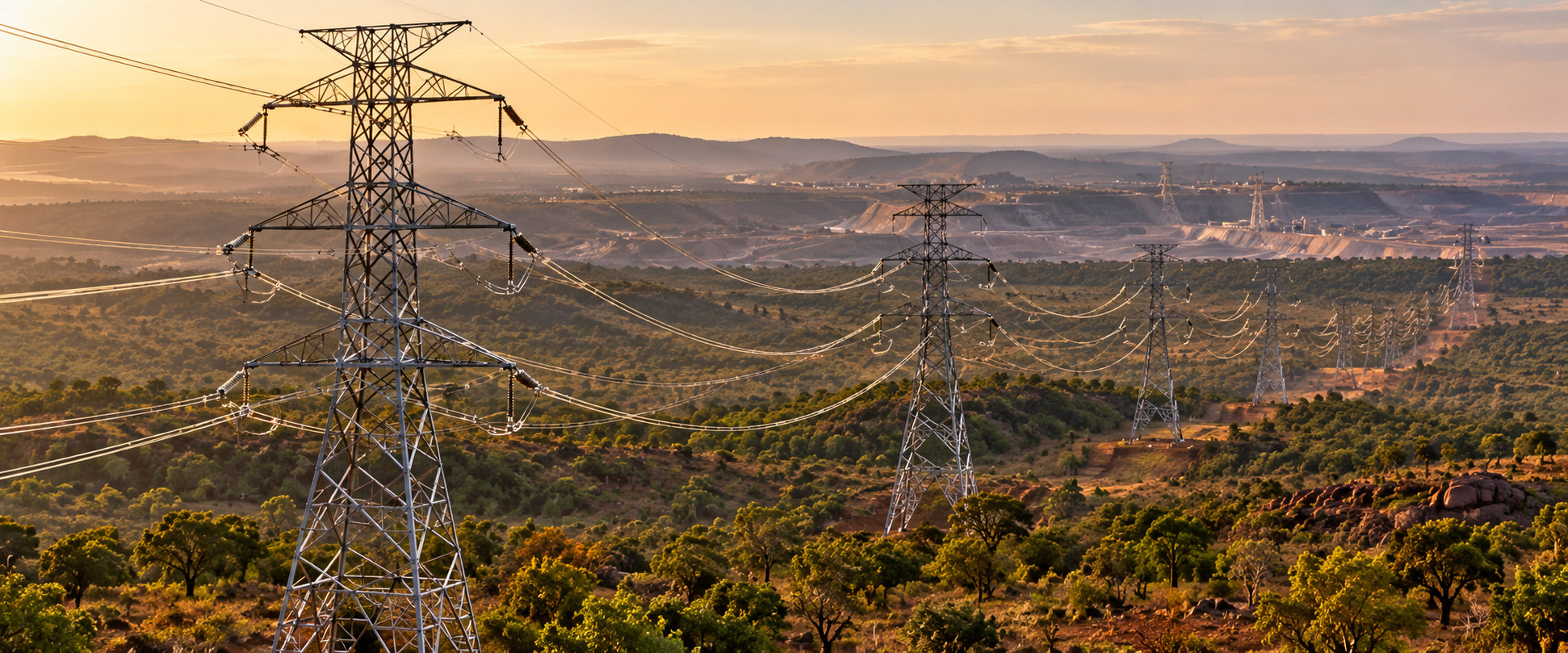
A new line from Zambia puts a price on the Copperbelt's power shortage. Collecting it depends on firm night-time electricity that the line cannot supply by itself.
For most of the past century, the ceiling on what Congo's Copperbelt could produce was set by geology, capital and the distance to the sea. Those constraints still bind, but electricity now sets the ceiling. It decides how much copper and cobalt the region mines, and how much of it is refined before export.
That is the context in which to read the estimate, attributed to Trafigura's Congo chief, that miners could save about $1 billion a year once a new line from Zambia is built. The figure is better understood as a price on the shortage than as a forecast.
Whether the $300 million Kalumbila–Kolwezi Interconnector can collect that value depends on something it cannot provide alone: electricity available at night and through a drought. ETA first noted the project in May, when it was costed at $250 million to $270 million. Its economics have since become clearer, and harder.
The deficit now has a diesel price
The mining region's shortfall is usually put at about a gigawatt. EnPower, the Congolese trader developing the line, projects it rising beyond 2,000 megawatts by 2030. A field study by Shanghai Metals Market found the grid meeting only about 40 percent of the Katanga mining district's needs.
Mines fill the gap with generators, and 2026 made that expensive. The same study traced a rise in Congo's diesel excise from $0.65 to $1.48 a litre between 2025 and March 2026, pushing generator power above $0.80 per kilowatt-hour; the underlying decree has not been published.
Kamoa Copper shows the arithmetic at site level. The mine draws 100 megawatts from SNEL against a 235-megawatt requirement that will reach 450 megawatts within five years, and runs generators to cover a gap of 20 to 40 megawatts. Its new solar and battery plant cut diesel use by about four million litres in a single month. The shortage is a running cost, paid by the litre.
What the interconnector adds
The case for the line is plain on the map. The one existing interconnection between Zambia and Congo is already saturated, according to its developer. The new line would run about 200 kilometres at 330 kilovolts, from a ZESCO substation on First Quantum's Sentinel mine property to Kolwezi. Its thermal capacity is 700 megawatts, with up to 550 megawatts of imports and a design that allows expansion beyond a gigawatt.
The financing roles are set out. Gridworks, owned by British International Investment, intends to hold most of the equity alongside Congo's strategic investment fund and EnPower. Trafigura is to arrange much of the debt. Every licence and concession is in place.
What the line supplies is a route into the Southern African Power Pool for electricity generated elsewhere, at a modest cost against the fuel bills it could displace. It adds no generating capacity. Its value rests on the power that can be bought at the Zambian end and the terms on which it can be sold at the Congolese one.
Financing has slipped before
The 6 October agreement is a framework, and the record argues for reading it as one. Ecofin reports that the partners have disclosed neither their individual commitments nor a date for financial close. The sovereign fund's participation remains subject to due diligence.
In May 2025, with Zambian regulatory approval secured, the International Finance Corporation was lead arranger and financial close was targeted for mid-2025, on a budget of $250 million. That date passed. The budget has since risen by a fifth, the debt arranger has changed, and the IFC's current role has not been explained.
Some of the delay is structural. A cross-border line answers to two regulators, two utilities and two currencies, and the partners describe this one as the first privately developed and financed cross-border transmission project on the continent. Lenders price that novelty. Long gestation is normal in these conditions, and none of this disqualifies the project. It does mean the $1 billion saving belongs to a project that has yet to show it can be financed.
Zambia's new surplus is mostly a daytime surplus
Supply is partly secured. EnPower reports a 350-megawatt supply agreement with ZESCO, and its project page still presents Zambia as a country in structural surplus.
The past three years complicate that description. In February, Zambia was still importing about 511 megawatts to meet domestic demand. Recovery since has been rapid. ZESCO ruled out a return to nationwide load-shedding in June, and by October installed capacity had reached 4,722 megawatts against peak demand of about 2,400.
The composition of that growth is the detail that counts. Solar rose from 178 megawatts in 2024 to 1,027.5 megawatts, and the President warned that transmission and distribution were falling behind generation. Zambia has added capacity quickly, but much of it produces only while the sun is up. A concentrator, a smelter and the pumps that keep an underground mine dry run through the night. Installed capacity measures what could be generated at noon in a wet year; a mine is billed for what arrives at three in the morning in a dry one.
Drought makes firm power the scarce commodity
Night-time supply in the region leans heavily on hydropower, and hydropower depends on rain. In mid-October, the Zambezi River Authority cut the 2027 Kariba allocation from 36 to 23 billion cubic metres, leaving ZESCO and Zimbabwe Power Company 11.5 billion each, on a regional outlook pointing to drought. The decision does not fix next year's output. It narrows the margin of the one resource that can carry a mine through the dark.
That is the hidden dependency in the line's economics. Daytime solar from Zambia can displace daytime diesel in Congo cheaply. Displacing night-time diesel requires storage, thermal plants, hydropower or firm imports wheeled across ZESCO's network from further south, each at a higher price.
The joint statement does not say what share of the 550 megawatts will be firm, what tariff miners will pay, or what wheeling will cost. Those three figures will decide the value of the line more than its capacity rating, and none of them appears in any public document.
The $1 billion is a bet on utilisation
The saving has been attributed to industry studies that have not been published, so it can be tested only from first principles. If the line carried 550 megawatts at 80 percent utilisation, it would deliver about 3.85 terawatt-hours a year. At a net saving of $0.25 a kilowatt-hour against diesel, that is roughly $960 million.
The headline survives this arithmetic only if three conditions hold together. The line must run close to full around the clock. Nearly every imported kilowatt-hour must replace generator power rather than cheaper grid supply. And the delivered tariff, wheeling included, must stay far below diesel.
Solar-heavy supply weakens the first condition at night. New load weakens the second, because power for a refinery that does not yet exist creates value but reduces no existing bill. The figure is best read as an upper bound on avoided fuel, blended with the value of output not yet produced. Published assumptions would let governments and investors separate the two.
Imports can recreate the enclave
ETA argued in May that captive mine power risks creating industrial islands, with reliable electricity inside the fence and little beyond it. Imported power arriving through a privately financed line raises the same risk at regional scale.
The joint statement pledges wider access for communities and businesses, and describes spare capacity on the line for the wider population. The gap that pledge must close is wide. About 22.5 percent of Congolese had electricity in 2024. Congolese rules require private producers to set aside at least 10 percent of output for communities near rural production sites, but whether that obligation reaches power imported for resale has not been addressed.
The likelier route to wider benefit is indirect. Mines that switch to imports could release SNEL capacity for other users, much as ETA has described in Zambia's mine-anchored market. That outcome depends on allocation rules, distribution investment and affordable tariffs, none of which a high-voltage line provides. Without them, the mines gain a second source of supply and the city around them keeps its first.
What would make the savings real?
The Copperbelt's power deficit is real, its diesel bill is rising, and a $300 million line is cheap against the output it could unlock. That output includes the downstream processing that, as ETA's reading of the IEA's 2026 minerals outlook showed, still lags the region's mining. Reliable power is also a precondition of the greater control over its minerals that Kinshasa has pursued.
The test of this project will come at financial close, and it will turn on supply contracts rather than steel. A credible structure would show three things: how much of the 550 megawatts is firm and from which generators beyond ZESCO, what miners will pay once wheeling is added, and how released or spare capacity reaches customers outside mining.
Those are commercial details, but they are also public policy, because the line will shape who in the Copperbelt receives reliable power for years to come. Until those terms are public, the $1 billion measures how much the Copperbelt would pay for reliable electricity. It is not yet evidence that the region will get it.