Climate Finance Is Becoming Africa's Industrial Strategy
For years, Africa has entered the climate finance debate carrying a moral argument. The continent contributed relatively little to the emissions warming the planet, is disproportionately exposed to the consequences, and wealthier economies that industrialised on fossil fuels owe a debt in return. That argument remains valid, but it is also becoming insufficient, because a different climate finance contest is now taking shape, one concerned less with who owes whom and more with who will manufacture the batteries, refine the minerals, produce low-carbon steel and own the infrastructure of the next industrial economy. For Africa, climate finance is no longer only about paying for solar panels. It is becoming industrial policy conducted through balance sheets.
The numbers behind the old argument remain severe. The African Development Bank puts Africa's climate financing gap at more than $213 billion a year through 2030, with only about 23% of the continent's climate finance mobilised domestically, against 95% in East Asia and the Pacific. The IEA says Africa holds roughly a fifth of the world's population but attracts only 2% of global clean energy investment, even as private clean energy investment on the continent has grown from around $17 billion in 2019 to nearly $40 billion in 2024. Those figures are usually read as evidence that Africa needs more finance, and it does. But volume alone obscures the more useful question: what is the finance being used to build? There is a real difference between financing a solar project whose equipment is imported and financing an industrial ecosystem in which cheap electricity supports manufacturing, processing and exports, and several African countries are beginning, unevenly, to show that difference in practice.
Morocco is financing a position, not just power
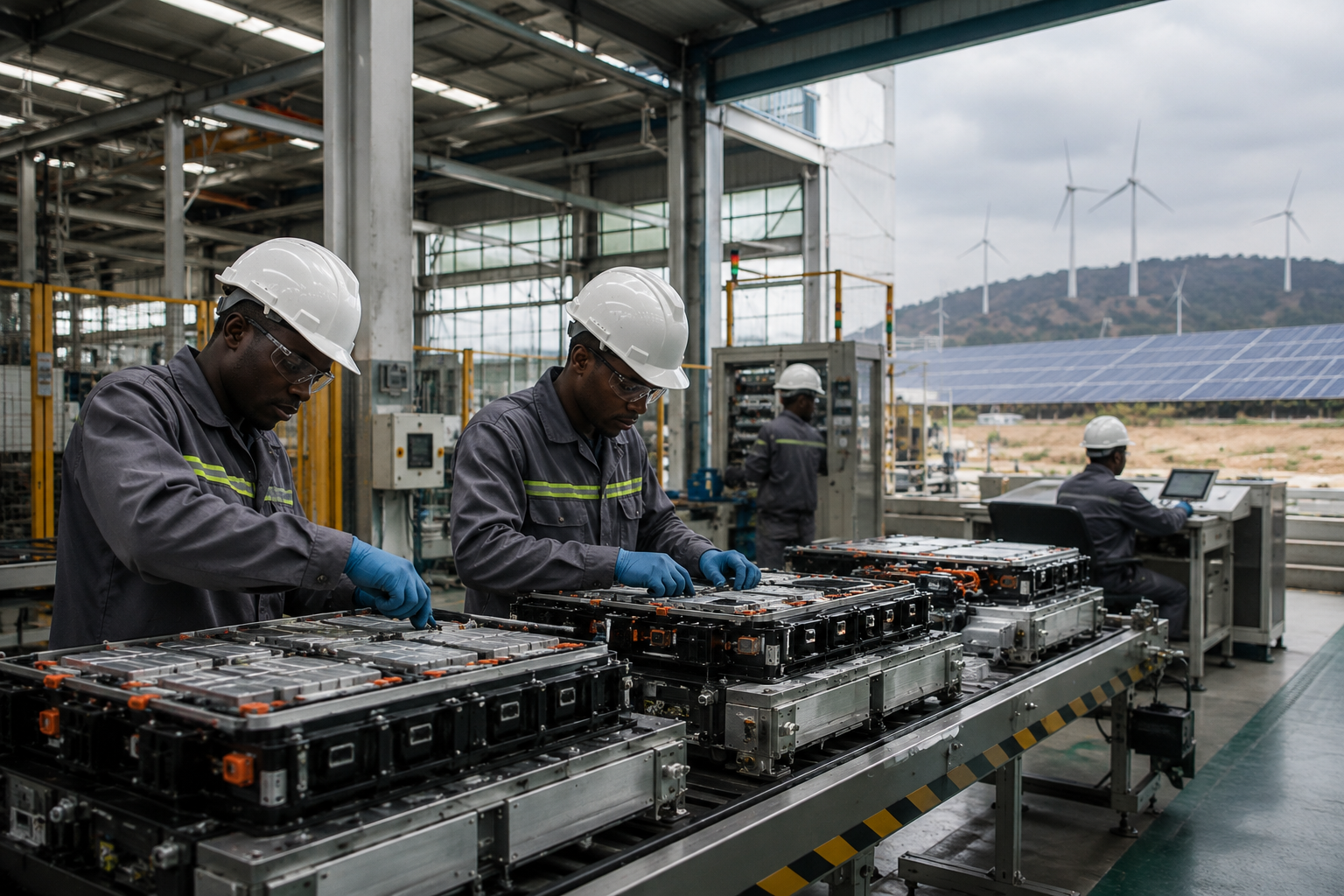
Morocco is Africa's clearest example of climate policy merging with industrial strategy. Its advantage was never simply that it built solar and wind capacity; it connected energy policy to an established automotive manufacturing base, ports, trade agreements and industrial parks, and that ecosystem is now moving toward batteries. In July 2026, the African Development Bank approved a €100 million loan to Gotion Power Morocco to build what the Bank calls Africa's first integrated lithium iron phosphate battery gigafactory, covering the full chain from cathode materials to battery cells in the Rabat-Salé-Kénitra free trade zone. The Bank is seeking to mobilise a further €141 million from financing partners, and the first phase is expected to create more than 600 direct jobs at a 70% local industrial integration rate.
That is climate finance doing something materially different from funding another generating plant: it is financing a position in a global manufacturing chain, which helps explain why Morocco overtook South Africa in the AfDB's latest industrialisation index, a shift the Bank attributes to sustained industrial upgrading and export diversification. Morocco is investing in the electricity system behind that expansion too. The World Bank approved $265 million in July 2026 for the Ifahsa pumped-storage hydropower project near Chefchaouen, a 300-megawatt facility designed to let the grid absorb at least a further gigawatt of solar and wind reliably. A battery factory and a pumped-storage plant may look like they belong to different sectors, but they don't. One is an industrial asset; the other is the electricity system that makes industrial assets competitive, and that pairing is what an integrated climate finance strategy actually looks like.
South Africa is discovering that decarbonisation is competitiveness
South Africa's transition began as an electricity security problem and a coal transition problem. It is increasingly becoming an industrial competitiveness problem instead. Government reforms have produced a pipeline exceeding 220 gigawatts of renewable projects, with roughly 36 gigawatts already in the grid connection process, and President Cyril Ramaphosa has described decarbonisation as part of the country's investment strategy, tying renewable power to electric vehicles, batteries and critical minerals.
Industry is already moving faster than the national debate: mining companies are increasingly procuring renewable electricity to cut exposure to Eskom, lower operating costs and meet the carbon requirements of international customers, with Anglo American's Envusa Energy venture targeting 3,000 megawatts by 2030 and Sibanye-Stillwater's renewable procurement expected to cover 64% of its South African electricity demand by 2028.
That response is not sentiment, but a reaction to a real commercial signal, since a tonne of metal produced on increasingly low-carbon electricity now has different market prospects from one produced on a carbon-intensive grid. The EU's Carbon Border Adjustment Mechanism entered its definitive phase in January 2026, placing a carbon price on embedded emissions in imports including iron, steel, aluminium, cement and hydrogen. Climate performance is migrating from sustainability reports into trade economics, and for African industrial economies, decarbonisation is increasingly a condition of market access rather than a virtue.
Egypt shows what a climate finance platform can do
Egypt's NWFE programme has tried to organise policy reform, development finance and private investment around a single national transition platform rather than financing projects independently. By March 2026, its energy pillar had helped mobilise roughly $5 billion, supporting 5.15 gigawatts of renewable capacity, according to the EBRD, which is also backing private-to-private electricity contracting, grid investment and a green supply-chain roadmap meant to help Egyptian exporters demonstrate low-carbon production to markets shaped by carbon regulation.
One element sits beyond the generation figure. Egypt is developing systems that would let companies verify products were manufactured using renewable electricity, specifically to strengthen competitiveness in export markets affected by carbon regulation. The renewable project stops being the end product of the finance; it becomes infrastructure supporting another economy, a more consequential measure of success than megawatts installed.
Nigeria reveals the limits of a green bond alone
Nigeria has been an African pioneer in sovereign green bonds, listing its third series, worth ₦47.355 billion, in May 2026. Its coupon is just as revealing as its green label: 18.95%.
Nigeria has built a domestic instrument capable of directing local capital toward climate projects, in an economy where that capital remains expensive, and that is the contradiction many African countries face. Domestic climate finance is essential because reliance on dollar-denominated foreign debt creates exchange-rate risk. But domestic borrowing can carry punishing interest costs of its own. Africa needs more than green bonds. It needs deeper pension and insurance markets, guarantees, local-currency lending, credible taxonomies and macroeconomic conditions that make long-term capital affordable, not simply more green-labelled instruments layered on top of expensive money.
Ghana shows why financial architecture matters
Ghana is attempting to build another piece of that architecture. Its Green Finance Taxonomy, the first in West Africa, establishes criteria for determining which activities qualify as environmentally sustainable across energy, transport, agriculture and buildings.
A taxonomy doesn't finance a solar farm. What it can do is reduce ambiguity: banks need to know what qualifies as green, investors need comparable standards, and governments need a framework through which incentives and public finance can be directed. The more important test for Ghana will be whether recent macroeconomic stabilisation eventually lowers borrowing costs enough for these instruments to matter at scale. A climate finance architecture operating on top of expensive money remains an expensive architecture regardless of how well the taxonomy is designed.
The next competition is over industry
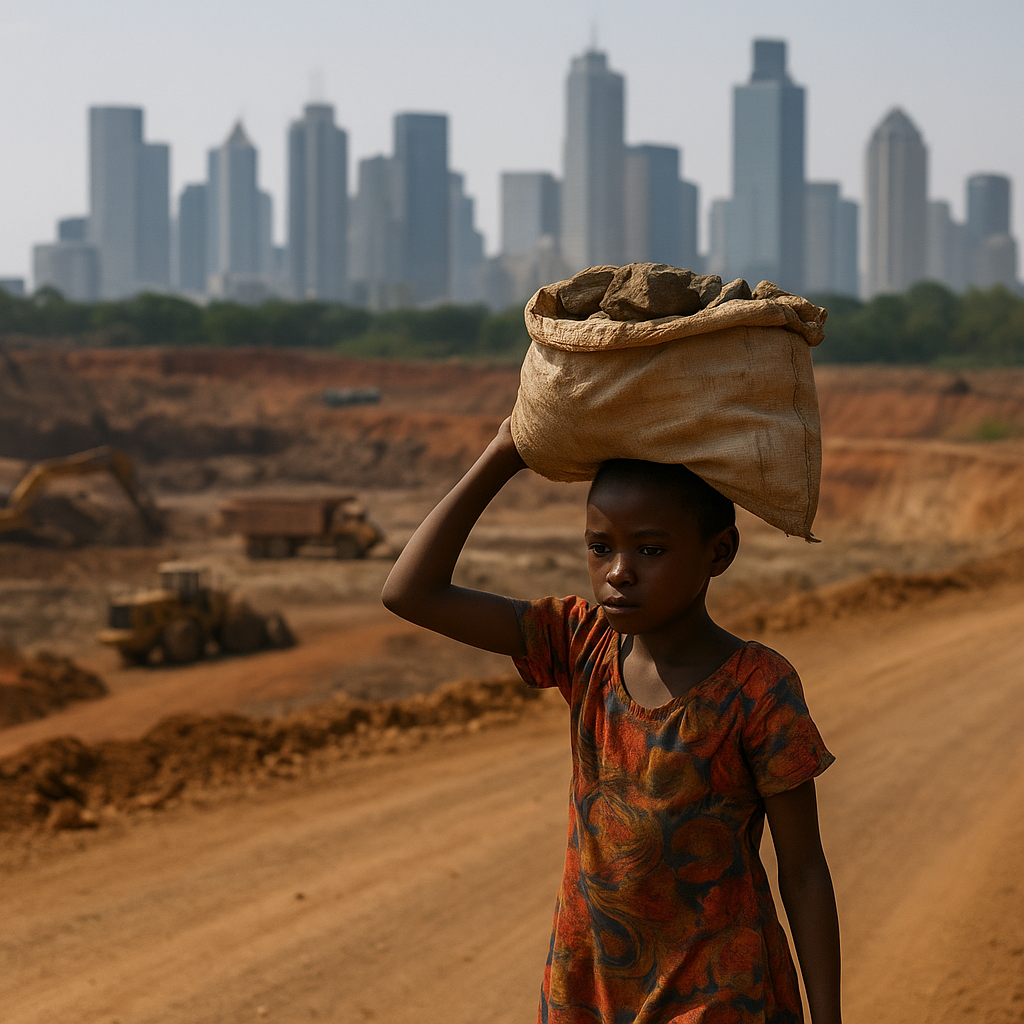
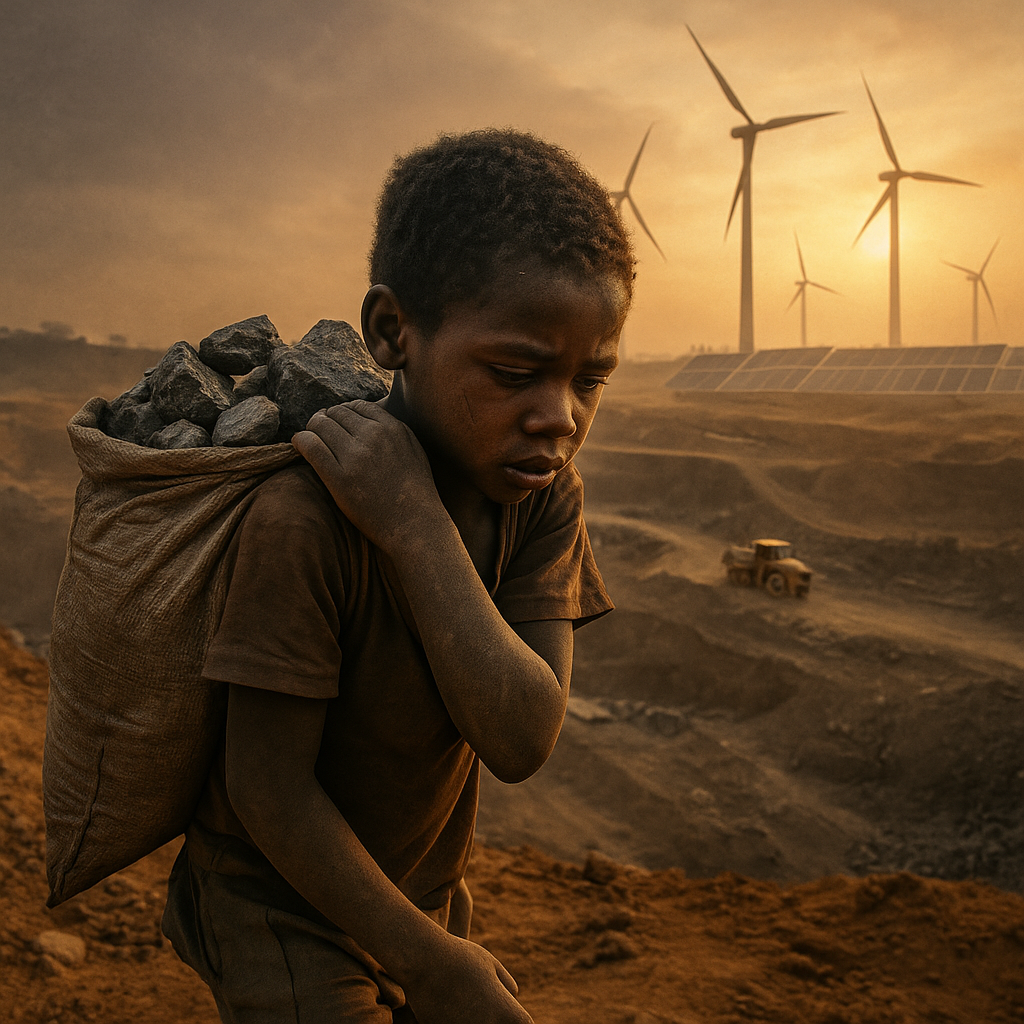
Africa should keep pressing for fairer international finance; current arrangements still leave African projects facing higher borrowing costs and currency exposure than comparable investments in wealthier markets. But waiting for the architecture to become fair isn't itself an industrial strategy. African governments still have to decide what they want climate capital to build: a solar farm, or a solar farm anchoring a copper-processing cluster; a green bond, or a domestic capital market that can finance transport and industrial efficiency at scale; a mine, or the electricity and logistics system that turns the mineral into battery material before it leaves the continent. Africa holds roughly 30% of the world's critical mineral reserves and captures less than 5% of the value added from them, a gap that has as much to do with the finance behind processing as with the minerals themselves.
The next phase of climate finance should be judged by more than emissions avoided or dollars mobilised: whether it lowered the cost of electricity, created domestic firms, protected exports, financed processing, deepened capital markets and left the economy more productive once the project was built. Morocco already understands this; South African miners are responding to it commercially; Egypt is building institutions around it, and Nigeria is trying to construct domestic instruments for it. Every other African economy will have to decide whether climate finance stays a line in environmental policy or becomes part of how it competes, because the countries that finance their transition strategically will not simply end up greener; they may end up richer, more industrial, and harder to bypass in the economy that comes next.