How African Energy Projects Actually Reach Financial Close
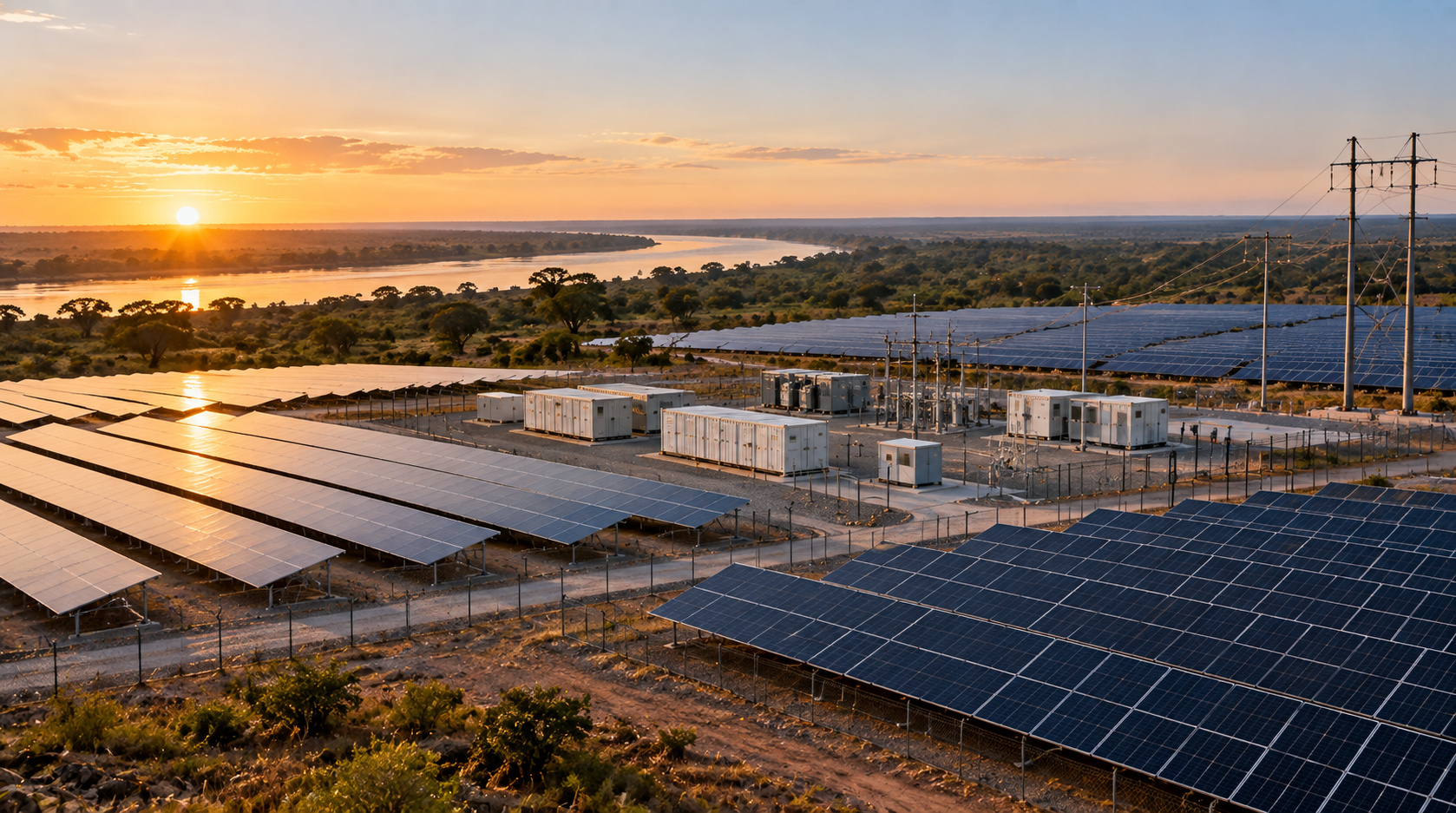
In January, a 32-megawatt solar project in western Zambia crossed a line that separates thousands of announced African energy projects from the relatively small number that actually get built. The Ilute Solar Project reached financial close. No solar panel suddenly began generating electricity that day, and construction had not yet produced a single kilowatt-hour. What changed was mostly invisible.
A group of lenders, including FMO, the African Development Bank-managed Sustainable Energy Fund for Africa, EDFI Management Company and Triodos Investment Management, had committed $26.5 million in senior financing. A private power-purchase agreement was in place with GreenCo. The contracts, risk allocation and financing structure had been accepted, and the project could finally start drawing money for construction.
That is what financial close means. And understanding how a project reaches it is essential to understanding Africa's energy-finance problem. Global energy investment is expected to reach $3.4 trillion in 2026, including about $2.2 trillion in clean energy. Capital plainly exists, yet the International Energy Agency says African project developers still struggle to turn potential investments into bankable assets, while the cost of capital for utility-scale energy projects on the continent is typically two to three times that in advanced economies and China. The missing part of the public conversation is what happens between those two facts. How does a solar farm go from a developer pointing at a piece of land to banks releasing tens or hundreds of millions of dollars? The answer is not one financing decision. It is a chain, and every link has to hold.
Stage one: development and feasibility ($1m-$5m, six months to two years)
Before institutional lenders take any interest, a developer has to establish that a site can support a commercially viable plant at all: resource assessment and preliminary engineering, land rights, a grid connection study assessing whether the network can actually absorb the electricity, environmental and social assessment, and financial modelling of construction costs, tariffs and revenue. All of this costs money before the project earns anything, and it is some of the riskiest capital in infrastructure, since a failed grid study, an unsuitable site or a licence that never arrives can mean the developer loses most of what it has already spent.
This is where the overwhelming majority of African energy projects actually end, and the IEA identifies this stage as Africa's central bottleneck: concessional finance is often least available where it is needed earliest, even though a project cannot be presented to a conventional lender until most of this work is already done. The African Development Bank's Sustainable Energy Fund for Africa, one of the four institutions that later financed Ilute, illustrates the shape of the problem from the funding side, having opened a 2026 programme offering up to $20 million in pre-investment support for a deliberately small cohort of three to five green hydrogen projects specifically to cover feasibility studies, engineering and transaction advice ahead of an eventual investment decision.
Stage two: The project needs permission and somewhere to send its electricity
Development work and permitting typically run in parallel. A project may require a generation licence, environmental approval, land documentation, planning permission and construction permits, and for a grid-connected plant, the connection agreement can matter as much as the generation licence itself; a 200-megawatt solar farm that cannot evacuate its power is not, commercially, a 200-megawatt asset. Every month of delay compounds directly into financing cost, since development capital usually carries interest and the investment window backing a project can close entirely before the permits do, which makes this stage the single largest source of project mortality after the initial feasibility attrition.
The World Bank's project finance guidance treats permits, planning approvals and land acquisition as conditions precedent that must be satisfied before financing becomes available at all. A developer can have secured land, measured an excellent resource and found an interested buyer, only to discover the nearest substation cannot accept the proposed capacity without a transmission upgrade nobody has yet agreed to pay for, at which point the project is still not bankable regardless of how good the underlying resource is.
Stage three: the power purchase agreement, the foundational document
The PPA is the single most consequential commercial document in the entire sequence, turning future electricity into future revenue by fixing the buyer, tariff, the duration, typically 20 to 25 years, and take-or-pay terms obliging payment for contracted capacity whether or not it is actually drawn. No lender commits debt without one, but a signature doesn't automatically make a PPA financeable, because lenders ask a harder question than whether a buyer has signed: can that buyer actually pay?
In much of Africa, the principal buyer is a national utility, and most are, in commercial terms, too financially weak for an international lender to treat their signature as reliable revenue on its own, which is why a 25-year promise from a distressed offtaker typically needs another layer of protection, a sovereign guarantee, before it counts as real revenue on a lender's model. Negotiating that guarantee is a separate process running in parallel with everything else, typically taking 12 to 18 months and consuming real political capital inside a finance ministry with its own competing priorities.
Ilute took a different route entirely. Rather than negotiating a sovereign-backed PPA with ZESCO, the developers structured the offtake as a merchant contract with GreenCo, converting the offtaker-creditworthiness problem into a market-access problem instead. That route isn't available to every project or every country; it depends on a functioning regional power market existing in the first place, and on a trader like GreenCo carrying enough credibility of its own to substitute for a government's.
Where it is available, though, it demonstrates something the standard sovereign-guarantee model does not: a project can reach financial close without adding to a government's own balance sheet risk, precisely the point Serengeti Energy's own leadership made in describing the deal as reducing dependence on government guarantees while still delivering bankable, investable power.
Stage four: equity commitment (20-30 percent of total project cost)
Once a project has a credible commercial structure, its sponsors capitalise a special-purpose vehicle that owns the project, signs the contracts and borrows the construction money, with shareholders supplying equity and lenders supplying debt. Equity absorbs losses first: the World Bank's own guidance describes it as first in, last out, since shareholders sit behind lenders in the repayment hierarchy and accept correspondingly more risk. For a $100 million project financed three-quarters with debt, shareholders still need $25 million of their own capital genuinely at stake, a commitment that tells lenders the developer has real exposure to the project's success rather than simply arranging other people's money.
This is one of Africa's less visible financing gaps: debt financiers generally will not take on the earliest, riskiest layer of exposure themselves, which is why institutions such as IFC are building vehicles specifically to expand the pool of patient, long-term equity available to distributed energy companies, a gap Kwama Energy's own participation as an equity sponsor in Ilute, alongside Serengeti Energy, illustrates directly.
Stage five: debt structuring (70-80 percent of total project cost, 15-18 percent cost in Africa versus 3-5 percent in Europe)
Senior secured debt requires the signed PPA with a creditworthy offtaker, a government guarantee if that offtaker is a weak utility, every permit and approval in place, completed environmental and social due diligence, a credible engineering, procurement and construction contract, and full insurance coverage. What that debt actually costs is the clearest single number in the entire process, and the spread between Africa and Europe is determined overwhelmingly by sovereign risk rather than by anything specific to a project's own engineering or technology. A solar farm using identical panels and an identical construction contractor to a European equivalent will still carry a debt cost several times higher purely because of where it sits on the map.
Stage six: de-risking instruments (18-24 months to negotiate each, 12-24 months further to coordinate several at once)
Between the debt stack and the specific risks that keep commercial lenders away sit partial risk guarantees from the World Bank and MIGA, first-loss provisions from development finance institutions, political risk insurance, and currency hedging instruments. Each carries its own negotiation timeline running largely independently of the others, and when a single project needs several of these instruments simultaneously, as most do, the coordination between them typically adds further delay beyond what any individual instrument's own timeline would suggest, since each institution's due diligence and approval processes rarely run to a shared calendar. Ilute's own financing, blending concessional, development and commercial capital from four separate institutions into one $26.5 million senior package, is itself evidence of how much coordination this stage requires even on a comparatively modest 32-megawatt project: four lenders with four separate mandates had to arrive at one shared set of terms before a single dollar moved.
Stage seven: currency, the most common late-stage failure point
A project earns revenue in local currency and typically owes its debt in dollars or euros, a mismatch that can sit inside a project unnoticed for years until the local currency moves. Currency hedging instruments for the long tenors African infrastructure debt requires are scarce and expensive precisely where they are needed most, and this is, in practice, the single most common cause of deals collapsing at the final stage: projects that have already cleared feasibility, permitting, the PPA, equity and debt structuring still fail to close because no affordable hedge exists for the specific currency pair and tenor the deal requires.
Stage eight: financial close
Financial close is the point at which every condition precedent from the previous seven stages is satisfied simultaneously, every party signs every document on the same day, and committed capital actually becomes available to draw down against construction progress. The typical timeline from initial project identification to reaching that day is five to ten years in Africa, against two to four years in Europe. Ilute reached it in roughly two years from its first public PPA signing at COP28 in December 2023 to financial close in January 2026, a genuinely fast timeline by African standards precisely because its financing structure sidestepped one of the sequence's most common points of failure, offtaker creditworthiness, rather than because any single stage was skipped.
Why the sequence matters more than any single fix
The instinct when reading a list like this is to look for the one stage that, if fixed, would collapse the whole timeline. There isn't one. A government that resolves permitting delays still leaves a developer facing an insolvent offtaker at stage three. A guarantee facility that speeds up stage six still leaves the currency mismatch at stage seven untouched. Development capital that clears the 80 percent attrition rate at stage one simply produces more projects arriving, in sequence, at every other bottleneck further down the chain. Ilute matters less as a template every developer can copy than as proof that the sequence itself is not fixed in its details, only in its logic. A sovereign guarantee is one way to make a weak offtaker's promise credible to a lender. A merchant contract with a regional trader inside a functioning power pool is another, available where the underlying market infrastructure exists to support it.
Either way, the full sequence, feasibility capital spent before any revenue exists, permits and grid access secured in parallel, a buyer whose promise to pay lenders actually believes, equity committed before debt, and due diligence that tests every assumption the model depends on, has to be completed before construction money moves, and understanding that sequence, not simply restating that Africa's financing gap exists, is what actually explains why some projects take two years and most never arrive at all.