Africa's Solar Boom Is Twice as Big as Anyone Knows
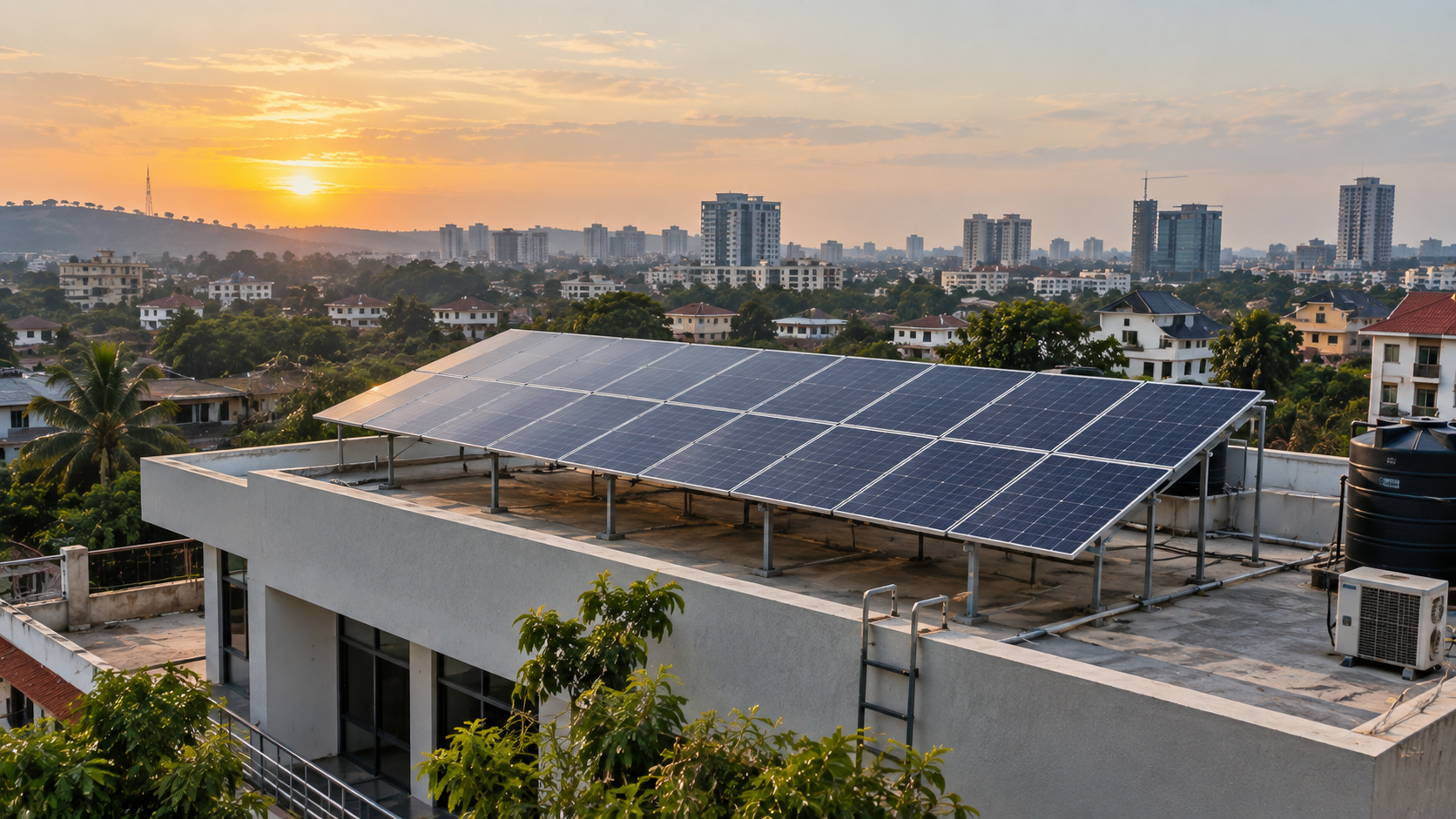
Nigeria installed 803 megawatts of new solar capacity in 2025, according to the Global Solar Council's Africa Market Outlook, a 141 percent jump that made it the continent's second-largest market behind South Africa, with roughly 96 percent of that capacity being off-grid systems, mini-grids and rooftop arrays, arriving outside any formal utility procurement process. That single figure captures the broader problem this piece is about: solar capacity that exists in the physical world well before it exists in any register a government or international agency consults.
A new analysis from Ember and the African Tech Futures Lab, published in late August, puts the continental version of that gap in stark terms. Ember estimates Africa installed 12 gigawatts of solar in 2025, nearly twice the International Energy Agency's official figure of 6.2 gigawatts for that year and more than two and a half times IRENA's 4.6 gigawatts. For 2026, Ember's own separate estimate, built from the same methodology, puts installations at 17 gigawatts, roughly 100,000 panels a day and the continent's third consecutive record year after growth of 25 percent in 2024 and 51 percent in 2025. The world's two most authoritative energy institutions are not merely undercounting Africa's solar boom. For the one year both sets of figures can be directly compared, they are missing more than half of it.
Why three-quarters of the boom is invisible by design
Ember's method starts in China. Because Chinese manufacturers supply the overwhelming majority of panels installed in Africa, customs records offer a near-real-time view of what leaves Chinese ports and where it goes, but an import isn't an installation, so Ember calibrated an installation rate against 368 gigawatts of solar deployed across the EU and five other markets over four years, where roughly 73 percent of exported panels are typically installed within six months, once adjustments are made for VAT-rebate-driven over-reporting of export values, falling spot prices at the point of shipment, and panels sitting in warehouses before use.
Applied to Africa, the method attributes three-quarters of the continent's solar growth between 2023 and 2025, roughly 20 of 26 gigawatts added, to distributed solar: small, customer-side systems installed mostly on rooftops, the category most difficult to measure anywhere in the world. Global Energy Monitor puts utility-scale additions over the same period at just 5.9 gigawatts, and IRENA records only 0.2 gigawatts of off-grid solar, figures unlikely to be significantly undercounted given how visible large procurement contracts are.
The Global Solar Council reached a converging conclusion independently in its own February 2026 report, finding utility-scale projects accounted for 56 percent of 2025's installed capacity while distributed solar, at an estimated 44 percent, was "clearly underestimated," since utility-scale projects have historically absorbed only around 15 percent of the panels Africa actually imports, leaving the remainder pointing to faster, less accurately reported growth elsewhere. Two separate research organisations, using different methods, are converging on the same structural blind spot.
That invisibility stems from more than poor data collection. Most African countries have no formal registration route for privately owned distributed systems, leaving installers no regulatory reason to report what they have built. Only three countries, South Africa, Tunisia and Tanzania, publish solar figures monthly or quarterly, and Ember could locate any official capacity reporting at all for just 36 of Africa's 54 countries, with only 14 of those covering 2025.
Some progress is under way: at least 15 countries have registration or permitting procedures at an advanced draft stage, South Africa runs a digital permitting platform used by more than 55 municipal utilities that captures each installation's location, and Eswatini and Namibia plan similar systems this September. But for now, as Joel Nana of the African Tech Futures Lab put it in the report, the transition under way is "chaotic and disruptive, and far from the orderly model planned in national strategies."
Where the boom is landing hardest
Thirty-six of Africa's 54 countries are on track for record solar installations in 2026, and 19 have posted year-on-year growth above 100 percent, led by the Democratic Republic of the Congo at 544 percent, Zimbabwe at 282 percent, Egypt at 176 percent and Zambia at 117 percent. South Africa, which once accounted for more than half of Africa's solar imports, is set to fall below a fifth of the continent's 2026 installations for the first time since 2019. Six countries now install more than a gigawatt a year: South Africa at 3.3 gigawatts, Egypt at 2.0, Nigeria and the DRC both at 1.7, Algeria at 1.4 and Morocco at 1.0. Senegal's additions between 2023 and 2026 alone are equivalent to almost 80 percent of its entire 2023 grid capacity; the DRC and Kenya are each adding more than half of theirs over the same window.
The more analytically significant list is a different one. In ten countries, home to a combined 190 million people, new solar added in 2026 alone will boost annual electricity generation by more than 10 percent: Sierra Leone at 97 percent, Togo at 24, Somalia and Djibouti at 21 each, the DRC and Comoros at 14 each, Namibia and Liberia at 12 each, Chad at 11 and Lesotho at 10. None of these countries features prominently in a major development-finance pipeline, a G7 guarantee mechanism or an investor conference agenda. In each, the informal, distributed solar economy is already delivering a scale of change the formal energy-transition conversation still treats as years away.
What the battery numbers actually mean
Since 2024, Africa has imported more dollars of batteries than solar panels from China; panel export values have doubled over two years, battery values have quadrupled, and Nigeria and the DRC are the largest markets, with battery imports now exceeding solar imports in both. That detail changes how the wider boom should be read. Batteries paired with solar in Africa's current deployment wave aren't primarily a grid-balancing technology. They are a diesel-replacement technology.
Chinese solar exports to Africa in the twelve months to June 2026 were worth $2.4 billion; generating the same electricity from diesel, at $1.40 a litre, would cost roughly that same $2.4 billion every three months, for a technology needing replacement every few years rather than lasting three decades or more. Africa's businesses, farms and telecom-tower operators are running that arithmetic one purchase at a time, without a subsidy or, in most cases, anyone counting what they have bought.
What the blind spot costs planners, and what would fix it
The consequences are concrete. The African Union's Continental Power Systems Masterplan forecasts just 23 gigawatts of total African solar by 2040, less than the 26 gigawatts Ember estimates were installed in the past three years alone. A planning document projecting less capacity by 2040 than has already been built shows a statistical system that cannot see what is being constructed. Where distributed solar is left out of national and regional planning, the risks are specific: utilities can overestimate future demand, procure generation nobody needs, or lock in fossil fuel capacity that then sits underused once solar arrives anyway. South Africa's 2025 Integrated Resource Plan, which estimates around 6 gigawatts of rooftop solar alongside utility-scale capacity, is close to the only national power plan on the continent built to see distributed generation at all.
The fix isn't universal surveillance of every rooftop panel, which would simply slow a market governments should be trying to understand. It is a different mix of evidence: customs records linked to installation estimates the way Ember has now demonstrated, anonymised sales data from importers and distributors, light-touch registration for larger commercial systems, and installer and inverter databases that let statisticians distinguish utility-scale, captive, rooftop and genuinely off-grid capacity from one another. None of this is a mystery to solve. It is a measurement problem to fix, and one considerably cheaper than the generation capacity misallocated when it goes unfixed.
Households, businesses and irrigation farmers are rational actors responding to a price signal that now strongly favours solar over diesel, and they are building the infrastructure of that response without waiting for a ministry or a donor to catch up. Africa's energy transition is arriving faster than the people responsible for planning the grid can currently measure it, and closing that gap in the data is now as urgent as closing the gap in the generation itself.