
African Energy Projects Are Funded to Be Built but Not to Be Maintained
The problem everyone knows, and the architecture nobody changes
The people who fund Africa's energy access programmes know that post-installation maintenance is where systems fail. They have known this for at least a decade. The World Bank knows it, IRENA knows it, and the Schatz Energy Research Center documented it explicitly in its quality assurance work with the Lighting Africa programme in Nigeria and Niger: historically, there has been a high failure rate for solar systems in many countries, often caused by poor maintenance and a lack of good operational practices following installation, even when initially high-quality system components are installed.
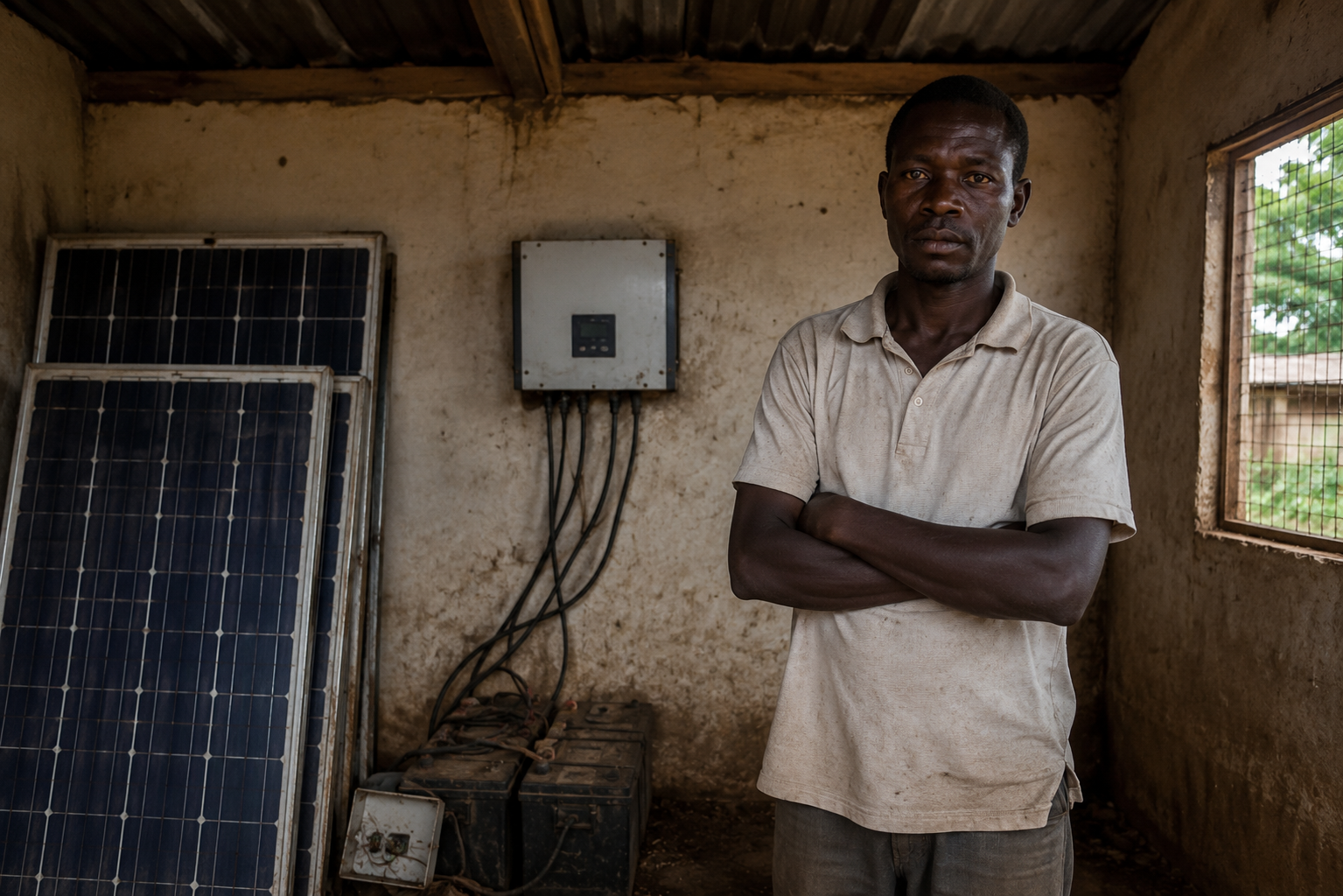
SolarAid's 2023 State of Repair report quantified the scale precisely: of 375 million solar energy kits sold and distributed to off-grid populations worldwide since the early 2000s, more than 250 million have fallen into disrepair. It estimated that 75 percent of all solar products in sub-Saharan Africa, approximately 110 million lights, no longer function. SolarAid further found that 91 percent of those non-functioning products were repairable and that 89 percent remained in rural households, meaning they hadn't been discarded., but simply been abandoned in place, inside the communities they were installed to serve.
And yet the financing architecture hasn't changed.
The reason is that every actor in the system is responding rationally to the incentive structure they face. The donor, implementing organisation, development finance institution, contractor, or the government ministry is behaving exactly as the architecture encourages. The aggregate result is a continent where energy systems are installed, declared successes, and allowed to fail. No individual actor is culpable. The architecture is.
This piece explains the four structural features of that architecture and what changing them would actually require.
The metric problem: installation is countable, maintenance is not
Development finance operates through measurement. Every donor-funded programme, results-based financing mechanism, and development finance facility relies on metrics that can be counted, attributed, and reported within a project cycle.
Installation is among the most measurable outputs in development finance. The number of solar systems deployed, households connected, clinics electrified, and megawatts commissioned are discrete outputs. They can be photographed, verified by an independent auditor, and published in an annual impact report before the programme closes. The World Bank's ESMAP, which has supported 182 World Bank energy access activities and mobilised $19 billion in external financing over its 2021–2024 business plan, measures and reports connections made, the moment of installation, not the years that follow it.
Whether a solar system is still functioning reliably three years after installation isn't an output within that framework. It is an operational condition that emerges long after the project cycle has ended, after the implementing organisation has moved to the next programme, and after the donor has published its impact report and disbursed its final tranche.
The metric architecture stops at installation. The operational life of the system continues.
This isn't a design flaw, but a design feature. ESMAP's results-based financing guide, the foundation for how most donor-funded energy access programmes structure their payments, ties disbursements to verifiable results at the delivery stage, such as connections made, systems commissioned, and households reached. Post-installation system functionality beyond a standard 12-month defects liability period doesn't appear as a payable result in any major programme ETA has reviewed. Yet lead-acid batteries, still widely used in off-grid solar systems across Africa because of their lower upfront cost, have an operational lifespan of 3 to 7 years, meaning the first replacement cycle falls entirely outside the window any existing metric architecture tracks or funds.
What gets measured gets funded. The architecture measures installation, while maintenance is the residual.
The attribution problem: failure prevented is invisible
The second structural feature is more subtle, and in some ways more intractable.
Development finance depends on attribution. Institutions must demonstrate that their specific intervention produced a measurable change. A new solar installation in a community that previously had no electricity is attributable with precision: the before-and-after is clear, the causal chain is direct, and the impact can be claimed without ambiguity.
Maintenance works differently. When a technician clears a fault code on a failing inverter at a rural clinic, the outcome is that electricity continues flowing. Medical equipment continues operating, vaccines remain refrigerated, and healthcare services continue uninterrupted. None of those outcomes appears as a new impact in any reporting framework, because none of them represents an improvement over the baseline; they represent continuation of the baseline. The prevention of failure is invisible because the failure it prevented didn't occur.
This creates a structural preference for new installations over maintenance of existing systems, even when the developmental return on maintenance investment is substantially higher. The perversity is precise: the more successful Africa's energy access programmes are at building an installed base, the larger the maintenance liability that base creates, and the more the attribution architecture steers resources away from maintaining it and toward new installations in communities not yet counted.
Consider the arithmetic of the current situation. Africa added 11.3 gigawatts of renewable capacity in 2025, according to IRENA data. That capacity will require active maintenance within three to five years, and no major donor or DFI programme has a funded mechanism to pay for it. The impact accounting framework that justified the installation can't justify the maintenance because it doesn't produce a new, attributable impact, but only preserves the impact that the installation already claimed.
The contractor problem: knowledge exits at commissioning
The third structural feature operates inside the delivery chain itself, at the specific moment when the entity with the most knowledge of a system transfers responsibility to the entity with the least.
Most African energy infrastructure is delivered through engineering, procurement, and construction contracts. The contractor designs the system, procures the equipment, builds the installation, conducts commissioning, and hands over at the end of the defects liability period, typically twelve months. The contractor is paid for delivering a commissioned system. That is the commercial relationship.
The contractor also happens to be the entity that best understands the system. They know the equipment specifications, the design assumptions, which components are likely to require attention first and what maintenance the system requires to function reliably through its rated lifespan.
None of that knowledge is required to transfer at commissioning. The standard EPC contract in donor-funded African energy programmes doesn't require it. The implementing organisation has strong incentives to ensure the contractor completes installation on time and within budget, because that is how programme metrics are met. It has comparatively weak incentives to require the contractor to build a local maintenance ecosystem, to train facility managers in fault diagnosis, to document spare parts supply chains, to design systems for maintainability by local technicians rather than visiting engineers, because none of those activities appears in the commissioning milestone.
The handover gap that results is a structural discontinuity. The party with knowledge exits, and the one without knowledge inherits responsibility. That new party is typically a school administrator, a health facility manager, a community committee, or a rural government office, with no technical training, maintenance budget, spare parts access, and no leverage over the contractor who built the system.
This is the specific moment at which most African energy systems begin their failure trajectory. UNICEF's documentation of cold chain technician training in Zambia, cited in ETA's analysis of health facility electrification, identifies the same mechanism from the health sector: delays in accessing specialised repair support routinely leave critical equipment unattended, disrupting services for months. The solution being piloted in Zambia isn't new technology, but the belated construction of the maintenance workforce and support architecture that should have been built before the first installation.
The public sector capacity problem: the institution designed to maintain has been hollowed out
The fourth structural feature is the most politically consequential.
In principle, responsibility for maintaining rural energy infrastructure should sit with national utilities, rural electrification agencies, and energy ministries. These are the institutions with the mandate, geographic reach, and, in theory, the resources to sustain operational support across an installed base.
In practice, many of these institutions have been systematically weakened over two decades of electricity sector reform that prioritised private-sector participation, cost recovery, and unbundling over public-sector operational capacity.
The private sector isn't willing to provide maintenance services in rural communities at prices they can afford. The public sector, meanwhile, has had its technical staffing and maintenance budgets reduced through reform conditionality that protected tariff reform and unbundling but didn't protect the operational capacity required to keep distributed rural infrastructure running.
The result is an institutional gap that sits at the end of every installation project, waiting. The contractor exits, and the public institution that should receive responsibility has no budget for the maintenance schedule, technical staff who know the system, and no supply chain for the components that will fail within three years. The community is left with the infrastructure and no support architecture for sustaining it.
What the architecture produces and what changing it requires
These four features form a mutually reinforcing logic. The metric problem means maintenance isn't funded; the attribution problem means it isn't valued; the contractor problem means the most capable provider exits at commissioning, and the public sector capacity problem means no fallback exists. Post-installation failure isn't an exception to the system's design. It is its predictable output.
Three reforms would change this. Holding a portion of programme disbursements in escrow, released only on verified system functionality five years after commissioning. Extending EPC maintenance obligations from twelve months to five years, with contractor payment structured across the operational period. And ring-fencing rural maintenance capacity within reform conditionality, protected with the same binding force as tariff reform.
Africa is building energy systems faster than the architecture can sustain them. That is not a technology failure. It is a choice.