How Much Electricity Would an African AI Economy Actually Need?

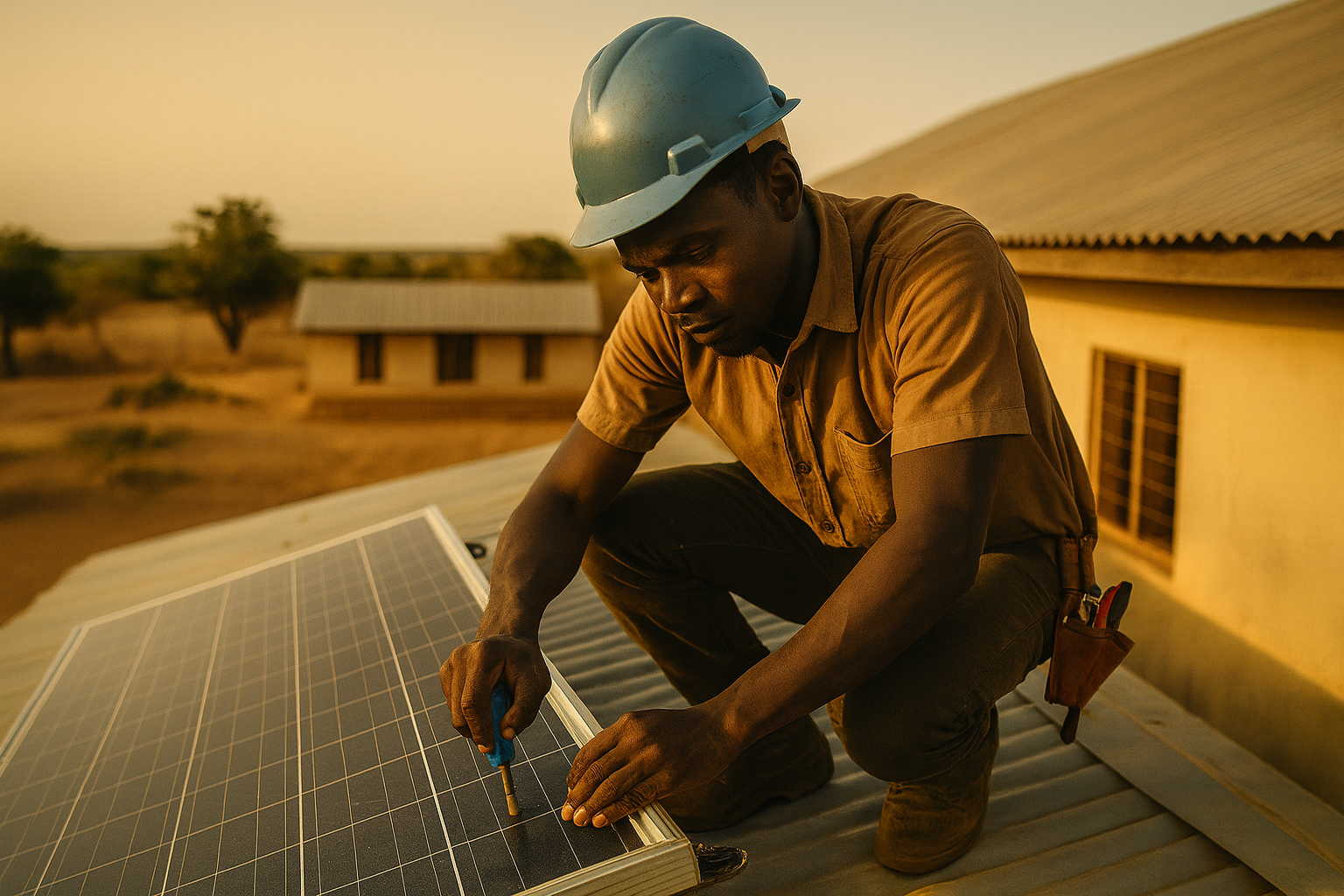
Last year in Lagos, one young engineer spoke with me about his plans to launch an AI-powered diagnostic tool that could screen for eye disease from a phone, cheap enough for a clinic in Kebbi State, for instance, to run without a specialist on staff. It sounded like a good idea to me. Then he told me where the model would actually run: on servers behind a hybrid of diesel generator backup and solar system, because the grid outside his office building gives him, on a good day, four hours of power.
Africa talks about AI the way it talked about mobile money a decade ago, as a leapfrog story, as proof that the continent can build its own digital future rather than simply consume someone else's. I believe that ambition is real and worth taking seriously. I also think almost nobody discussing it has actually done the arithmetic on what an AI economy costs in electricity, country by country, megawatt by megawatt.
Part of the problem, I think, is that we keep discussing AI and electricity in separate rooms. Our communication ministries talk about AI strategy, our energy ministries talk about generation targets, regulators talk about tariffs, and investment promotion agencies talk about attracting data centre capital. Each conversation is coherent on its own terms, and none of them recognises that an AI economy doesn't respect the boundary between these ministries. It needs all of them working from the same numbers at the same time, and right now, in most of the countries I work across, they are not.
The number that started this
In 2024, Africa's data centres consumed less than one kilowatt-hour of electricity per person, while the United States consumed 540 kilowatt-hours per person from data centres alone, in the same year. By 2030, the IEA expects Africa's figure to rise to just under two kilowatt-hours per capita. America's will pass 1,200. That isn't a gap I can round away or explain with better financing, because it is a physical distance measured in generation capacity that doesn't yet exist, and I don't think the investment conversation Africa is having about AI has priced that distance honestly.
The scale of what AI infrastructure actually consumes is worth sitting with. Global data centre electricity demand is set to more than double to around 945 terawatt-hours by 2030, slightly more than Japan's entire electricity consumption today. Training a model at the scale of GPT-4 takes roughly 50 gigawatt-hours, enough to power a medium-sized African city for months. Running it afterwards, answering millions of queries a day, needs one to two megawatts of continuous power for every ten million daily queries. An AI economy that actually served Africa's 1.4 billion people, health diagnostics, agricultural forecasting, and language translation, would need inference infrastructure running at tens or hundreds of continuous megawatts, before a single training run or cooling system is counted.
What Africa actually has right now
As of mid-2025, Africa has 223 data centres across 38 countries, less than 0.02 percent of the world's more than 11,800. South Africa has 56 of them, Kenya 19, and Nigeria 17, which means three countries hold 41 percent of everything the continent has built. McKinsey expects total capacity to grow from around 0.4 gigawatts today to somewhere between 1.5 and 2.2 gigawatts by 2030, requiring $10 to 20 billion in construction. I want that number to land properly: a Baker McKenzie assessment published this June put Africa's entire projected 2030 capacity at roughly the size of one large American AI campus. A single hyperscale facility of the kind Microsoft or Amazon builds in Virginia will consume more electricity on its own than every data centre Africa is expected to have running by the end of the decade.
I did my own arithmetic against Tracking SDG7's figure for Africa's total 2024 electricity generation, about 982 terawatt-hours. At under two kilowatt-hours per capita across 1.4 billion people, Africa's entire projected AI electricity demand in 2030 comes to roughly 2.8 terawatt-hours a year, under 0.3 percent of what the continent already generates. America's data centres alone, at 1,200 kilowatt-hours across 330 million people, will consume about 396 terawatt-hours, more than 40 percent of Africa's entire current electricity generation, spent on AI infrastructure by one country.
Nigeria and Kenya are not the same story
I keep returning to Nigeria and Kenya because they show how differently this plays out depending on what a country's grid actually looks like. Nigeria's 17 data centres need roughly 137 megawatts today and are aiming for 400 or more by 2030, on a national grid that averages under 5,000 megawatts of available generation for 220 million people, the same grid that has already pushed more than 60 percent of the country's manufacturers to build their own captive power because they cannot depend on it. Adding 400 megawatts of AI demand to that system is a request that the same gas payment chain, distribution losses and tariff shortfalls I have written about elsewhere finally get resolved, because a data centre cannot run on hope any more than a hospital can.
Kenya is a genuinely different case, and I think it deserves to be told as one. Its geothermal grid gives it continuous, reliable baseload, which has also made it the most credible data centre destination on the continent outside South Africa. But even Kenya has a limit, and I think it's instructive that we found it so quickly. A proposed one-gigawatt data centre campus, backed by G42 and Microsoft, was announced there in 2024. By mid-2026 it had stalled, because the government couldn't guarantee the annual capacity payments a load of that size required against a national installed capacity of only around 3,000 megawatts. President Ruto said supplying that single gigawatt in full would mean cutting power to roughly half the country.
One data centre. Half a country's electricity. That is what happens when a genuinely good electricity system meets a load an order of magnitude larger than anything it was built to carry. The difference between Kenya and the Gulf states now building AI infrastructure at sovereign scale isn't the electricity; Kenya has that, up to a point. It's the sovereign capital and the land banked at scale that the Gulf can deploy and Kenya, for now, cannot.
Learning from Ireland before we become Ireland
There is a country that already lives on the other side of this problem, and I think we should study it rather than simply admire its data centre economy from a distance. By 2024, data centres consumed 22 percent of Ireland's total metered electricity, according to Ireland's own statistics office, rising to 23 percent in 2025, more than every urban household in the country combined. That concentration has forced Irish regulators into new connection moratoria, and years of contentious grid planning they didn't choose so much as have been forced on them by a sector that grew faster than anyone modelled.
Africa is nowhere near that problem. Our difficulty isn't too much data centre demand chasing too little grid. It is the opposite: modest new industrial loads our grids still struggle to accommodate reliably, long before AI enters the picture at all. But Ireland's lesson travels in both directions. A large digital load can't be treated as an ordinary customer that simply shows up at the edge of the system and gets connected in due course. It has to be part of power system planning from the first conversation, not the last one, and that is the advantage Africa still has, and Ireland no longer does: we are early enough to plan for this rather than clean up after it.
What I think this arithmetic actually asks of us
I don't read any of this as an argument against Africa building an AI economy. The use cases, the demographic weight behind them, are real, and the case for hosting our own workloads rather than routing them through servers in Europe is one I believe in. But an AI economy needs electricity that is always on, always sufficient, and priced so the economics of running a data centre actually work, and outside Kenya and parts of South Africa, our systems are not yet giving that baseline to the factories and clinics that already exist, let alone to a new class of infrastructure layered on top. Every serious national AI strategy should be able to answer, in megawatts, where its compute ambitions will actually draw power from, and every energy plan should already be treating data centres as a coming source of demand rather than a surprise to be managed later.
That young engineer in Lagos is still building his diagnostic tool. I hope it works, and I think it probably will, because the model itself isn't the hard part any more. The hard part is still the four hours of grid power a day, and the hybrid power system, while the AI does something genuinely useful with the electricity it manages to get. If we build the AI economy before we build the electricity system underneath it, we will not have built an AI economy at all. We will have built a great many very expensive generators, and called it the future.