Copper, Cobalt, Lithium: The Six Minerals Africa's Energy Transition Needs
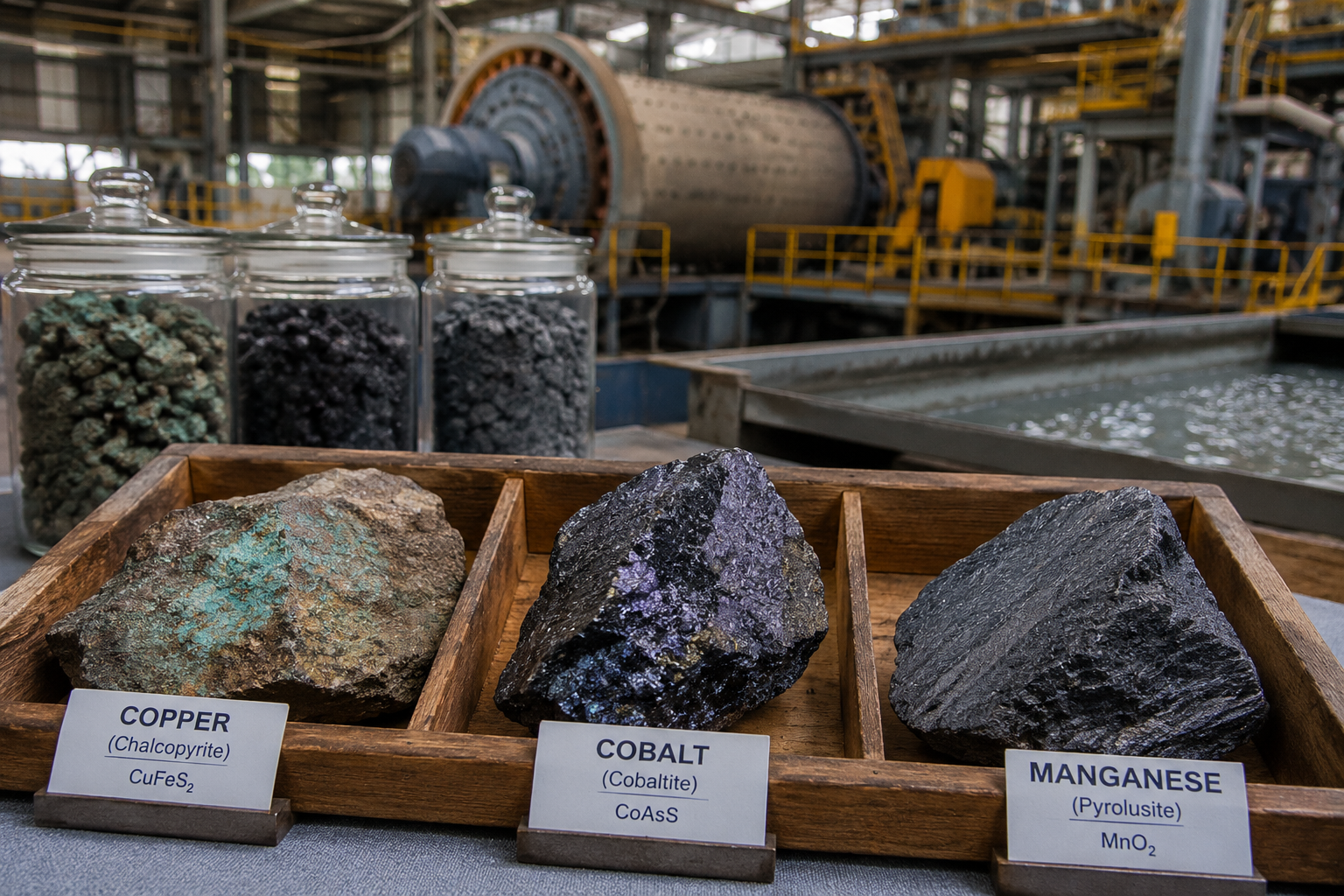
Coal, oil and gas are burned. The value lies in the energy released, not in the substance itself. But clean energy technology works the opposite way. A solar panel, a wind turbine, an electric vehicle battery and a transmission cable all contain specific minerals that become part of the object, mined, processed and manufactured into components before any clean energy flows at all.
That distinction is more important for Africa than for any other region, because the continent holds large reserves of several minerals this transition can't proceed without. Understanding which minerals, why those particular ones, and where Africa actually sits in the supply chain for each is where to begin in judging whether the continent benefits from the energy transition or simply supplies it.
Demand for these minerals has been growing at close to 10% a year, roughly ten times faster than for conventional metals, according to the IEA. Global battery demand grew more than 35% in 2025, passing 1.5 terawatt-hours, and lithium demand has grown around 25% annually over the past two years. Six minerals account for most of Africa's position within that surge: copper, cobalt, manganese, graphite, lithium and the platinum group metals. Each does a different job inside clean energy technology, and Africa's standing in the supply chain differs from one to the next.
Copper carries the current through everything
Copper conducts electricity, which makes it essential to solar panels, wind turbines, electric vehicles, battery storage and transmission infrastructure without exception. An offshore wind turbine needs more of it than an onshore one because the cabling to shore runs longer and at higher voltage; offshore wind alone accounts for nearly 40% of copper demand from wind energy despite making up only a fifth of new wind capacity. Demand is forecast to rise 30% by 2040, and the IEA expects supply from existing and under-construction mines to cover only around 80% of what will be needed by 2030.
Africa holds roughly 8 to 10% of global copper reserves, a smaller share than its production would suggest. The DRC and Zambia together produced about 4.2 million tonnes in 2025 and are, in the IEA's Global Critical Minerals Outlook 2026, identified as the single largest contributor to narrowing the world's copper supply gap through 2035, reflecting the unusually high grade of their deposits rather than the size of the reserve base beneath them.
Cobalt gives the Congo genuine leverage
Cobalt is where Africa's position is most concentrated. The DRC alone produces about 76% of the world's mined cobalt, and Africa as a whole holds roughly 54 to 55% of global reserves, according to the USGS's 2025 Mineral Commodity Summaries. Cobalt stabilises the chemistry inside lithium-ion batteries, and a typical EV battery contains 10 to 20 kilograms of it; demand from batteries alone is projected to rise 50 to 60% by 2040.
The DRC demonstrated exactly what that leverage looks like in 2025: an export ban in February, replaced in September by a quota capping exports at 96,600 tonnes, under half of the previous year's production, backed by a strategic reserve empowered to withhold or release volumes as prices move. Cobalt responded by approaching $58,000 a tonne in early 2026, more than triple the level a year before. The DRC has a clear opportunity, provided the leverage buys domestic processing rather than volatility; for now, most Congolese cobalt still leaves the country unrefined, headed mainly for China. That leverage also has a shelf life: some battery manufacturers are already moving toward lower-cobalt or cobalt-free chemistries to cut cost and supply risk, so the DRC's window to convert price power into lasting industrial capacity is not indefinite.
Manganese exposes how little of Africa has actually been mapped
Manganese does two jobs: it goes into battery cathodes, increasingly in chemistries designed to cut cobalt content, and it is essential to the steel in wind turbine towers and EV structures. Africa holds some 36 to 38% of global reserves, concentrated in South Africa and Gabon, and Gabon's own figures reveal an odd mismatch: it produces 23.2% of the world's manganese from just 3.6% of proven reserves, almost certainly because the reserves have never been properly explored. South Africa's Manganese Metal Company is building a $25 million plant to produce 5,000 tonnes of battery-grade manganese sulphate a year by 2026, rather than exporting standard ferromanganese as before.
Graphite is Africa's largest opportunity on a twenty-year view
Every lithium-ion EV battery uses graphite as its negative electrode, making it, by volume, one of the most important battery minerals, even though it draws less attention than lithium or cobalt because it is more abundant globally. China processes about 90 % of the world's battery-grade graphite, and Africa holds roughly a quarter of global natural graphite reserves, concentrated in Tanzania, Mozambique and Madagascar. The IEA projects those three countries could together supply about a third of the world's mined graphite by 2040, up from around 11% in 2025, exactly because China's processing dominance is driving the diversification effort, though the path isn't guaranteed: Tanzania's Mahenge and Nachu projects stalled after 2017 legislative changes frightened off investors, while Mozambique's sector has advanced more steadily.
Lithium's reserves are probably bigger than they look on paper
Lithium carries the charge in the batteries running EVs, grid storage and consumer electronics, and it is the mineral most associated with the energy transition in public conversation, with demand forecast to grow fivefold between 2025 and 2040. Africa's reported share of global reserves is small, about 1.6% according to the USGS, though widely considered an underestimate given how little exploration the continent has seen compared with established mining regions. Output still rose 44% in 2025, led by Zimbabwe and Namibia.
Zimbabwe commissioned the continent's first lithium refining facility in early 2026, a genuine step up from raw ore exports, while Namibia, Mali and the DRC advance projects of their own. Ghana's parliament ratified its first lithium mining lease, for the Ewoyaa project, in March 2026, though the project still needs roughly $185 million in financing before construction begins, a reminder that a ratified lease is a regulatory milestone, not yet a mine. Morocco's Gotion gigafactory in Kenitra, due to open in the third quarter of 2026, will process lithium into battery cells, taking Morocco further up the value chain than any other African country has yet managed in battery manufacturing.
Platinum group metals are South Africa's alone to lose
Platinum, palladium and rhodium, together known as the platinum group metals, go into hydrogen fuel cells, catalytic converters and the electrolysers that split water into green hydrogen. South Africa holds 79.3% of the world's PGM reserves and produces around 80% of global platinum output, a dominance more complete than Africa's position in any other transition mineral. With IRENA and the IEA both projecting significant electrolyser deployment through the 2030s, and platinum the catalyst material current electrolyser technology needs at scale, South Africa's endowment looks set to matter for the hydrogen economy roughly as much as the DRC's cobalt matters for batteries today.
The gap that decides whether any of this pays off
Refining concentration across these minerals reached a record in 2025, with the top refining country averaging a 70% share, up from 68% in 2020, and for most of these six minerals, that country is China. The DRC ships most of its cobalt unrefined to Chinese processors; Tanzania and Mozambique do the same with graphite. Zambia exports copper concentrate rather than refined metal largely because domestic smelting capacity, and the electricity to run it reliably, remain insufficient, a constraint ETA examined in its analysis of Zambia's 2026 copper export duty waiver. Zimbabwe's lithium refinery, commissioned this year, is the continent's first, for a mineral that has been commercially viable for years.
The pattern holds across all six: Africa mines, China processes, the world manufactures, and every step outside Africa is value retained elsewhere. Processing these minerals domestically is estimated capable of creating some 2.3 million jobs and lifting continental GDP by roughly 12%, a figure that measures the scale of what the current arrangement leaves uncaptured. The shortfall isn't primarily a failure of will; governments have announced beneficiation targets and export controls in reasonable measure. It persists because the conditions industrial processing requires, reliable electricity, water, trained engineers and affordable finance, are not yet in place at the scale processing demands.
What is different this time is who needs the fix. Governments in Europe, North America and Asia now treat concentrated mineral processing as an economic security risk, not simply an efficiency question, and are funding alternatives to it. That gives Africa leverage earlier commodity cycles didn't offer: the buyers now need diversified supply almost as urgently as African producers need investment. Mining determines where a mineral comes from. Whether Africa's transition moment becomes an industrial one will be decided by whether that leverage buys processing capacity while it is still on offer, or is spent on royalties and price alone.