The Human Gap: How the Just Energy Transition Is Outpacing Everyday People
New policy analysis by Nozuko Poni, The Human Gap: How the Just Energy Transition Is Outpacing Everyday People. Why benefits arrive without understanding.
Executive Summary
Every quarter, Independent Power Producers under South Africa's Renewable Energy Independent Power Producer Procurement Programme (REIPPPP) report against their economic development obligations, and those figures are checked, filed and carried forward. The programme's contracting architecture contains no equivalent requirement to show that the communities receiving those benefits have been meaningfully engaged, informed or made aware of what they received and why. This analysis argues that the gap is the predictable output of an accountability structure designed with a missing half, not a failure of individual trusts or companies. It defines meaningful engagement as verified comprehension, and proposes closing the gap inside the architecture government already enforces: an engagement obligation written into Schedule 2 of the Implementation Agreement, reported alongside economic development metrics, with a possible flow-down into trust deeds.
Key Findings
Economic development commitments are written into Schedule 2 of REIPPPP Implementation Agreements and reported to the IPP Office every quarter, with penalties for shortfalls. The Bid Window 6 standard-form Implementation Agreement contains no obligation relating to community engagement or awareness. Economic development counted for 30 percent of bid evaluation in Bid Windows 1 to 4, and became a pass-or-fail qualification gate from Bid Window 5. Research on REIPPPP communities repeatedly finds limited awareness of how trusts operate, how shareholding is financed and why income takes years to arrive. Government has acknowledged that compliance monitoring is weak, and relies largely on IPPs' self-reported data. Meaningful engagement should be measured as verified comprehension, not meetings held or attendance registers. An engagement obligation in Schedule 2 would use contracting machinery that already exists, without new institutions.
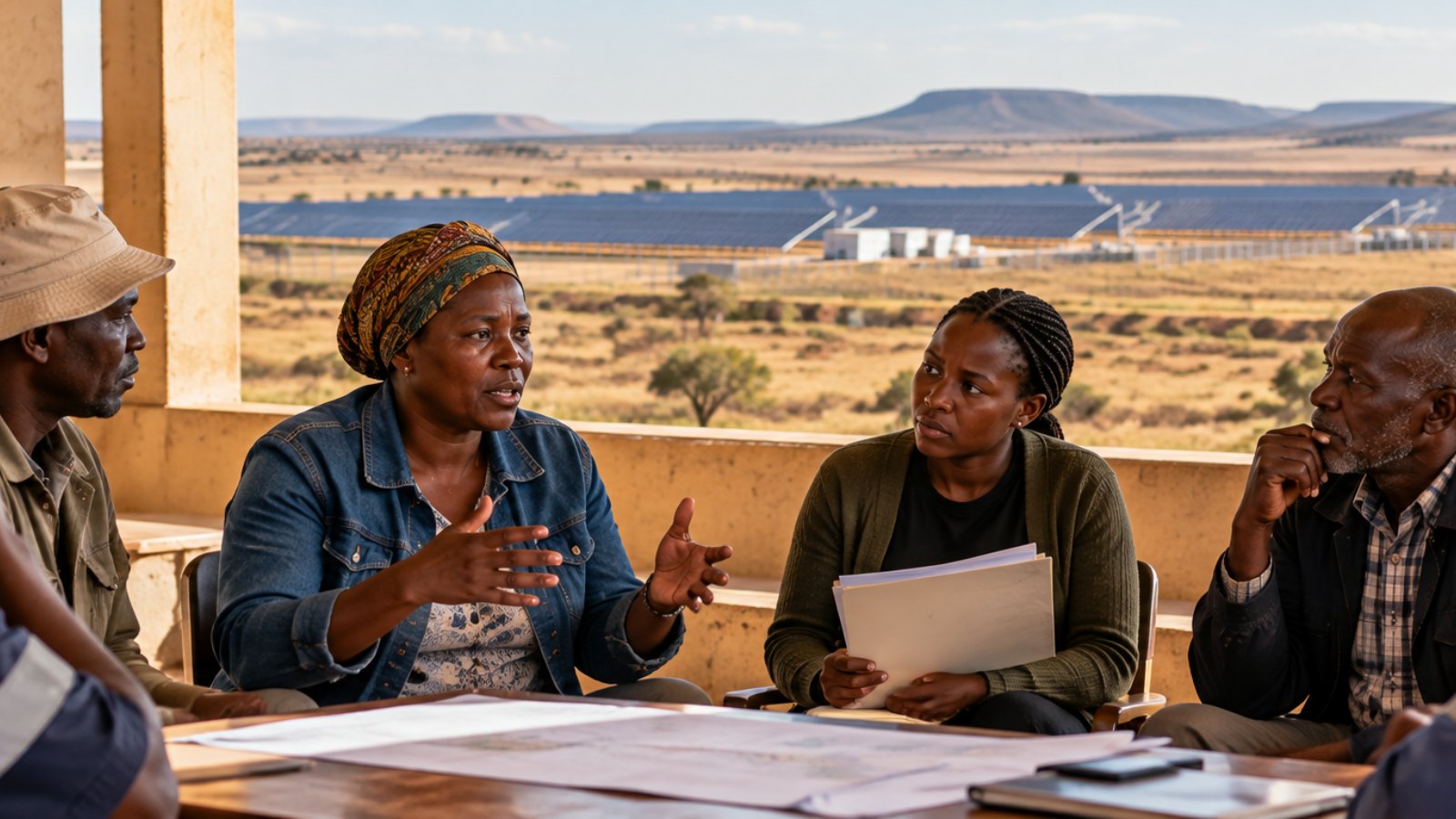
Every quarter, companies building South Africa's wind and solar farms report to government what they have delivered to their host communities: jobs, local content, enterprise development, and money flowing into community trusts. Those figures are checked, filed and carried forward, and shortfalls carry penalties. Nobody is required to report whether the communities receiving those benefits understand what they received, why, or how it relates to the energy transition.
Nozuko Poni, a communications and social impact practitioner and ETA Fellow, calls this the human gap. Her Signature Analysis argues that it is not a failure of particular trusts or companies. It is the predictable output of an accountability structure that government designed with a missing half.
Half governed, half left to chance
Under the Renewable Energy Independent Power Producer Procurement Programme (REIPPPP), economic development commitments are made at bid stage and written into Schedule 2 of the Implementation Agreement, the binding contract between government and each producer. In Bid Windows 1 to 4, those commitments counted for 30 percent of bid evaluation. From Bid Window 5, the weighting moved to 90/10, and economic development became a set of minimum qualification criteria that a bid must clear before price is assessed. Either way, the obligations remain contractually binding.
A review of the published Bid Window 6 standard-form agreement finds no equivalent obligation for community engagement or awareness. Trusts, producers, their funders and the department that designed the architecture all answer for how money moves. None is formally required to answer for whether communities have been informed or engaged. Poni is careful about one limit: signed agreements are confidential, so whether earlier agreements follow the same structure could not be verified.
What the research keeps finding
The pattern appears across a decade of research. A Wits Mandela Institute study of early projects found communities unaware of how their trusts operated, including the payback arrangements that determine when benefits flow. A study of two solar parks in Limpopo found local leaders waiting passively for benefits they did not know had been committed. A 2021 study, based on interviews with more than 80 people connected to the programme, found a widespread failure to explain how trust shareholding is financed and why income takes years to arrive.
That study also found trusts often set up for compliance purposes, and engagement work described by one practitioner as unplanned and absent from any metrics. Meanwhile, government itself has acknowledged that even the economic development side is weakly monitored, relying largely on producers' self-reported data.
Poni's explanation is structural. What government contracts for and requires to be reported becomes accountable. What sits outside that chain becomes diffuse or voluntary, left to whichever trust or company chooses to engage well.
Comprehension as the floor
The analysis offers a clear standard. A community has been meaningfully engaged when its members can explain what benefits they have received through the trust, why, and how those benefits relate to the project and the wider transition, and when that understanding has been verified directly with the community rather than reported on its behalf.
The standard deliberately sets aside counts of meetings held or attendance registers, which would reproduce the compliance logic the paper criticises. Comprehension does not guarantee communities influence over decisions, Poni argues, but influence is impossible without it. That makes it the right minimum for a contract.
Using the architecture that already exists
Her recommendation avoids new institutions. A community engagement obligation would be written into Schedule 2 of the Implementation Agreement, alongside job creation and local content, and reported against a verified comprehension measure next to existing economic development metrics. Government, as the author of the agreement, would hold that obligation first. A flow-down into trust deeds could extend it to trustees, although the paper treats its legal workability as an open question for further review.
The Independent Power Producers Office, which administers procurement and the economic development framework, is the primary actor. The Department of Electricity and Energy, as the government party to the agreements, would carry any contractual change. The Development Bank of Southern Africa could model the approach in its lending in the meantime.
The finding reaches beyond South Africa. Across the continent, benefit-sharing is becoming a standard feature of energy and mining projects. Poni's analysis is a reminder that money delivered to a community is only half of the transaction. The other half is whether the community can understand, question and direct what is being done in its name.
The full analysis, including five figures, the evidence on monitoring and the proposed contractual flow, is available to download.
Suggested Citation
Poni, N. (2026). The Human Gap: How the Just Energy Transition Is Outpacing Everyday People. ETA Fellows Programme Signature Analysis. Energy Transition Africa.