The World Has 16.6 Million Renewable Jobs. Africa Has 344,000.
For a continent frequently described as central to the world's clean energy future, that number is striking. But the most useful question raised by the International Renewable Energy Agency and International Labour Organisation's latest Renewable Energy and Jobs: Annual Review isn't why Africa has so few jobs, but where renewable energy employment is actually created, what kinds of jobs the continent's current transition produces, and how much of its own economic activity the statistics fail to see.
Read that way, the report describes something more exact than exclusion from a boom. It describes three separate gaps: a value-chain gap, because high-value manufacturing sits almost entirely elsewhere; a workforce-data gap, because much of Africa's decentralised solar economy isn't being counted; and an industrial-policy gap, because deployment isn't automatically converting into domestic industrial employment. None of the three is solved by the other two.
Africa's estimated renewable workforce actually grew faster than the world's, from 324,000 in 2023 to 344,000 in 2024, about 6.2%, against a global increase of only 2.3%. But its position remains small beside China, which alone accounts for 7.29 million renewable energy jobs, 43.9% of the world total, with Brazil at 1.38 million and India at 1.28 million. The lesson is that they capture more of what happens around deployment, not necessarily deploying more renewable energy.
More megawatts no longer guarantee proportional jobs
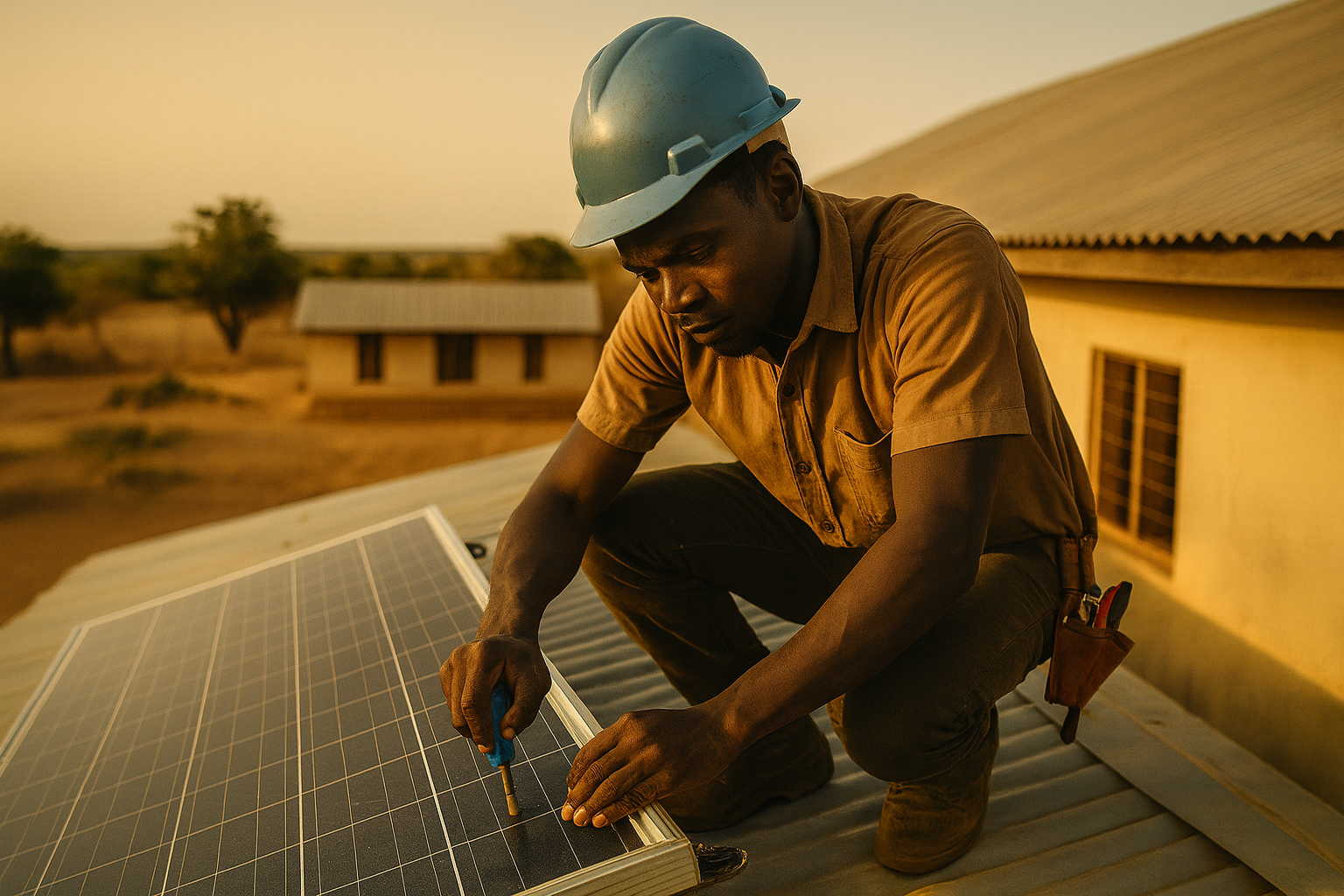
The report's first warning is that renewable energy employment rose only 2.3% in 2024 even as the world added record generating capacity, a gap the authors attribute to rising labour productivity, economies of scale, automation, and changes in the mix of what gets deployed. Utility-scale projects generate significant construction employment but need comparatively few workers once operational, and manufacturing keeps automating as it matures. Distributed rooftop solar behaves differently: it stays labour-intensive because every system needs its own sale, transport, site assessment, installation, and maintenance call.
For African governments, that distinction is important because the continent's green-jobs case has often rested on a simple equation: install more capacity and jobs follow, and this report is direct evidence that the equation is weakening. Deployment is an energy strategy, and it becomes an employment strategy only when policy deliberately shapes where equipment is manufactured, who installs it, which firms supply it, and what skills remain afterwards.
Jobs follow value chains, not resources
China's renewable workforce reached 7.29 million in 2024, with solar PV alone employing about 4.22 million people, more than twelve times IRENA's estimate for Africa's entire renewable workforce across every technology. That scale is inseparable from industrial structure: China produced 81.6% of the world's solar PV modules in 2024, across an integrated chain spanning polysilicon, wafers, cells, modules, and inverters, with global module manufacturing capacity reaching 1,554 GW. Africa received only about 4% of China's module exports that year.
Buying a solar module creates real economic activity in Africa; producing the silicon, wafer, cell, module, frame, inverter, and mounting system creates a larger and far more durable employment ecosystem. Natural resource potential alone tells us little about where renewable jobs accumulate. The countries capturing the largest employment benefits combine deployment with manufacturing, domestic supply chains, finance, and skills formation. The sun doesn't decide where these jobs are created; it is industrial structure that does.
Nigeria: a market moving faster than the statistics
IRENA records Nigeria's installed solar PV capacity at just 197 MW, including 124 MW off-grid. Chinese solar panel imports into Nigeria, meanwhile, rose from 861 MW in 2023 to 1.33 GW in 2024 alone, almost seven times the country's officially recorded cumulative capacity. IRENA concludes that official statistics appear not to capture a significant amount of rooftop installations.
That gap is worth being precise about. It demonstrates that deployment statistics are likely missing substantial activity; it does not, by itself, tell us the size of the workforce behind it, since some imported modules sit in warehouses or reach the market later. ETA has already reported the human side of that gap: installers trained through apprenticeship rather than certification, retailers selling inverters alongside unrelated goods, work that exists in Nigeria's solar economy without appearing in any employment category. What this report adds is the scale of the discrepancy in hard numbers. A workforce that cannot be measured is harder to train systematically, certify, or connect to industrial policy.
Nigeria's own response includes plans for a 1.2 GW solar assembly facility with the Rural Electrification Agency and Oando Clean Energy, and a proposed 1 GW facility with REA, InfraCorp, and Solarge carrying a local-content target. Factory announcements are not industrial transformation. What will matter is whether these plants reach sustained production, how much input value is sourced locally, and whether domestic suppliers form around them.
South Africa: job-years, not jobs, and a geography nobody planned
South Africa's Renewable Energy Independent Power Producer Procurement Programme has attracted roughly ZAR 239 billion in investment and procured 7.8 GW from 104 producers, generating 86,531 cumulative job-years of direct employment. A job-year is one full-time position lasting one year, not 86,531 people currently employed, and two-thirds of that total, 57,952 job-years, came from construction rather than the longer-lived category of operations (28,579).
The geography is harder to read past; the Northern Cape holds 52,705 job-years, 61% of the total, from 51 projects. Limpopo, KwaZulu-Natal, Mpumalanga, and Gauteng, provinces holding 63% of South Africa's population, share just 3,458 job-years across five projects, and KwaZulu-Natal reports none at all. The report does not identify a single cause; resource quality, land availability, transmission access, procurement history, and project economics can all play a part. What the data shows, without needing a stated cause, is that renewable investment does not automatically follow population or unemployment. Separately, IRENA estimates South Africa supported about 33,800 solar PV jobs in 2024, most tied to rooftop and private systems rather than the procurement programme. ETA has previously reported the other side of that figure: the volume of low-cost Chinese panel imports into South Africa that domestic manufacturers say is undermining a local industrial base, a debate now playing out at South Africa's own trade ministry over tariffs and local-content rules. This report's job-year data and that debate describe the same underlying gap from two different angles.
Egypt: deployment and industrial ambition moving together
Egypt's solar PV employment more than doubled to roughly 5,900 jobs in 2024, with wind rising from 4,000 to 5,200, alongside 734 MW of new solar and about 300 MW of new wind capacity. More consequentially, Egypt is attempting to localise manufacturing: a Sunrev Solar complex in the Suez Canal Economic Zone is designed for 2 GW each of cell and module capacity, with more than 1,800 direct jobs projected, and a second planned complex combining cells, panels, and battery storage is expected to add 841 more.
These are projected, not guaranteed, outcomes. But the direction illustrates the point that importing equipment and manufacturing it produce fundamentally different employment structures, and the realistic question for most African markets is not whether to manufacture everything, but which parts of the value chain their scale, skills, and demand can actually support.
What the report is careful to admit
IRENA is clear that its own estimates combine national statistics, industry data, and modelling that vary by technology and country, and that informal employment is especially hard to capture. Even the global movement from 16.2 million jobs in the previous edition to 16.6 million this year isn't pure job creation as it includes a revised estimate for Indian biofuels employment absent from the earlier count. Governments cannot announce green-job targets responsibly without knowing how many installers already exist, what they are qualified to do, and how much of that work is currently invisible to the state.
The report's inclusion findings show that women hold 32% of full-time renewable jobs globally, ahead of oil and gas's 23% but below the economy-wide average of 43.4%, concentrated in administrative roles (45%) rather than STEM (28%) or senior management (19%). People with disabilities, some 1.3 billion people worldwide, remain largely outside the sector's workforce, with only three in ten participating in the labour market at all, and those employed earning 12% less on average, more in lower-income economies. Africa's renewable workforce is still being built, which means exclusion doesn't have to be inherited from older energy systems, but it won't correct itself simply because the technology is cleaner.
IRENA models a pathway to 30 million global renewable jobs by 2030 and nearly 40 million by 2050, contingent on education, industrial policy, and stronger supply chains. For Africa, the opportunity is larger than climbing a share table. The continent needs to decide whether imported modules stay imported or get assembled and eventually manufactured regionally, whether rooftop technicians remain permanently informal or can be certified into firms that hire others, whether procurement programmes measure only megawatts or also lasting local supplier capability, and whether it can measure enough of its own energy economy to know if any of this policy is working.
Africa's 344,000 renewable energy jobs are a map of where it still has value to capture, across three gaps that require three different kinds of policy work.