Africa's Green Hydrogen Pipeline Has Almost No Final Investment Decisions
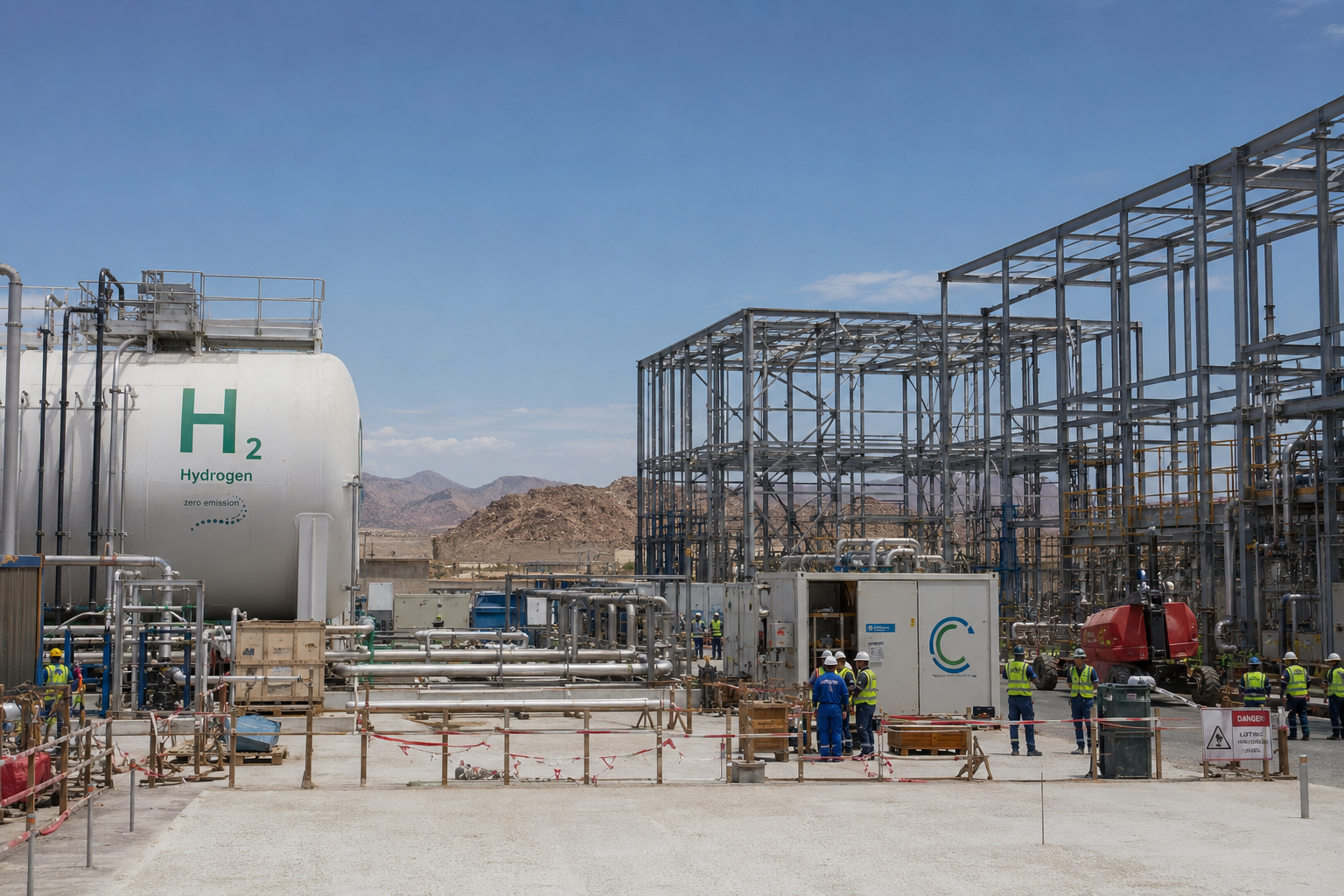
The frame is by now familiar. Africa has abundant solar and wind resources, which the IEA estimates have more than 1,000 terawatts of technical potential for solar and onshore wind, theoretically sufficient to produce over 45,000 million tonnes of hydrogen per year. Eight countries have formal hydrogen strategies, and the African Green Hydrogen Alliance has framed the sector as a vehicle for industrialisation, fertiliser sovereignty, and export revenues. Thirty-one projects are targeting production of 1.2 million tonnes of low-emissions hydrogen by 2030, covering 17 gigawatts of electrolyser capacity, with two-thirds of that concentrated in gigawatt-scale projects.
This is how Africa's green hydrogen ambition has been covered: as evidence of momentum, of the continent's renewable endowment finally attracting the capital it deserves.
The IEA's Global Hydrogen Review 2026 confirms that pipeline in scale, and also supplies the number that makes the momentum narrative more complicated than it appears. Of 17 gigawatts of announced electrolyser capacity targeting 2030, 2 percent has reached final investment decision.
One FID out of thirty-one
The IEA's analysis states that hydrogen project pipeline to 2030 has 31 projects, which could allow increasing production to 1.2 million tonnes, but only one has reached final investment decision (FID). The report doesn't name the project, and independent verification of which specific project has cleared FID isn't possible from public sources at the time of publication
The significance of the FID figure requires two baselines to be correct.
The first is current output. Africa produces approximately 6 kilotonnes of low-emissions hydrogen today, from electrolyser projects in South Africa (60 megawatts), Egypt (15 megawatts), and Namibia (12 megawatts). The 1.2 million tonne pipeline target represents a roughly 200-fold increase from that baseline. The gap between current output and announced ambition is a financing gap, a demand certainty gap, and an institutional gap between the project as announced and the project as bankable.
The second baseline is the existing hydrogen economy, which requires careful separation from the green hydrogen pipeline. Africa's total hydrogen use reached 3.1 million tonnes in 2024, roughly 3 percent of global demand. That consumption is concentrated in six countries: Egypt at nearly half, Algeria at 20 percent, Nigeria at 17 percent, South Africa at five percent, Libya at five percent, and Equatorial Guinea at three percent. Ammonia production accounts for nearly three-quarters of that demand. Approximately 90 percent is produced from natural gas reforming, with the remainder from coal and industrial by-products.
What "announced" actually means
The project-level picture illustrates the range of what "pipeline" currently covers. The IEA flags the 17-gigawatt pipeline as "difficult to bring to fruition in just 4 years". The average project size is 560 megawatts, and bringing that scale of electrolyser capacity to financial close, securing construction financing, procuring equipment, completing permitting, and commissioning infrastructure in a four-year window would be demanding in any market, worse still in African markets, where the financing conditions are structurally more challenging.
South Africa's Coega Green Ammonia Project represents the most advanced position. The $5.8 billion project developed by Hive Hydrogen South Africa, a joint venture between UK-based Hive Energy and South African infrastructure firm BuiltAfrica, will integrate 3.6 gigawatts of renewable energy with a 1.2 gigawatt electrolyser to produce approximately one million tonnes of green ammonia annually for export to Asia and the European Union.
The SA-H2 Fund has committed up to $20 million for development activities, with an option to invest up to $200 million in the construction phase subject to FID. The project holds Strategic Integrated Project status from the South African Presidency. Topsoe was selected as electrolyser technology supplier in May 2026 in a deal valued at approximately $1 billion. Front-end engineering and design is now targeted for Q3 2026, with FID expected by Q3 2027 and commercial operations projected for late 2029 or 2030. Coega is the pipeline's most advanced project, and it hasn't yet reached FID.
Namibia's Hyphen Hydrogen Energy project, a $10 billion-plus, 3 gigawatt development, received a $10 million pre-investment loan from the African Development Bank's Sustainable Energy Fund for Africa. The project has been working toward FID for several years. The $10 million pre-investment loan against a multi-billion-dollar project illustrates the scale mismatch between available de-risking instruments and the capital required.
Mauritania's Project AMAN, a $40 billion, 30 gigawatt initiative by CWP Global, was suspended in June 2025 after the developer was unable to secure long-term offtake agreements at commercially viable prices. The CEO stated that "there is nobody out there who wants to buy green or even blue ammonia at a price that works for producers." Development has since been described as continuing at "the pace of global markets", a formulation that means indefinite delay.
More broadly, Mauritania's hydrogen strategy target of 1.2 million tonnes of hydrogen as 6.9 million tonnes of ammonia exports by 2030, an investment of 22.7 billion USD by the end of the decade, equivalent to approximately 20 times the country's current GDP, also saw its two largest land-concession agreements, accounting for 20 of the 23 million tonnes of announced ammonia capacity, put on hold.
Egypt's Ain Sokhna facility is the continent's first operational green hydrogen plant, but at small scale and distinct from the gigawatt-class pipeline. Egypt's SCZONE Globeleq Phase 2, targeting 1,945 kilotonnes per annum, remains at feasibility stage. The IEA flags Egypt's longer-range pipeline, including 1.9 million tonnes-plus, as "mega projects in very early stages... low likelihood of materialising in the short term."
Why the gap exists
According to the IEA's own diagnosis, financing costs are the dominant driver of hydrogen production cost in Africa.
The IEA presents weighted average cost of capital figures across African hydrogen-producing countries that make the mechanism visible. Tunisia and Ghana: approximately 16 percent. Namibia, Morocco, and South Africa: 6.6 to 8.3 percent. Germany: 2.3 percent. China: 3.6 percent. Each one-percentage-point rise in the cost of capital adds approximately 0.2 USD per kilogram to the levelised cost of hydrogen production. Financing costs account for 30 to 40 percent of total hydrogen production cost in most African markets. The same renewable resource that could produce hydrogen at 3.2 USD per kilogram in Morocco, the cheapest achievable cost in the IEA's regional analysis, would cost significantly more in markets where capital is more expensive, even if the sun shines equally.
Only two of Africa's 54 countries, Botswana and Mauritius, hold investment-grade sovereign credit ratings across all agencies. The sovereign ceiling mechanism ties the creditworthiness of energy projects to the country's rating. A commercially sound hydrogen project in a speculative-grade economy can't access capital at the rate that would make it bankable, regardless of its technical quality.
The second barrier is offtake certainty. Without firm, long-term contracts committing buyers to purchase green hydrogen derivatives at a specified price and volume, projects can't reach financial close. The AMAN suspension illustrates this, and so does the IEA's observation that the first H2Global renewable ammonia auction, which produced a seven-year Egypt-origin ammonia offtake agreement via Fertiglobe at a fixed euro price, represents one of the few concrete demand anchors available to the African pipeline. FID hasn't yet been taken on the underlying project.
The domestic versus export tension
More than 80 percent of Africa's announced low-emissions ammonia capacity targets export to European and Asian markets seeking to decarbonise their industries.
Africa's own nitrogen situation offers a different frame. The continent uses fertiliser at one-sixth of the global average, holds 20 percent of global cropland, but uses only 4 percent of global nitrogen fertiliser. The food trade deficit reached 22 billion USD in 2024. The African Union's 2024 Fertiliser and Soil Health Action Plan commits to tripling use by 2034, which would generate demand for approximately 1.5 million tonnes of hydrogen, close to the entire 2030 pipeline target.
The Moroccan case is the clearest example of this paradox within the pipeline. The world's largest phosphate reserve holder imports 3.6 million tonnes of ammonia annually, the molecule required to process its own mineral wealth at a cost exceeding 1.5 billion USD in 2024. State-owned OCP's green hydrogen ammonia projects targeting 3 million tonnes by 2032 are industrial input substitution, not export revenue logic.
What separates the projects nearing investment decision
The initiatives furthest along the pipeline share observable characteristics. Committed offtake partners are present: Coega's relationship with ITOCHU and European buyers; Kenya's Olkaria geothermal ammonia project, financed in full at 800 million USD by Kaishan Group with domestic and regional offtake. Government de-risking instruments are deployed at construction scale: South Africa's Strategic Integrated Project status, the SA-H2 Fund's 200 million USD construction option, the AfDB's 470 million USD partial credit guarantee to Morocco's OCP.
The projects furthest along are also in countries where the cost of capital sits at the lower end of the African range and where an industrial base provides domestic offtake. South Africa holds 89 percent of global PGM reserves, a supply-chain asset for PEM electrolysers. Kenya's geothermal grid runs at well under 200 grams of CO₂ per kilowatt-hour one of the few African power sources that meets green hydrogen certification thresholds.
These are observable patterns in a small sample, not a replicable formula.
Reading future hydrogen headlines through the FID filter
Two percent of announced pipeline capacity at FID is the number to carry from this report into the next wave of African hydrogen announcements. Every new gigawatt figure, every government signing, every headline pledge can be read against three questions: who has committed to buy the output, at what price, and for how long? What de-risking instruments are in place at construction scale? At what cost of capital do the project economics work?
Africa's resource base is genuine. Morocco's achievable production cost of 3.2 USD per kilogram is globally competitive. Algeria holds 80 percent of the region's sub-4.5 USD per kilogram potential. EU certification requirements are creating structural demand for documented low-emissions hydrogen from well-positioned exporters.
What separates that potential from a functioning supply chain is institutional: the offtake agreement, the credit guarantee, the certification scheme, the regulatory framework stable enough to attract commercial lenders.
One FID out of 31 projects is not a verdict. It is a precise description of the distance between announcement and bankability.