When the United States Walks Away: What Trump’s UN Climate Withdrawal Means for Africa’s Energy Transition
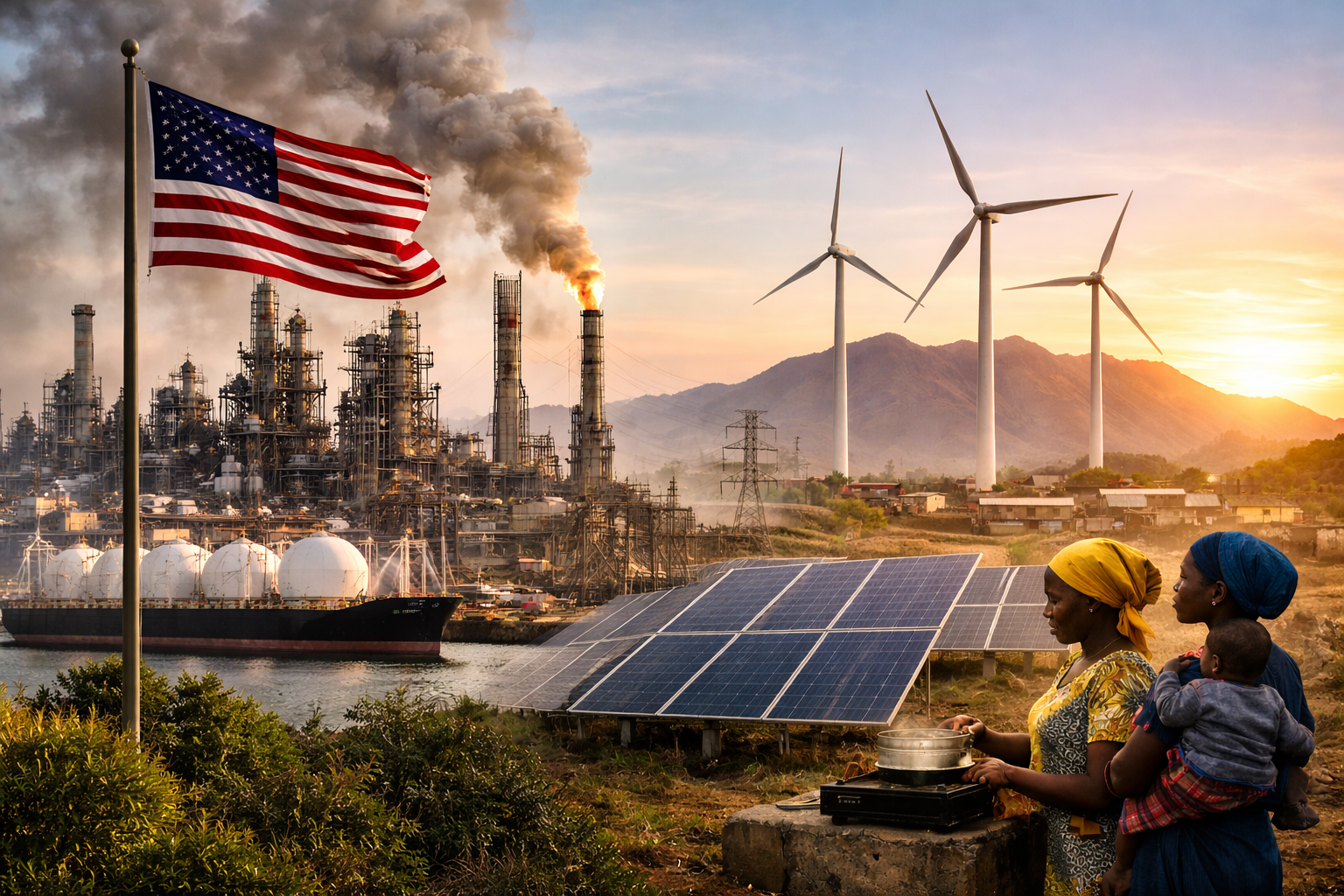
When the United States withdraws from global climate institutions, the consequences are never confined to Washington. They ripple outward through markets, multilateral banks, diplomatic alignments, and the fragile architecture of climate finance that many developing countries depend on.
President Donald Trump’s decision to withdraw the United States from the UN Framework Convention on Climate Change (UNFCCC) and associated climate bodies marks a rupture more profound than the earlier exit from the Paris Agreement. This is not a disagreement over targets or timelines, but a retreat from the very system that coordinates global climate action.
For Africa, a continent simultaneously grappling with energy poverty, climate vulnerability, and the demands of rapid development, this moment is both destabilising and clarifying.
The question is no longer whether global climate governance is fragmenting.
It is how Africa responds when one of its largest historical emitters walks away.
A Break from the Architecture, Not Just the Agreement
The UNFCCC is not a symbolic forum. It is the legal and institutional backbone of global climate cooperation, underpinning emissions reporting, adaptation planning, finance mechanisms, and scientific coordination.
By withdrawing from it, the United States is stepping outside the rules-based system that has governed climate diplomacy for more than three decades. According to Reuters, legal experts have already raised questions about the implications of withdrawing from a Senate-ratified treaty and about the difficulty of re-entry should political winds change again
For Africa, the immediate concern is not symbolism. It is predictability.
Climate finance, technology cooperation, and adaptation support are structured around UNFCCC processes. When a major actor exits, uncertainty rises, and uncertainty is costly for countries already struggling to mobilise capital for grids, renewables, and resilience.
Climate Finance in a More Fragile World
Africa’s energy transition is already underfunded. According to World Bank tracking, hundreds of millions of Africans still lack electricity access, while investment in clean energy falls far short of what is needed to meet development and climate goals
The withdrawal of the United States from UN climate institutions does not automatically eliminate all U.S.-linked finance. But it does weaken the credibility of collective commitments and complicates coordination among donors, development banks, and private investors.
Climate finance flows follow signals. When the architecture frays, capital becomes more cautious, more fragmented, and more conditional.
For African countries seeking long-term investment in grids, mini-grids, clean cooking, and industrial power, this raises the risk that finance becomes more bilateral, more transactional, and less predictable.
This is not a theoretical concern. Energy Transition Africa has previously documented how delivery-focused finance already struggles under fragmented governance
A weakened global framework only intensifies that challenge.
The End of Consensus, the Rise of Coalitions
Trump’s withdrawal accelerates a trend already underway: the shift from universal climate consensus toward coalitions of the willing.
Europe has reaffirmed its commitment to climate action and criticised the U.S. move as damaging to global cooperation
China continues to expand its clean-tech industrial base while positioning itself as a stable long-term partner on energy infrastructure. Other countries are quietly recalibrating their strategies around bilateral and regional arrangements.
For Africa, this fragmentation carries both risk and opportunity.
The risk is marginalisation becoming a rule-taker in a world of competing blocs. While the opportunity lies in strategic alignment, choosing partnerships deliberately rather than relying on a single global forum.
But this requires clarity about priorities.
Africa Cannot Afford Strategic Drift
Africa’s energy transition is often discussed in moral terms of justice, fairness, and responsibility. These matter. But in a fractured global system, strategy matters just as much.
Without a clear African position on fossil fuel phase-out, clean energy scale-up, and industrial power needs, external actors will fill the vacuum with their own agendas.
This is already visible in debates over gas, critical minerals, and infrastructure corridors. As Energy Transition Africa has analysed, ambiguity weakens bargaining power and delays finance.
Trump’s withdrawal makes that ambiguity more costly.
In a world where the rules are less binding, Africa’s leverage will depend on how clearly it articulates what it wants and what it will no longer accept.
Fossil Fuel Phase-Out in a Fragmented Order
The U.S. exit will inevitably embolden fossil fuel interests globally. It signals that political reversal is possible, even in large economies, and that climate commitments are not irreversible.
For Africa, this presents a choice.
One path is defensive: resist phase-out language, hedge positions, and wait for the global picture to stabilise.
The other is proactive: assert an African-led case for fossil fuel phase-out rooted in development, health, and economic resilience, not external pressure.
As Energy Transition Africa has argued elsewhere, fossil fuels are increasingly failing Africa, delivering volatility, pollution, and fiscal risk rather than energy security
In a weakened global system, Africa gains more by leading with clarity than by clinging to ambiguity.
A Stronger Case for African Agency
Paradoxically, Trump’s withdrawal strengthens the argument for African agency.
If global climate governance can no longer be relied upon to deliver predictable finance and coordination, Africa must shape its own coalitions across regions, with development banks, and with partners willing to commit for the long term.
This means:
- prioritising investments that reduce fuel imports and currency exposure;
- accelerating renewables, storage, and decentralised systems;
- aligning industrial policy with clean energy availability;
- and demanding finance that supports delivery, not just pledges.
It also means being explicit about fossil fuel phase-out, not as a concession to external pressure, but as a rational development strategy in a volatile world.
What This Means for 2026 and Beyond
The immediate headlines will focus on diplomatic fallout, but the deeper story is structural.
Trump’s withdrawal accelerates the transition from a rules-based climate order to a power-based one. In such a world, countries with clear strategies fare better than those waiting for consensus to return.
For Africa’s energy transition, this moment demands:
- strategic confidence rather than caution;
- clarity over compromise;
- and leadership grounded in African realities, not global optics.
While the continent cannot control U.S. politics, it can control how it positions itself in response.
A Final Word
Global climate governance has entered a period of uncertainty. For Africa, uncertainty is not new, but neither is resilience.
Trump’s withdrawal from UN climate institutions is a setback, but it is also a reminder that Africa’s energy future cannot depend on the permanence of others’ commitments.
A just, rapid energy transition, including a planned fossil fuel phase-out, remains in Africa’s interest, with or without universal consensus.
The task now is to pursue it with clarity, agency, and resolve.