Who Really Benefits From Africa’s Transition Minerals? Winners, Losers, and the New Global Power Map
There is a growing conviction in global energy circles that Africa holds the keys to the world’s decarbonisation. The minerals essential to electric vehicles, battery storage, and renewable technologies, cobalt, lithium, manganese, copper, graphite, nickel, and rare earths, are increasingly sourced from African soil. Already, these resources shape foreign policy, corporate strategies, diplomatic alliances and global trade deals.
But beneath the triumphant headlines lies a more complicated and uncomfortable truth: Africa is rich in transition minerals, but not yet rich because of them. The continent finds itself at the centre of a global power map, but still at the margins of global value creation.
This article examines the critical question policymakers, investors, and citizens must confront:
Who truly benefits from Africa’s transition minerals, and who is being left behind?
The answer, as it stands today, is neither simple nor flattering.
The world needs Africa’s minerals, but Africa doesn't yet benefit from them
Africa controls significant shares of global critical mineral reserves:
- Nearly half of the world’s cobalt
- More than 80% of platinum group metals
- Roughly 38% of manganese
- Fast-growing lithium production
- Large copper and graphite reserves
Minerals from Africa now power electric cars in Europe, grid storage systems in the United States, and industrial supply chains in China and South Korea. Automakers depend on African minerals indirectly through suppliers and refiners.
Yet despite this global reliance, the continent captures a shockingly small share of the total economic value generated across the battery and clean-technology value chain.
Africa supplies the minerals. Others reap the profits.
This pattern is not new. It is the oldest story in African economic history. But the stakes are profoundly different now. Critical minerals are no longer a commodity story; they are a geopolitical story, a climate story, a security story, and an industrial story wrapped into one.
If the world builds its clean future on African minerals while African communities remain impoverished, then the energy transition risks becoming a new chapter in an old book.
Mapping the winners: who gains the most today?
1. Global Mining Corporations
Major mining companies, many headquartered outside Africa, remain the primary beneficiaries.
They control:
- Exploration licences
- Mining concessions
- Long-term off-take agreements
- Processing rights
- Export routes
- Commodity trading relationships
Their shareholders earn the returns.
Their home governments earn the taxes.
African countries, by contrast, often receive royalties that have stayed largely unchanged for decades—even as mineral prices spike.
2. Foreign Refiners and Processors
The highest value in the mineral chain sits not at the mine, but at the refinery.
China processes:
- Over 70% of global cobalt chemicals
- Over 80% of lithium hydroxide
- More than 60% of manganese processing
- Over 90% of graphite anodes
While Africa exports ores and concentrates at low margins, refiners in Asia capture the chemical, material and precursor value, multiplying profits many times over.
3. EV and Battery Manufacturers
Whether in Europe, China or North America, manufacturers benefit from:
- Cheap raw inputs
- Predictable supply streams
- Off-take deals that lock in future supply
- Access to minerals without the cost of refining them locally
They remain the biggest winners because value grows as minerals move downstream.
4. Trading Hubs Outside Africa
Rotterdam, Shenzhen, Busan and Singapore process, trade or manage African minerals. These hubs handle logistics, insurance, financial services and brokerage, earning huge margins on minerals that originated on the continent.
Africa loses twice: Once by exporting raw materials, and again by missing out on associated industries.
Mapping the losers: who is being left behind?
1. Mining Communities
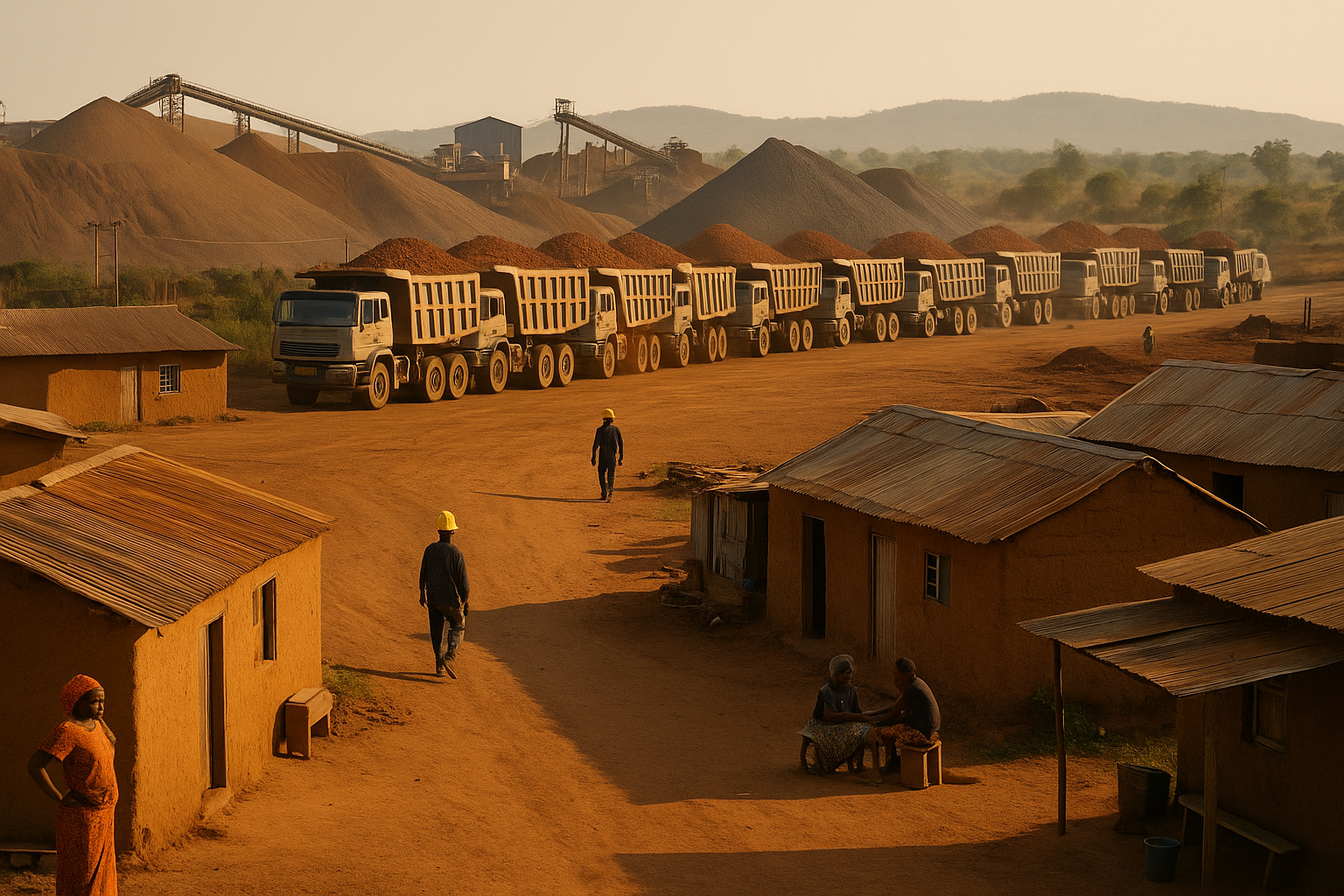
These are the people who live closest to the minerals, yet see the least benefit.
Many communities experience:
- Land displacement
- Low-paying, insecure jobs
- Polluted rivers and soils
- Hazardous informal mining
- Poor schools and health centres
- Unfulfilled corporate social responsibility promises
In some regions, electricity produced for mining sites never reaches nearby villages.
This is not a “green” transition for them, it is a continuation of extractive patterns predating independence.
2. African Governments and National Budgets
Weak governance, tax loopholes and under-reporting undermine revenue collection.
A 2025 audit in the DRC found:
- $16.8 billion in under-reported mining revenues over five years
- Local development funds short-changed by tens of millions
Without reform, governments cannot translate mineral wealth into national development.
3. African Industries That Never Emerge
Every tonne of unprocessed minerals exported represents:
- Lost manufacturing jobs
- Lost industrial capabilities
- Lost intellectual property
- Lost global competitiveness
A country cannot develop unless it builds factories, not just mines.
(Insert internal link here to Monday’s article on Africa’s mineral boom and factories.)
4. Africa’s Future Generations
Once minerals are gone, they are gone forever.
Unless transformed into infrastructure, education, skills and industry, extractive booms become fleeting episodes that strip wealth rather than create it.
The global scramble: why everyone wants African minerals
Demand for African minerals is projected to quadruple by 2035.
Drivers include:
- The EV revolution
- Grid-scale storage batteries
- Green hydrogen
- Renewable energy expansion
- Defence and semiconductor sectors
This scramble has already intensified geopolitical engagement:
- The EU’s Critical Raw Materials Act
- The US Inflation Reduction Act and minerals partnerships
- China’s multi-decade investment footprint across Africa
- India’s new resource security strategy
- Gulf States investing in mining and processing
Africa is no longer a sideshow. It is a central player in the global clean-energy future.
Yet power does not lie in being needed. it lies in negotiating from a position of discipline and unity.
Tracking the value: why Africa captures so little
Three structural realities undermine Africa’s value capture:
1. Little Local Processing
More than 80% of Africa’s critical minerals are exported raw or semi-processed.
Without refining:
- Jobs are minimal
- Tax revenue is limited
- Economic complexity remains low
- The continent remains vulnerable to price shocks
2. Weak Regional Integration
Battery supply chains are regional, not national. Africa’s fragmented markets prevent economies of scale.
Regional corridors, like the DRC–Zambia EV battery initiative, are promising but early.
3. Lack of Policy Consistency
Industrialisation requires policy stability for decades. But African countries often provide stability for months.
Without predictable regulations, investors build factories elsewhere.
Who could be the winners if Africa made the right choices?
1. African Processing and Manufacturing Hubs
Morocco, South Africa, Namibia, Kenya and Zambia can emerge as processing and precursor powerhouses, if they create stable electricity, industrial zones and long-term incentives.
2. Youth and Skilled Labour
Africa’s biggest mineral is not cobalt or lithium, it is its people.
Battery industries require thousands of skilled technicians, engineers and chemists.
Investing in youth transforms mineral wealth into industrial talent.
3. Local Governments and Mining-Town Economies
If revenue-sharing mechanisms are modernised, mining towns could fund:
- Schools
- Clinics
- Water systems
- Clean energy microgrids
- Job-creation programmes
4. Regional Economic Communities
Shared infrastructure and shared value chains would finally give Africa the scale needed to compete.
The path forward: how Africa ensures it doesn't lose again
Africa must build a value chain, and not a conveyor belt.
The continent’s priorities must include:
- Local refining and precursor production
- Transparent, modern mining contracts
- Regional industrial corridors
- Skills academies for battery manufacturing
- Environmental protections for communities
- Sovereign wealth strategies for long-term wealth
- Fair revenue-sharing with mining regions
- Clean energy powering industrial zones
This is not idealism, it is the minimum requirement for justice in the energy transition.
A final reflection: a future written or rewritten
The world’s clean future cannot come at Africa’s expense.
And Africa’s mineral wealth cannot become another missed opportunity.
The winners of the transition will be the countries that add value, build industries, train their people, and negotiate without fear.
The losers will be those who let history repeat itself.
Africa has been here before.
We cannot afford to be here again.
This time, the continent must insist on being more than the world’s mineral warehouse.
Africa must become a producer, not just a provider.
A player, not a pit stop.
A beneficiary, not a bystander.
The global energy transition is being written now.
Africa must not be a footnote in a story it should be co-authoring.